
So, you want to trademark your artist name. The core of it involves a thorough search to make sure the name is actually unique, filing an application with the , and then proving you're using the name in commerce. This whole process is what gives you the legal muscle to protect your brand and stop others from using your name on music, merch, or anything else.
Your Artist Name Is Your Brand—Here’s Why a Trademark Is Crucial

Before we jump into the step-by-step of how to do this, it’s really important to get why it matters so much. Your artist name is more than just a name; it’s the heart of your professional identity. Frankly, it's your single most valuable business asset and the foundation you build your entire career on.
When you register a trademark, you get exclusive nationwide rights to use that name for specific things—like sound recordings or apparel. This legal ownership is what stops another artist from dropping a track under your name or some random company from printing bootleg t-shirts with your logo. It’s what turns your name from a simple label into a protected, enforceable brand.
The Real-World Risks of Not Having a Trademark
Operating without a registered trademark is like building a house on shaky ground. You could spend years building a fanbase and creating goodwill around your name, only to find out another performer in a different state has been using a similar one all along. This is a recipe for disaster, leading to confused fans, a diluted brand, and legal battles that are not only expensive but also ones you might not win.
It's not just the name itself. Even catchphrases tied to an artist can become priceless intellectual property. A famous example is the legal fight that erupted when Michael Jackson's heirs demanded a broadcaster stop using the phrase “King of Pop.” Why? Because it was a registered trademark owned by the company managing Jackson's brand. This shows just how powerful it is to protect every part of your artistic identity. You can find more on this and other music industry trademark cases to see why this is so critical.
Your artist name is your promise to your audience. A trademark is the legal guarantee that you, and only you, can deliver on that promise. It’s the difference between having a name and owning a brand.
A High-Level View of the Journey
Getting a handle on how to trademark your artist name is much less intimidating when you see the whole road laid out. We'll get into the nitty-gritty of each step later, but the journey itself follows a pretty clear path from initial idea to final registration.
To give you a quick bird's-eye view, here's a look at the core stages you'll go through.
Core Stages of Trademarking Your Artist Name
| Stage | Key Action | Objective |
|---|---|---|
| Stage 1 Discovery & Search | Conduct a comprehensive search. | Confirm your name is unique and legally available for use. |
| Stage 2 Application | Prepare and file the application. | Submit all required information and specimens to the USPTO. |
| Stage 3 Examination | Wait for USPTO review. | An examining attorney reviews your application for conflicts. |
| Stage 4 Registration | Receive official registration. | Gain full legal rights and use the ® symbol. |
| Stage 5 Maintenance | File renewals periodically. | Keep your trademark active and protected long-term. |
Think of this as your roadmap. Each stage has its own purpose, and completing them in order is what gets you to the finish line: a legally protected brand you can build a career on.
Confirming Your Artist Name Can Be Trademarked

Before you spend a single dollar on an application, you need to answer one crucial question: is your artist name even eligible for a trademark? Not every name qualifies. The U.S. Patent and Trademark Office (USPTO) has specific rules, and the biggest one revolves around a concept called distinctiveness.
A trademark's whole purpose is to tell the world where a product or service is coming from. If your name is too generic or just describes what you do, it can't act as a unique signpost for your brand. That's why a name like "The Singer" would be nearly impossible to trademark for musical performances—it doesn't distinguish you from anyone else who sings.
The Spectrum of Distinctiveness
To get a feel for how the USPTO looks at names, imagine them on a scale from strongest to weakest. The more unique and less descriptive your name is, the stronger your trademark will be and the easier it will be to register.
This concept is the foundation of trademark law, and it’s very different from copyright, which protects your actual creative works like songs and lyrics. For a deeper dive, it's really helpful to understand the core differences between trademark vs copyright protection for musicians.
Here’s how names generally break down:
- Fanciful Names: These are completely invented words that mean nothing outside of your brand. They make the strongest trademarks. Think of band names like "Limp Bizkit" or "Foo Fighters"—these names were created from scratch just for the brand.
- Arbitrary Names: These are real words that have no logical link to the music or services you offer. "Poison," for example, is a real word, but it has nothing to do with being a rock band. This makes it a strong, arbitrary mark.
- Suggestive Names: These names hint at a quality of your music or vibe without directly spelling it out. They take a little imagination to connect the dots. A name like "Rage Against the Machine" suggests a rebellious, anti-establishment theme without literally describing it.
- Descriptive Names: These names flat-out describe a feature, quality, or the artist. "Acoustic Guitar Duo" is a perfect example. These are incredibly weak and usually can only be registered after years of use have given them a "secondary meaning" in the public's mind.
Key Takeaway: You want to aim for a name that is Fanciful, Arbitrary, or at least Suggestive. These categories give you the best shot at a successful registration and provide the strongest legal protection for your brand down the road.
Red Flags That Will Get Your Application Rejected
Beyond lacking distinctiveness, a few other major red flags can stop your trademark application dead in its tracks. Knowing these deal-breakers now can save you a ton of time, money, and heartache.
First and foremost is a likelihood of confusion. If your name is too close to an existing trademark for related goods or services, it will get rejected. This isn't just about identical names; it includes names that look similar, sound similar (like "Boyz II Men" vs. "Boys to Men"), or create a similar vibe. Trying to trademark "Ariana Grande" is obviously a non-starter.
The USPTO will also reject applications for names that are:
- Merely a Surname: You generally can't just trademark a last name unless it has gained a distinct secondary meaning through massive public recognition, like "McDonald's."
- Deceptively Misdescriptive: You can't call your solo electronic act "The Nashville String Band." That's misleading consumers about what you do.
- Scandalous or Immoral: Marks that are considered offensive or disparaging are often refused.
- Confusingly Geographic: Naming your band "The Detroit Sound" might be rejected if you have no connection to the city and your music doesn't actually represent that iconic style.
By honestly checking your artist name against these criteria, you can get a good sense of its strength and spot potential problems before you even start the formal process. This self-assessment is a critical first step.
Conducting Your Essential Trademark Search
Jumping into a trademark application without first doing a deep, comprehensive search is a massive gamble. Think of it like booking a non-refundable international flight before checking if your passport is valid. This search is, without a doubt, the most critical step in the whole process. It’s what tells you whether your chosen artist name even has a realistic shot at getting approved.
Filing an application for a name that's already taken—or is just too similar to an existing one—is a surefire way to lose your non-refundable application fee and waste months of your time. A proper search gives you the confidence to either move forward with your name or pivot to something stronger before you've invested too heavily in it.
The chart below gives you a simplified look at the mechanics of getting your application filed and paid for, but don't forget: the success of this entire flow hinges on the quality of that initial search.
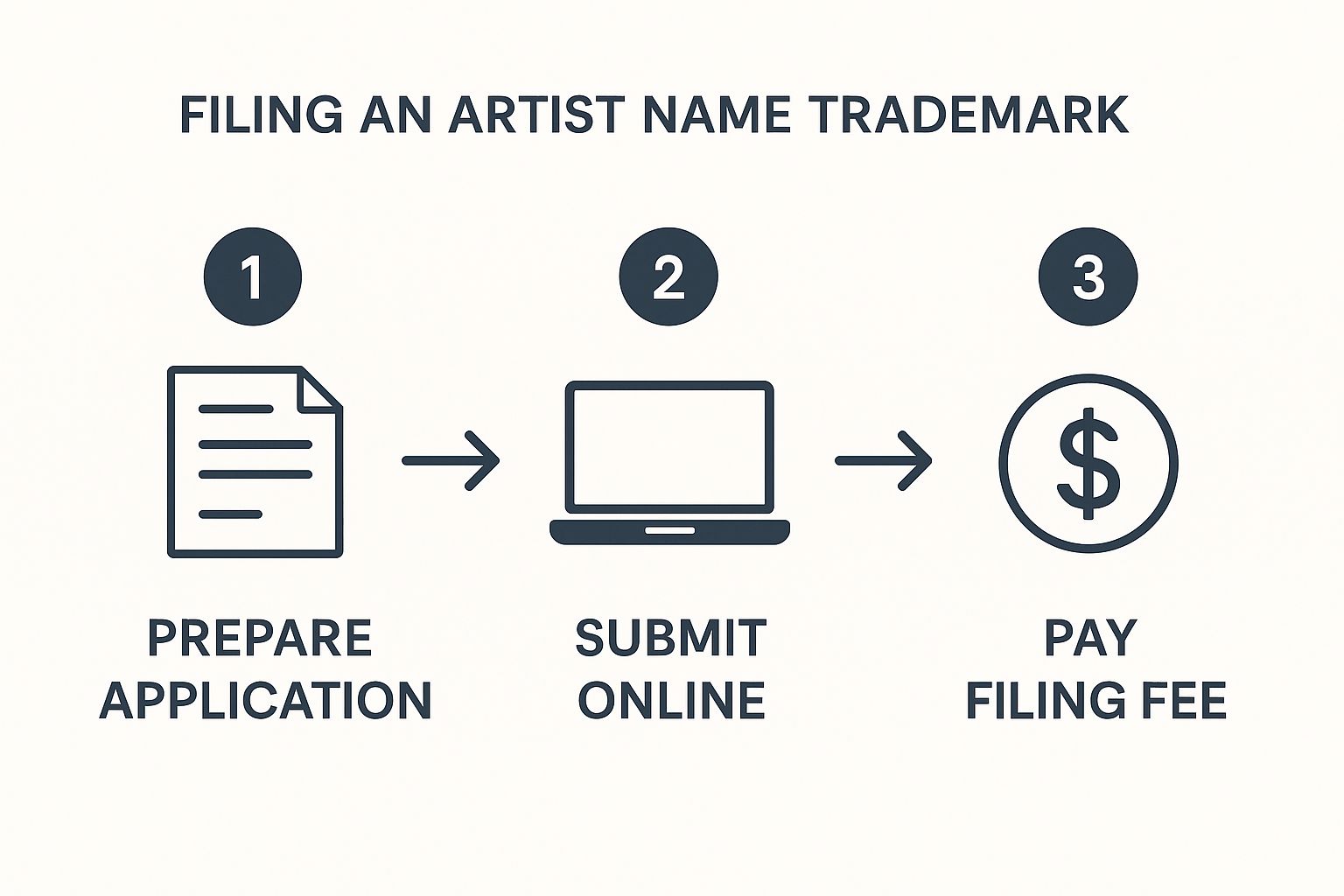
This process flow shows the steps, but all the strategic work—the searching—has to happen long before you even think about filling out a form.
Starting with Free Search Tools
Your first stop should be the free, powerful databases available to the public. These tools are fantastic for uncovering direct hits and other obvious roadblocks. You don't need to be a lawyer to get started, just patient and methodical.
Two essential places to begin your search are:
- USPTO's TESS Database: The is the official database for all U.S. federal trademark applications and registrations. This is non-negotiable.
- WIPO's Global Brand Database: This is an excellent resource for checking trademarks across multiple international jurisdictions at once. It's vital if you have any global ambitions for your music.
Registering your artist name gives you legal control over your brand. This research phase is where it all begins. It’s worth noting that the also requires proof that a stage name has been used on multiple distinct works (like different albums or singles) to qualify for registration for songs and videos. You can find more great info on .
Going Beyond an Exact Match Search
Here's a rookie mistake: typing your exact artist name into the search bar, seeing "no results," and thinking you're in the clear. That's not enough. The legal standard isn't about an exact match; it's about "likelihood of confusion," which is a much fuzzier concept. You need to think like a trademark examiner and hunt for anything that could be considered confusingly similar.
This means you have to search for:
- Phonetic Equivalents: Names that sound alike, even if they're spelled differently. If your name is "Krysstal," you absolutely must search for "Crystal," "Chrystal," and "Kristal."
- Similar Meanings: Look for names that create a similar vibe or commercial impression. If your name is "Urban Knights," you should also search for things like "City Knights" or "Metro Squires."
- Alternative Spellings and Typos: Brainstorm and search for every common misspelling or creative variation of your name.
This is what the WIPO Global Brand Database interface looks like. It lets you conduct these kinds of broad searches across tons of international collections.
Using the "advanced search" features in tools like this is how you uncover not just direct hits, but the "close calls" that could sink your application.
When to Hire a Professional
While you can and should do a preliminary search yourself, there are limits to what you can find on your own. For instance, free databases don't include "common law" trademarks—these are names that are being used in business but aren't federally registered. They can still block your application.
Pro Tip: Seriously consider hiring a trademark attorney or a professional search firm for a comprehensive search. It's a wise investment. They have access to specialized databases and can provide a legal opinion on your name's viability, potentially saving you from a costly rejection down the line.
An attorney doesn't just find conflicts; they analyze them. They can tell you if a similar mark is in a completely unrelated field (like a band name that's similar to a brand of power tools), which might mean it's not actually a blocker. This level of analysis is tough to do on your own and is crucial for making a smart decision about your brand's future.
Alright, with a clean trademark search behind you, it's time to shift from research to action. Filing the official application is where you formally ask the government to grant you exclusive rights to your artist name.
I know the online forms can look intimidating, but if you break them down into their core parts, the whole process becomes much more manageable.

This stage is all about clearly communicating exactly what you want to protect and how you're using it in the real world. Getting these details right is crucial. Any mistakes can lead to delays or even rejections from the U.S. Patent and Trademark Office (USPTO) examining attorney who reviews your file.
Choosing Your International Class
One of the first—and most important—decisions on the application is picking the right International Class of goods and services. A trademark doesn’t just protect your name for everything under the sun; it protects it for specific commercial activities. You have to tell the USPTO exactly what those are.
For musicians, a few classes are almost always relevant. Think about all the ways you currently use (or plan to use) your artist name to make money. Each one likely falls into a specific category.
Here's a look at the most common classes musicians need to think about.
Common Trademark Classes for Musicians
| Class Number | Description | Examples |
|---|---|---|
| Class 041 | Entertainment Services | Live musical performances, DJ services, providing non-downloadable music online |
| Class 009 | Musical Recordings and Digital Media | Vinyl records, CDs, downloadable audio files, music videos |
| Class 025 | Apparel and Merchandise | T-shirts, hats, hoodies, jackets, wristbands |
It's vital to be both accurate and forward-thinking here. Filing in multiple classes costs more since the government fee is per class, but it gives you much broader protection. If you know you'll be launching a merch line soon, it's often smart to include Class 025 right from the start.
The Critical Role of the Specimen of Use
Perhaps the most common snag for artists is submitting a proper specimen of use. This isn't just a formality; it's the hard evidence you must provide to prove you are actually using your artist name in commerce for the classes you've selected.
A bad specimen will get your application kicked back with an "Office Action," delaying everything.
The key is that the specimen has to show your name being used as a brand to sell something. It must connect the name directly to the goods or services. The full trademark application process involves several key milestones, and preparing a strong specimen is a foundational one. For a clear breakdown, reviewing the six-step process of applying for a trademark can provide valuable context.
Here's what works and what doesn't:
- For Live Performances (Class 41): A screenshot of a concert flyer or an online event page showing your artist name alongside ticket prices or show information is a great example. A photo of you simply performing on stage, however, likely won't cut it because it doesn't show a commercial transaction.
- For Merchandise (Class 25): The best specimen is a photo of a t-shirt with your artist name on a hangtag, displayed on an online store with an "Add to Cart" button. A simple mockup of a t-shirt design will probably be rejected. The USPTO needs to see the item as it's actually offered for sale.
- For Music (Class 09): A screenshot from Spotify or Apple Music showing your artist name next to a track that is available for streaming or download is perfect. Just the album cover art by itself, with no link to a point of sale, isn't enough.
In-Use vs. Intent-to-Use Applications
Finally, you'll need to decide on your application's filing basis. This choice really just depends on where you are in your career.
An In-Use (Section 1(a)) Application is for artists who are already using their name in commerce. This means you’re already playing shows, selling merch, or distributing music under the name. If this is you, you'll need to submit your specimen of use at the same time you file the application.
An Intent-to-Use (ITU) (Section 1(b)) Application is for artists who have a genuine plan to use the name in commerce soon, but haven't started yet. This is perfect for securing your name while you're still recording your first album or planning a tour.
If you file an ITU application, you don't submit a specimen right away. Instead, you'll file a "Statement of Use" and your specimen later on, once your mark is actually in use. This path is fantastic because it lets you lock in an earlier filing date, giving you priority over anyone who tries to file for a similar name after you.
What to Expect After You File Your Application
Hitting "submit" on your trademark application feels great, but it’s really just the start of the process. The post-filing period is often called "the waiting game," and for good reason. You’ll need to be patient, as the entire journey from filing to a final registration certificate can take anywhere from several months to over a year.
Once your application is submitted, it goes into a queue at the U.S. Patent and Trademark Office (). Eventually, it gets assigned to a government employee called an examining attorney. This person’s job is to review every single detail of your file to make sure it follows all the legal rules.
The Examining Attorney’s Review
Think of the examining attorney as a gatekeeper. They will conduct their own comprehensive search for any conflicts with existing trademarks and will scrutinize the information you provided. They'll look closely at the international classes you chose, your description of goods and services, and, most importantly, your specimen of use.
This is where a lot of applications hit their first snag. The examiner is actively looking for any reason to refuse registration, whether it’s a simple procedural mistake or a more serious legal problem. If they do find an issue, you won’t get an outright rejection—at least not right away.
Instead, you'll receive an official letter called an Office Action.
An Office Action isn't a denial. It’s a formal request for more information or a notice of a legal problem that you need to fix. A timely and well-crafted response is absolutely critical to keeping your application moving forward.
An Office Action can be issued for all sorts of reasons, such as:
- A flawed specimen: Maybe the proof you submitted didn't clearly show your artist name being used in a commercial way.
- Vague descriptions: The examiner might need you to be more specific about the "entertainment services" you're providing.
- Likelihood of confusion: This is the big one. It means the examiner believes your name is too similar to an already registered trademark.
Responding to an Office Action comes with a tight deadline, so you have to act fast.
Publication for Opposition
If the examining attorney finds no issues (or if you successfully argue your way through an Office Action), your artist name moves on to the next phase: publication. Your mark gets published in the Official Gazette, a weekly online journal from the USPTO.
This isn't just a formality. The publication starts a 30-day window where any third party who thinks your trademark will harm them can formally oppose it. For example, another artist might feel your name is too close to theirs and could damage their brand recognition.
Oppositions are pretty rare, but they are serious. They can trigger a legal proceeding that’s like a mini-trial within the USPTO. If no one opposes your mark within that 30-day period, you've cleared the final major hurdle.
Registration and Thinking Globally
Congratulations! Once the publication period ends without any trouble, the USPTO will issue your official registration certificate. Your artist name is now a legally protected asset, and you can officially start using the coveted ® symbol.
But here's something crucial to remember: a U.S. trademark registration is territorial. It only protects you inside the United States. This is a huge deal for artists with a global audience. The global landscape for trademarks is incredibly concentrated; in 2023, 62% of all trademark filings happened at just five offices worldwide, and the U.S. saw around 849,876 filings alone. You can dig into more of these yourself.
For artists with a significant fanbase abroad, this data highlights why you need to think about filing in other key countries to secure your rights internationally. This is also where a deep understanding of your brand's scope is essential, especially when it comes to merchandise versus services. Our guide to trademarking for musicians and international classes can help you map out a protection strategy that makes sense for your career.
Common Questions About Trademarking an Artist Name
Even after breaking down the process, diving into the world of intellectual property can leave your head spinning. That's completely normal. The specifics of how to trademark an artist name can get confusing, fast. Let's tackle some of the most frequent questions I get from artists to help you make clear, informed decisions about protecting your brand.
How Much Does It Really Cost to Trademark an Artist Name?
There’s no single price tag here. The total cost is a mix of government fees and, if you go that route, attorney fees.
The itself charges a filing fee for each class of goods or services you apply under. Think of classes as categories, like "recorded music" or "live performances." This fee usually runs between $250 and $350 per class.
If you're feeling confident and decide to handle the filing yourself, that government fee will be your main expense. However, most artists find it's worth the investment to hire a trademark attorney. Legal fees for a trademark application can start around $500 and go up to $2,500 or more, depending on how complex your situation is. It might seem like a lot upfront, but it’s an investment in getting it right the first time and avoiding costly rejections down the road.
A DIY filing might save you a few hundred dollars initially, but trust me, a small mistake can cost you your entire application fee and months of wasted time. An experienced attorney helps make sure your application is solid from the very start.
Do I Absolutely Need a Lawyer?
Legally, no. If you're a U.S. citizen filing in the U.S., you're not required to use a lawyer. But is it a good idea? Absolutely. I highly recommend it.
The trademark application process isn't just filling out a form; it's a legal proceeding with strict rules and deadlines. It's loaded with potential pitfalls that are incredibly easy for a newcomer to fall into.
A good trademark attorney does way more than just submit paperwork. They:
- Run a professional, deep-dive search to see what risks you’re up against.
- Help you craft a strong application that minimizes the chance of getting a rejection (an "Office Action") from the USPTO.
- Handle any legal arguments with the USPTO examining attorney who reviews your file.
- Manage all the deadlines and correspondence so you don't miss something critical.
Ultimately, hiring an attorney massively increases your odds of a successful registration. That initial investment often saves you far more in the long run by preventing expensive mistakes and securing your brand for the future.
What Is the Difference Between Using ™ and ®?
You’ve definitely seen both of these symbols, and they mean very different things. Getting the distinction is crucial for understanding your rights.
You can use the TM (™) symbol literally anytime you want to claim a name as your brand. It puts the world on notice that you consider that name a trademark, even if you haven't officially registered it. This is what we call a "common law" trademark. It gives you some limited protection, but usually only in the specific geographic areas where you’re actually doing business.
The R (®) symbol, on the other hand, is the real deal. You can only use it after your trademark has been officially registered with a national office like the USPTO. Using the ® symbol signals that you have nationwide legal ownership and much stronger rights to stop anyone from infringing on your brand. It’s a powerful deterrent.
How Long Does a Trademark Last?
A U.S. trademark registration can theoretically last forever, but it doesn't happen on its own. You have to actively maintain it by proving you're still using the name in commerce and by filing specific documents at regular intervals.
The first major checkpoint is a Declaration of Use, which is due between the 5th and 6th years after your registration date. Miss that, and your registration is gone. After that, you have to file a renewal every 10 years. Staying on top of these deadlines is absolutely essential to keep your brand secure for your entire career.
Protecting your artist name is one of the most important business decisions you'll ever make. The process can feel overwhelming, but you don’t have to go it alone. At Cordero Law, we specialize in helping artists and creators secure their intellectual property with confidence. If you're ready to take the next step, contact us for a consultation and let's build a secure foundation for your brand together.