
An invention disclosure template is the formal document inventors use to pin down the details of a new idea or technology. This is the critical first step in the patent process, giving you a time-stamped record and a clear description for patent attorneys to start their evaluation.
Why Your Big Idea Needs a Formal Disclosure

That initial spark of inspiration is a great feeling, but what comes next is what really matters. Before you can even think about protecting your creation, you have to document it properly. Let鈥檚 be clear: a few notes scribbled on a napkin just won't cut it in the eyes of the law or a potential investor.
This is exactly where an invention disclosure template becomes your most important tool.
This structured document turns a fleeting idea into something tangible and official. It鈥檚 the foundational piece of evidence for your future patent application, establishing a firm "date of invention" that can be crucial down the road. Think of it as the bridge between raw creativity and formal intellectual property protection.
Securing Your Place in Line
A well-completed disclosure form does a lot more than just describe what you've made. It communicates your idea's value and novelty to patent attorneys in a language they understand, which significantly speeds up their evaluation process鈥攕aving you time and money.
A vague concept is hard to protect. A detailed disclosure gives your attorney the concrete information needed to seriously assess patentability. It also forces you to think through the critical parts of your invention:
- The Problem: What specific issue does your invention solve?
- The Solution: How does it work in a way that current solutions don鈥檛?
- The Uniqueness: What鈥檚 the "secret sauce" that makes it novel and non-obvious?
An invention disclosure is your insurance policy for innovation. It ensures every brilliant idea is logged, reviewed, and ready for protection before competitors even know it exists.
From Documentation to Protection
Ultimately, the choice between different protection avenues鈥攍ike a patent or a trade secret鈥攈inges on what you've documented. Our guide on the trade secret vs patent debate can help you figure out which path is right for your innovation.
Once your invention is formally documented, you can start looking into how to pay for its protection, maybe by seeking . This initial step opens the door to all those future opportunities.
How to Use Your Free Disclosure Template
Alright, you've got the idea. Now it's time to get it down on paper and make it official. To help you get started, we've put together a simple, no-nonsense invention disclosure template.
You can grab it right here in your preferred format:
- Download the Word Version Here
- Download the PDF Version Here
But I don't want to just hand you a template and walk away. The real value is understanding why each section matters. Once you know the purpose behind each field, filling it out becomes a whole lot less intimidating. You'll know exactly what information to provide and why it's critical.
Think of it as a pretty straightforward path from idea to documentation.
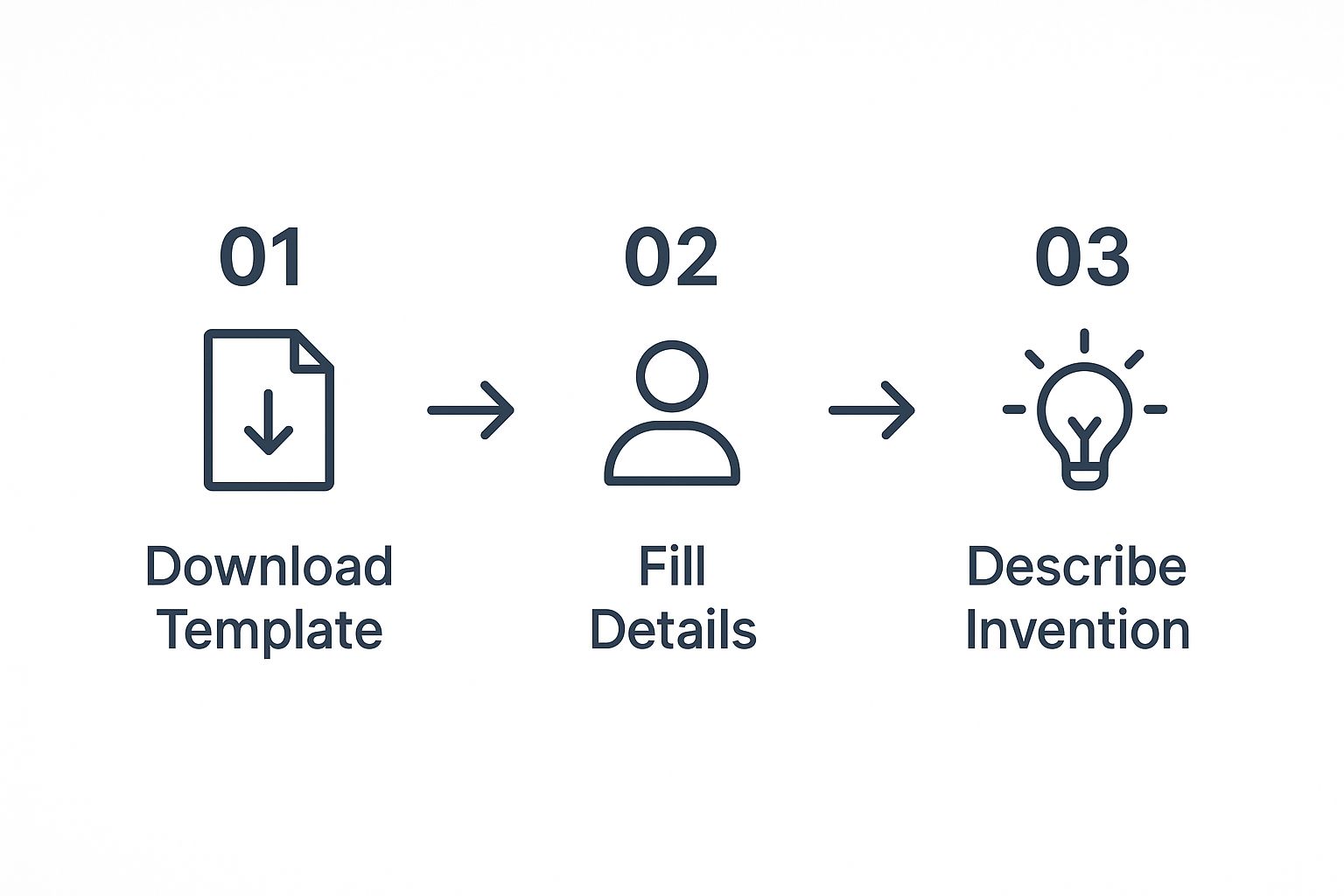
This process is designed to take the concept in your head and translate it into a concrete document your patent attorney can actually work with.
Breaking Down the Template Sections
Our template is structured to pull out all the essential details a patent attorney or a review committee is going to look for. It starts with the basics and logically moves into the nitty-gritty technical details of your idea, ensuring nothing gets missed.
To give you a clear roadmap, this table breaks down the key parts of the disclosure form. Think of it as a cheat sheet to help you fill out the template with total confidence.
Anatomy of an Invention Disclosure Template
| Section Name | Purpose | What to Include |
|---|---|---|
| Inventor(s) & Contributors | This legally establishes who actually came up with the invention. It's a non-negotiable legal requirement for a valid patent. | The full legal names, contact info, and specific roles of every single person who contributed intellectually to the core concepts of the invention. |
| Title of Invention | This gives your idea a short, descriptive name for easy reference as it moves through the patenting process. | A clear, concise title that gets right to the point of what your invention does. Think something like, "Self-Heating Insulated Beverage Container." |
| Detailed Description | This is the heart of the entire document. It鈥檚 where you explain exactly what your invention is, how it works, and what makes it special. | A complete breakdown of the invention鈥檚 structure, components, and how it operates. Explain the problem it solves. Don't be afraid to add sketches or diagrams. |
| Prior Art & Existing Solutions | Here, you show the novelty of your idea by pointing out how it improves upon or differs from what鈥檚 already out there. | List any products, patents, or even articles you know of that are similar. Then, explain precisely what makes your invention different and, more importantly, better. |
| Key Dates & Disclosures | This creates a legal timeline for your invention, locking in the date of conception and any public demonstrations of the idea. | Jot down the date you first thought of the idea, when you built the first prototype, and any time you disclosed it publicly (like at a conference or in an article). |
Completing this form is your official first step, but it's just the beginning of a much longer journey. Once it's done, this document becomes the cornerstone for all the legal work that follows.
If you're curious about what happens next, you can get a full overview in our guide to the patent filing process.
Writing an Invention Description That Shines

This section is where the rubber meets the road. It鈥檚 the part of your invention disclosure where your idea transforms from a concept floating in your head into a tangible asset.
I can't stress this enough: a vague or rushed description is the fastest way to confuse a patent attorney and grind your entire project to a halt. Your goal here is to tell a clear, compelling story about what you've created.
Think of yourself as a guide. You're leading someone through your invention for the very first time. They need to understand the problem it solves, exactly how it works, and what makes it special. This isn't the time for marketing fluff or broad, sweeping claims. It's about precision.
Start with the Problem You Solve
Every great invention I've ever seen started by tackling a real-world problem. Before you get lost in the technical weeds, you have to set the stage. What鈥檚 the specific issue your invention addresses?
Let's use a "smart coffee mug" as an example.
- A weak problem statement sounds like this: "People's coffee gets cold too fast."
- A strong problem statement is much more specific: "Commuters and office workers consistently struggle to maintain their coffee at an optimal drinking temperature of 135掳贵 for more than 15-20 minutes. Existing insulated mugs slow heat loss but offer no active temperature control, leading to a subpar drinking experience."
See the difference? The second example gives a patent attorney immediate context and hard numbers to work with. It frames the problem in a way that makes your solution feel necessary.
Detail How Your Invention Works
Okay, now it's time to walk the reader through your solution. Explain the structure, the components, and how it all operates, step-by-step. Don't assume the reader knows anything about this. Be methodical. A solid understanding of the is a huge help here.
Sticking with our smart mug example, you would detail things like:
- The Components: Break it down. Describe the dual-wall vacuum-insulated stainless steel body, the rechargeable lithium-ion battery in the base, the embedded heating element, and the Bluetooth-enabled control chip.
- The Process: Explain how it functions. A user sets their desired temperature via a mobile app, which sends a signal to the mug. Then describe how the internal sensor monitors the liquid's temperature and activates the heating element only when it drops below the set point.
- The Visuals: Attach drawings! Seriously, they don't need to be professional blueprints. A simple, hand-drawn sketch with clear labels can be incredibly effective. Show a cross-section of the mug and point out each key part.
A well-labeled drawing is worth a thousand words. It bridges the gap between your written description and a patent attorney's understanding, often highlighting functional relationships that are difficult to explain with text alone.
This level of detail is critical because it becomes the foundation of a future patent application. For inventors aiming for that, understanding how to file a provisional patent can provide valuable context on why this initial documentation is so important.
Emphasize Your Secret Sauce
Finally, you need to hammer home what makes your invention novel and non-obvious. This is the core of its patentability. It鈥檚 not enough for your invention to be different; it has to be an inventive leap beyond what already exists.
For the smart mug, the "secret sauce" isn't just that it heats coffee. The real novelty might be:
- A proprietary power-saving algorithm that allows the battery to last 75% longer than any competitor.
- The unique shape of the heating element, which creates a convection current for perfectly uniform temperature distribution, avoiding annoying hot spots.
- A predictive pre-heating feature that syncs with your phone鈥檚 calendar to warm the mug just before a scheduled meeting.
Be specific. Use comparisons and data if you have them. This is your chance to prove that your invention isn't just another product鈥攊t's a genuine breakthrough.
Navigating Prior Art and Public Disclosures

This is the part of the invention disclosure where inventors often stumble, and trust me, the consequences can be serious. If you overlook what鈥檚 known as prior art or misunderstand what counts as a public disclosure, you could kill your patent application before it even gets started.
Let's clear things up. Prior art is basically all the public knowledge related to your invention that existed before you filed for a patent. It鈥檚 the evidence that proves whether your idea is actually new and not just a rehash of something already out there. This includes everything from existing patents and published articles to products already sitting on a shelf.
Think of yourself as a detective here. A little digging upfront can save you a ton of time and money by spotting potential roadblocks early. It also shows your patent attorney you've done your homework, which makes their job a whole lot easier.
What Counts as a Public Disclosure?
This is where the lines get blurry for a lot of people. A "public disclosure" isn't just a big press release or a flashy product launch. It鈥檚 any non-confidential communication about your invention to someone outside your immediate team.
This can cover a surprisingly wide range of activities:
- Presenting your concept at a conference or trade show.
- Discussing the nitty-gritty details in an academic paper or article.
- Explaining the invention to a potential investor without an NDA in place.
- Even an informal chat at a networking event could technically count.
The rules around this are strict and change from country to country. For instance, in the United States, inventors generally have a one-year grace period after a public disclosure to file for a patent. But that safety net doesn't exist in most other countries, where any public disclosure can instantly destroy your ability to get a patent. You can find more insights on this critical distinction over at .
Your invention disclosure form is your logbook for these activities. Documenting every single presentation, conversation, or publication isn鈥檛 just paperwork鈥攊t鈥檚 a vital step in protecting your potential patent rights around the globe.
A Quick Checklist for Reporting Disclosures
When you get to this section of the template, you have to be thorough. You need to give a clear, honest account of anything and everything that might qualify as a public disclosure.
Use this simple checklist to jog your memory so you don't miss anything critical:
- Presentations and Talks: Have you presented any part of this invention at a conference, seminar, or even an internal company meeting that included non-inventors?
- Publications: Has any information about the invention popped up in a journal, blog post, or thesis?
- Conversations: Did you discuss the functional details with investors, partners, or customers without a non-disclosure agreement (NDA) signed and sealed?
- Demonstrations: Have you shown a working prototype to anyone outside of the core invention team?
Answering these questions honestly gives your legal team the full picture. It allows them to build the right strategy to protect your intellectual property while navigating the complex timelines and international laws that come into play. Honesty and detail are your best friends here.
Common Mistakes Inventors Make on Their Disclosure
Learning from the missteps of others is one of the smartest shortcuts in the innovation game. You'd think filling out an invention disclosure is just straightforward paperwork, but I've seen some common pitfalls trip up even brilliant inventors, delaying their progress or weakening their potential patent claims down the line. Avoiding them is key.
One of the biggest errors I see is simply being too brief. Inventors often assume the patent attorney will "get it" from a high-level summary. That's a huge gamble. Your attorney wasn't in the lab with you; they need every single detail to build a rock-solid case for why your invention is novel and non-obvious.
Another classic slip-up is messing up the list of contributors. It鈥檚 easy to either forget a colleague who dropped a key conceptual insight during a whiteboard session or, on the flip side, add a manager who only provided funding or moral support. Remember, inventorship is a legal determination, not a pat on the back. It's strictly about who intellectually contributed to the conception of the invention.
Vague Descriptions and Missing Details
A description that reads like a marketing brochure is a major red flag. Phrases like "a superior method" or "a groundbreaking device" are completely useless without the technical meat to back them up. Your attorney needs the "how," not just the "wow."
- Mistake Example: An inventor describes their creation as an "advanced algorithm for better data sorting." This tells me nothing.
- How to Fix It: Instead, you need to detail the specific steps of the algorithm. Explain the logic behind it, and show me precisely how it's different from existing sorting methods like Quicksort or Mergesort. You have to get into the weeds.
Similarly, I see a lot of inventors underestimate the prior art section. They'll either leave it blank or do a quick, superficial Google search. A thorough initial search shows you've done your due diligence and helps your attorney get ahead of the arguments a patent examiner is almost certain to make.
Don鈥檛 treat your disclosure form as just another piece of paperwork to rush through. Think of it as the foundational legal document for your invention. Every field you fill out鈥攐r fail to fill out properly鈥攈as consequences downstream.
The Rise of Digital Management
To combat these kinds of inconsistencies, many companies have moved to more structured systems. In fact, by 2020, over 70% of large corporations had adopted some kind of digital tool to manage their disclosures, which helps cut down on administrative headaches and keeps everything uniform. This makes it way easier for review committees to assess ideas fairly. You can and what it means for you.
But even with these fancy tools, the buck stops with you, the inventor. It's your responsibility to provide accurate and complete information. Take the time to be thorough, specific, and honest in every single section. Trust me, a polished, professional invention disclosure is your best first move to speed up the entire patent process.
Common Questions About Invention Disclosures
Even with the best template in hand, you're going to have questions. It鈥檚 just part of the process, especially if you鈥檙e new to the world of inventing and intellectual property. Let鈥檚 walk through some of the most common things that trip people up.
I get these questions all the time from inventors, and getting the answers straight from the start can save you a world of headaches down the road.
Who Should Be Listed as an Inventor on the Form?
This is a big one. Seriously. Getting this wrong can have major legal consequences and is one of the top reasons patents get invalidated later.
An inventor is someone who contributed intellectually to the conception of the invention. It鈥檚 about who came up with the core ideas that make the invention work. It has nothing to do with who physically built the prototype, who secured the funding, or who managed the project. The key is creative contribution.
- If you and a colleague spent hours spitballing ideas and together figured out the key mechanism, you should both be listed.
- But if you designed a device and then handed a technician a specific set of instructions to assemble it, that technician is probably not a co-inventor.
When in doubt, it鈥檚 always smarter to list anyone who might have had a hand in the creative process. Let the patent attorney sort out the legal definition of inventorship later. Better to over-disclose than to leave someone off and risk your patent.
How Detailed Do My Drawings Need to Be?
You can relax on this one. You don't need to be a professional engineer or a CAD expert to make useful drawings. Your sketches don鈥檛 have to be perfect, museum-quality blueprints.
Their one and only job is clarity. They exist to help someone else鈥攗sually an attorney or a review committee鈥攗nderstand how your invention works.
Clear, well-labeled drawings are incredibly valuable, even if they're just neat sketches on a napkin. Focus on showing the main components, how they connect and interact, and what makes your approach different. Simple flowcharts and block diagrams work great for processes, too. Your attorney will use these sketches as a starting point to get formal patent drawings made later on.
What Happens After I Submit the Disclosure Form?
Hitting "submit" is what kicks off the formal review process. Your form doesn't just get filed away in a cabinet; it becomes a live document that people will actually analyze.
Typically, the form goes to a patent review committee, your company鈥檚 IP department, or directly to an outside patent attorney. They're going to evaluate your idea based on a few critical factors:
- Novelty: Is this thing actually new? How does it stack up against what's already out there?
- Usefulness: Does it solve a real problem that people have?
- Commercial Potential: Is there a market for this? Can it make money?
This stage almost always involves a follow-up meeting where they鈥檒l ask you to clarify points and dive deeper into the details. Based on this whole review, they'll decide whether or not to move forward with a patent application. This is exactly why your initial submission needs to be as thorough and clear as possible鈥攊t鈥檚 the foundation for this huge decision.
Can I Update My Disclosure After Submitting It?
Yes, and you absolutely should. Innovation is messy and rarely happens in a single "aha!" moment. It's an evolving process. If you come up with a significant improvement, discover a better way to build it, or think of a new use for it after you鈥檝e already submitted your form, you need to document it.
The best way is to submit an updated or entirely new disclosure form that references your original one. This builds a clear, defensible timeline of how your invention developed and makes sure any new patentable ideas get captured. When it comes to your IP team or attorney, over-communicating is always the right call. Keep them in the loop on every bit of progress.