
So, you’ve landed on the perfect business name. It’s catchy, it captures your brand’s essence, and you’re itching to build an empire around it. But before you start printing business cards or snap up that domain, there's a crucial step that far too many entrepreneurs skip: a thorough clearance search.
This isn't just a quick Google search. I’m talking about a deep dive to make sure no one else already has rights to a similar name.
Failing to do this initial homework can be absolutely devastating down the road. Imagine pouring months of your life and thousands of dollars into building your brand, only to get a cease and desist letter that forces you to start from scratch. Trust me, it’s a nightmare scenario, and it's completely avoidable with the right research upfront.
Going Beyond a Simple Web Search
A proper clearance search is about digging into multiple databases to get the full picture. The goal here is to unearth any potential conflicts that could blow up in your face later.
You need to systematically check these key areas:
- Federal Trademark Database: Your first stop should be the United States Patent and Trademark Office (USPTO) . You're hunting for registered trademarks and pending applications that are either identical or what's called "confusingly similar" to your name.
- State Business Registries: Every state has its own database of registered businesses like LLCs and corporations. You'll need to search the registry for any state where you plan to do business.
- Domain Name Availability: Check if the .com and other key domain extensions are available. Even if a domain isn't being used, the fact that it's registered could be a sign that another brand is in the works.
- Social Media Handles: Try to lock down your brand name across every social media platform that matters to your business. If your preferred handle is already taken, it can be an early red flag that someone else is already operating in your space.
Understanding "Likelihood of Confusion"
The heart of a trademark search isn't just about finding an exact match. It’s all about figuring out the “likelihood of confusion.� This is a legal standard that asks a simple question: would a typical consumer be likely to get your brand confused with an existing one because the names are similar and you're in a similar industry?
For instance, if you wanted to open a coffee shop called "Starbrews," you would almost certainly get a very unhappy letter from Starbucks' lawyers. Even though the names aren't identical, the similarity is close enough—and you're in the same business—that it creates a high likelihood of confusion.
Doing this foundational work is so important. As you can see below, the cost of sorting out a name dispute later is astronomically higher than the cost of preventing one in the first place.
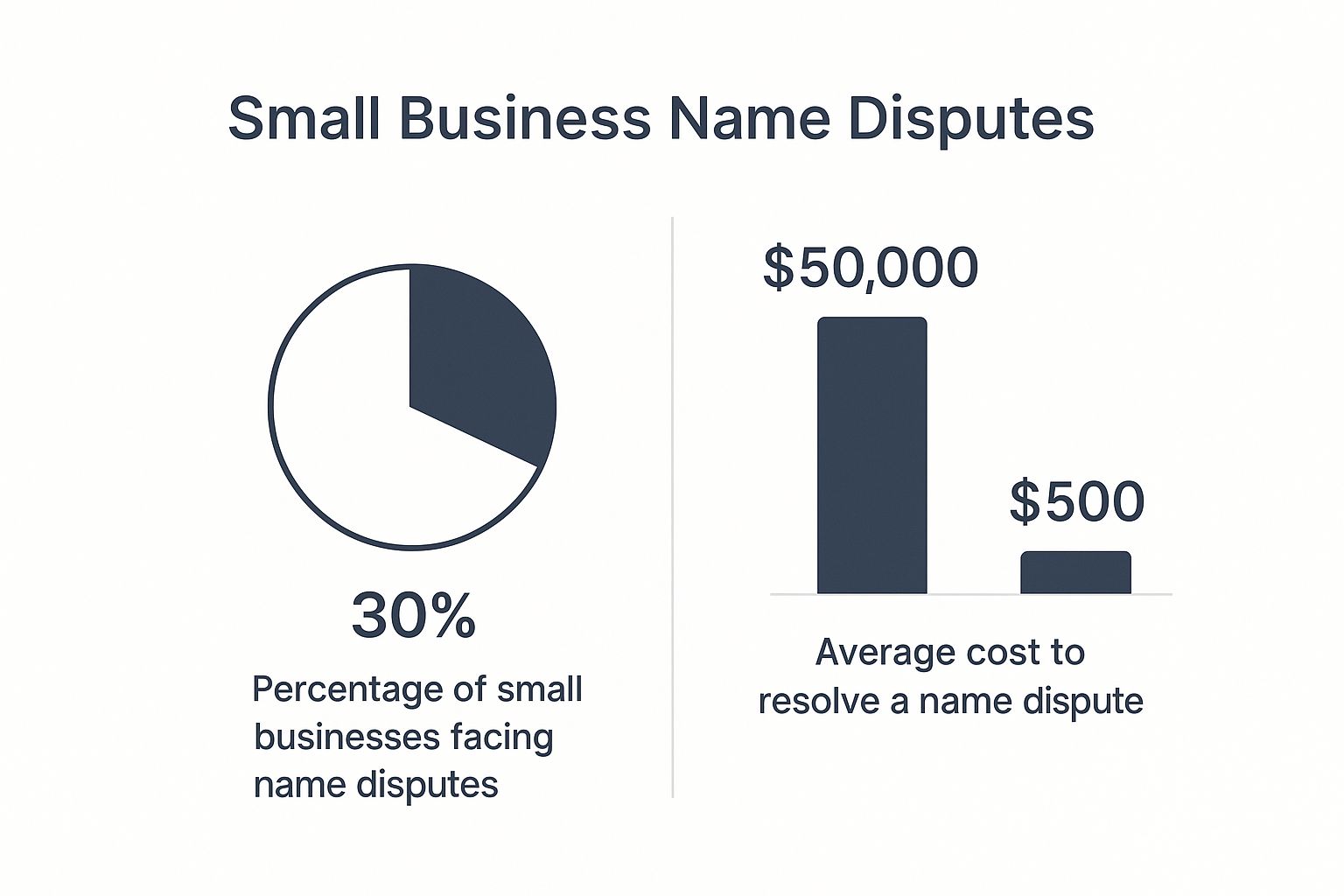
As the data shows, the small investment in securing your name from day one is just a tiny fraction of what a legal battle could cost you.
Now, let's look at the different ways you can protect your name and what each one actually does for you.
Comparing Your Business Name Protection Options
It’s easy to get confused by the different legal tools available. This table breaks down what each type of registration offers, so you can see which one fits your needs.
| Protection Method | Geographic Scope | Level of Exclusivity | Best For |
|---|---|---|---|
| Federal Trademark | Nationwide | High (prevents others from using a similar name for similar goods/services) | Businesses operating or selling online or across state lines. |
| State Trademark | State-specific | Moderate (only protects you within that state's borders) | Local businesses that only operate within a single state. |
| Business Entity Name | State-specific | Low (prevents others from registering the exact same entity name in that state) | Simply meeting the legal requirement to form an LLC or corporation. |
| DBA ("Doing Business As") | County or state | Very Low (often just a public notice, offers no real exclusivity) | Sole proprietors or partnerships using a name different from their own legal name. |
Essentially, while registering your LLC or corporation name with the state is a necessary legal step, it offers very little brand protection. A federal trademark is the gold standard for securing exclusive rights to your name on a national level.
Once you’ve done this due diligence and you're confident your name is clear for use, you can move forward with much more peace of mind. To dive into what comes next, check out our guide covering the six-step process of applying for a trademark in the US.
Making It Official With Trademark Registration

Okay, so your initial search gave you the green light. That’s a great first step, but now it's time to go from hoping your name is protected to legally ensuring it is. This is where trademark registration comes in, transforming your business name from a simple label into a valuable, legally defensible asset. Think of it as putting an official lock on your brand identity.
This isn't just about paperwork. It’s a proactive strategy for protecting my business name from competitors who might try to piggyback on your hard work. A registered trademark gives you exclusive rights and serves as a public declaration that the name is yours, which helps stop others from causing confusion in the marketplace.
State vs. Federal Trademark Protection
I see a lot of confusion around whether to file for a state or federal trademark. The right call really boils down to your business's current and future plans.
- State Trademark: This protects your name only within the borders of the state where you register. It might be enough for a truly local business—say, a single-location bakery or a neighborhood landscaping service that has absolutely no plans to expand beyond state lines.
- Federal Trademark: Now, this is the heavyweight champion of brand protection. A federal trademark, registered with the United States Patent and Trademark Office (USPTO), gives you nationwide protection. It's pretty much essential for any business operating online, selling products across state lines, or dreaming of growing beyond its local roots.
For the vast majority of modern businesses, especially any with an online store or social media presence, a federal trademark is the clear winner. It means someone in another state can't just open up a similar business with a confusingly similar name.
A federal trademark is your brand's national passport. It grants you the legal presumption of ownership and the exclusive right to use your business name across the country for your specific goods or services.
Preparing Your Trademark Application
Don't rush this part. I’ve seen small mistakes on applications lead to costly delays or even outright rejection. You need to be crystal clear on two things: the mark itself and the goods or services it represents.
First, decide what you're actually trademarking. Is it the standard character mark (the name itself, in plain text)? Or is it a stylized design mark (your logo)? A standard character mark offers broader protection for the words themselves, while a design mark protects the specific visual elements of your logo.
Next, you have to correctly identify your class of goods or services. The USPTO uses a classification system to group everything. For instance, clothing falls into Class 25, while software services are in Class 42. You have to file under the correct class(es) that accurately describe what your business does. Getting this wrong is a super common reason for an application to get rejected.
Timing Your Filing Correctly
Another critical decision is when to file. This depends on whether your business is already up and running.
- In-Use Application: You file this if you are already using your business name in commerce. That means you're actively selling goods or services under that name right now.
- Intent-to-Use (ITU) Application: This is a powerful tool that lets you "reserve" a name you plan to use soon but haven't launched yet. It secures your spot in line (your priority date), but you'll eventually have to prove you're using the name in commerce to finalize the registration.
Filing an ITU application can be a brilliant strategic move. It lets you lock down your name while you're still finalizing your business plan or product. For personalized guidance on strategic moves like this, it often pays to get expert business legal advice.
This push to protect a business name isn't just happening in the US; it's a global priority. The European Union Intellectual Property Office (EUIPO) recently reported a 4% jump in trademark applications, with over 112,000 filed in just nine months. This surge shows that entrepreneurs everywhere are realizing how crucial it is to legally secure their brands. You can dig into more of to see how other businesses are taking action.
Defending Your Brand in the Digital World

Having a registered trademark is a powerful shield, but let's be realistic—the real battlefield for your brand is online. Protecting your business name today is all about securing your digital turf before someone else stakes a claim. It’s about controlling your brand’s presence across all the websites and platforms where your customers will actually look for you.
This isn't an optional step anymore. It's an essential, ongoing part of keeping your brand's reputation intact. You have to make sure that when people search for you, they find you—not an imitator, a competitor, or worse, a scammer.
Lock Down Your Domain Name Assets
Think of your main domain name (like yourbusiness.com) as your digital headquarters. But your strategy can't just stop there. You have to think defensively and anticipate how others might try to siphon off your traffic or confuse your customers.
A classic move is typosquatting. This is where someone registers common misspellings of your domain name. For example, if your site is corderolaw.com, a typosquatter might grab corderalaw.com or cordero-law.com just to capture traffic from people who make a simple typo.
To shut this down, I always recommend purchasing:
- Common Misspellings: Brainstorm the most likely ways someone could mistype your name.
- Different Extensions: Secure the
.net,.org, or country-specific versions if they're relevant to your market. - Hyphenated Versions: If your name is multiple words, buy both the hyphenated and non-hyphenated domains.
These extra domains don't need to be full-blown websites. You can simply redirect all of them to your main site. It’s a small investment that prevents some major headaches down the road.
Claim Your Social Media Handles
Just as crucial as your domain is your name on social media. My advice? Even if you have no plans to be active on a platform today, go create a profile and claim your handle. If you wait, you risk someone else grabbing it, forcing you into a clunky, unprofessional alternative like @YourBusinessName123.
Claiming your social media handles is like planting your flag. It secures your spot and prevents brand squatters from moving in and either demanding a payout or, worse, impersonating your business and trashing your reputation.
Create accounts on all the major platforms where your audience might hang out—think Instagram, Facebook, X (formerly Twitter), LinkedIn, TikTok, and YouTube. Keep the branding consistent across every single one to build a cohesive and instantly recognizable digital identity. This is a non-negotiable step in protecting my business name from impersonators.
Monitor Your Brand Online
Your digital defense has to be active, not passive. You can't just register your assets and hope for the best. You need to be actively monitoring the internet for any unauthorized uses of your name. This includes hunting for everything from counterfeit products to negative reviews on obscure blogs.
The explosion of global e-commerce has made this more challenging than ever. Digital threats like domain hijacking and phishing are everywhere, and enforcing your intellectual property rights now means tackling millions of fake items. In the EU alone, customs officials recently seized counterfeit goods worth billions, which really highlights the scale of the problem. This shows why digital brand protection must go far beyond just trademarks and include proactive online monitoring. You can dig into more of these .
A great starting point is to set up automated alerts. Tools like Google Alerts can shoot you a notification whenever your business name is mentioned online, giving you a chance to address issues quickly before they spiral out of control.
Building Trust Through Data Privacy Compliance

Truly protecting your business name goes way beyond legal filings and trademark registrations. It’s about building a reputation that customers genuinely trust. A massive, and often overlooked, piece of that puzzle is how you handle their personal data.
Believe it or not, protecting my business name is directly tied to protecting my customers' privacy.
Think about it. A single data breach can wreck your brand's reputation, sometimes for good. The name you poured everything into building can suddenly become associated with carelessness and risk, scaring off both current and potential customers. This isn't just about legal busywork; responsible data handling is a core part of brand integrity.
Connecting Privacy Compliance to Brand Value
Wading through the complex world of data privacy laws might feel like a chore, but it’s actually a powerful way to show customers you value and respect them. That’s how you build the kind of loyalty that turns a one-time buyer into a lifelong advocate for your brand.
The legal landscape is only getting more complex. Globally, 144 countries now have data privacy laws on the books, which covers about 79% of the world's population. Here in the U.S., 42% of states have passed their own privacy laws, and the EU’s GDPR continues to set a global standard.
With fines for violations topping 2.1 billion EUR in a single year, you can't afford to ignore this. You can get a better sense of the scale by checking out these .
Here’s a different way to look at it: Your privacy policy isn't some legal document you bury in your website's footer. It's a public promise. It's a marketing tool that proves your company is committed to doing things the right way, which directly strengthens your brand's good name.
Actionable Steps for Building Trust
The good news is you don't need a huge legal team to start building a trustworthy data privacy framework. It really boils down to being transparent and communicating clearly.
Here’s how you can start turning compliance into a genuine brand asset:
- Write a Clear Privacy Policy: Use plain English, not dense legalese. Tell people exactly what data you collect, why you need it, and how you plan to use it. Simple as that.
- Be Upfront About Cookies: Don't hide behind confusing options. Use a clear and simple cookie banner that gives people a real choice and explains what the different cookies are for.
- Only Collect What You Actually Need: This is what's known as "data minimization." If you only need an email for your newsletter, don't ask for a phone number. It shows you respect their boundaries and their privacy.
When you handle customer data with care, you're doing more than just avoiding hefty fines. You are actively protecting your business name by proving that your brand is one people can count on.
Enforcing Your Rights When Facing Infringement
That moment you discover someone else is using your business name? It feels like a punch to the gut. All the blood, sweat, and tears you poured into building your brand can feel like it's about to go up in smoke. This is where the idea of protecting your name stops being theoretical and becomes very, very real. The key is to act decisively, but not to panic.
Your first move is to become a documentarian. Start taking screenshots of their website, their social media pages, and any ads you find where they're using your name. If confused customers are emailing you, save those emails. This evidence is gold because it proves the infringement is happening and, just as importantly, shows that it's causing real-world confusion.
The Power of a Cease and Desist Letter
Before you start picturing a dramatic courtroom showdown, you should know that most of these disputes get resolved with a simple, firm legal notice. A well-written cease and desist letter is often all it takes to make an infringer back down. It's a formal demand telling the other party to stop using your name because it's stepping on your legal rights.
Can you write one yourself? Sure. But having an attorney draft and send it adds a layer of seriousness and professionalism that's hard to ignore. It sends a clear message: you mean business and you're ready to take the next step if you have to.
A truly effective letter needs to hit these key points:
- Your Rights: Clearly state your claim to the name, whether it's from a registered trademark or your long-standing use in the market (common law rights).
- The Infringement: Get specific. Detail exactly how and where they are using your name in a way that's likely to confuse your customers.
- The Demand: Be direct. State that they must stop all use of the name by a specific, but reasonable, deadline.
- The Consequence: Mention that if they don't comply, you're prepared to pursue all your available legal options to protect your brand.
Think of this letter as your first, and most cost-effective, weapon. In many cases, it gets the job done quickly, saving you a world of time and money.
Knowing When to Escalate to Legal Counsel
Sometimes, a letter just isn't enough. The other party might ignore it, flat-out refuse to stop, or even argue that they have a right to the name. If your first attempt is met with silence or a "no," it's time to bring in your lawyer.
Once you’ve sent a formal demand and it’s been rejected, do not get into a back-and-forth argument yourself. Your next conversation should be with your attorney to plan your strategy. Arguing on your own can accidentally weaken your legal position.
An attorney can properly size up the strength of your case, analyze the infringer's response (or lack thereof), and lay out your options. This might mean sending a stronger, more aggressive follow-up letter, filing a lawsuit, or looking at other ways to resolve the dispute.
It's also crucial to get the basics of intellectual property right. This situation is about your business name, which falls under trademark law. To get a better handle on how this differs from other protections, check out our detailed guide on trademark vs. copyright protection. Understanding these distinctions helps you see the full picture of what makes your brand valuable.
Common Questions on Business Name Protection
As you get into the weeds of protecting your business name, a few questions always seem to come up. I hear these from entrepreneurs all the time, so let's clear the air and tackle them head-on.
Is a Trademark the Same as a Business Registration?
This is a big one, and the answer is a hard no. They're two completely different legal tools that do two completely different jobs.
When you register your business name with the state (like an LLC or a corporation), you're just getting the legal authority to exist as a company. It basically stops someone else in that same state from registering the exact same corporate name. That's about it. It offers almost zero brand protection.
A trademark, on the other hand, is all about your brand. This is what gives you exclusive rights, nationwide, to use your name for the specific products or services you sell. It’s what stops others from using a name that’s close enough to yours to confuse your customers.
Think of it like this: Your business registration is your company's birth certificate. Your trademark is like owning the rights to your unique public identity. One makes you an official entity; the other protects how the world recognizes you.
How Much Does It Cost to Trademark a Business Name?
The total cost really breaks down into two buckets: government fees and legal fees.
First, you have the filing fee paid directly to the U.S. Patent and Trademark Office (USPTO). This fee is charged per class of goods or services. Right now, that can run you anywhere from $250 to $350 for each class you file under.
Then there's the cost of hiring an attorney to manage the process. This can range from a few hundred to a couple of thousand dollars, and it really depends on how complex your situation is. Trying to DIY it might save some cash upfront, but I’ve seen it happen time and time again: a small mistake on the application gets it rejected, and you’re back to square one, paying those non-refundable government fees all over again.
Honestly, the investment in a lawyer who knows how to run a proper search and file the application correctly from the start is almost always worth it.
What Should I Do If My Desired Business Name Is Taken?
It’s a gut-punch to find out your perfect name is already in use, but don't throw in the towel just yet. You've got options.
The first thing to figure out is how it's taken. Is it a registered federal trademark, or just an LLC registered in some other state? If it’s trademarked for something completely unrelated to what you do (say, "Apex" for car tires when you're launching "Apex" for accounting software), you might still have a clear path forward.
But if there's a real conflict, it’s time to get creative.
- Tweak it: Can you add a word? Change up the spelling? Make a small modification to set it apart?
- Get a great tagline: Sometimes a really strong, differentiating tagline can do the heavy lifting for you.
- Go back to the drawing board: This can feel like a step back, but it's often a blessing in disguise. It forces you to land on an even more unique name that you can truly own and protect for the long haul.
Navigating the world of intellectual property is one of the most important things you can do to build a secure and valuable brand. At Cordero Law, we specialize in helping entrepreneurs and creatives protect their most important assets. If you're serious about securing your business name, let's talk. Learn more about how we can empower your brand at corderolawgroup.com.