
It's easy to think of trademarking your stage name as some far-off, overly formal legal step you'll get to someday. But honestly, it's one of the most important business moves you can make as an artist. Your name isn't just a creative label—it’s your brand, your reputation, and a seriously valuable asset all rolled into one.
Protecting it is the difference between building a secure career and leaving your entire identity up for grabs.
Why Your Stage Name Is a Core Business Asset

Let's reframe this. Your stage name is much more than a cool moniker you use on stage. It's the central hub of your entire business. Every t-shirt you sell, every ticket purchased, and every stream is tied directly to that name. It's the brand your fans recognize and connect with on an emotional level.
Once you start treating your name like the business asset it is, you unlock its real power. A registered trademark gives you the legal muscle to control how your name is used, stopping others from cashing in on your hard work and reputation.
From Creative Idea to Commercial Powerhouse
Think about the big names. Artists like Lady Gaga or The Weeknd aren't just names; they're global brands. That leap from a person to a brand doesn't just happen. It’s the result of an artist recognizing the commercial value of their name and taking legal steps to own it.
Without a trademark, you're opening yourself up to some pretty disastrous scenarios:
- Brand Dilution: Another artist could pop up with a similar name, confusing your fans and watering down your brand’s unique identity.
- Lost Revenue: Someone else could start hawking unauthorized merch with your name on it. Without a registered trademark, your options to stop them are limited and can get expensive, fast.
- Future Fights: As you get more popular, you might find another performer in a different state has been using the same name, sparking a legal battle over who actually has the rights to it.
A registered trademark is your official claim of ownership. It’s a public declaration that says, "This name is mine, and it represents the quality and creativity my fans expect." It’s a proactive shield, not just a reactive sword.
The Business Case for Trademarking Your Name
When you look at trademarking through a business lens, the value becomes crystal clear. It’s a direct investment in the long-term stability and growth of your career. It establishes legal ownership, which is the foundation for every way you'll ever make money from your brand.
Think about the doors that legal ownership opens:
- Licensing Deals: You can license your name for things like video games, ad campaigns, or product endorsements, creating entirely new ways to earn money.
- Merchandising Control: It guarantees you are the only one who can legally produce and sell official merchandise, from t-shirts to posters.
- Increased Market Value: A legally protected brand is way more attractive to record labels, sponsors, and investors because it’s a secure, defensible asset.
Ultimately, not trademarking your stage name is like building a house on land you don’t own. Sure, it might look great for a while, but you risk losing everything you’ve built. Securing your name is a foundational business move that ensures your empire has a solid, legally protected ground to stand on.
Your Pre-Filing Checklist Before You Apply

Before you spend a single dollar on application fees, it’s time to do some essential groundwork. I can't stress this enough. A thorough clearance search is your best defense against having your application rejected, which happens to about 1 in 5 applicants on their first try.
This isn't just about avoiding a denial. It's about making sure your chosen name is truly available and defensible for the long haul. Jumping straight to filing is a common and costly mistake I see artists make all the time. The initial search phase is where you spot potential conflicts that could force you to rebrand down the line—a far more expensive and painful process.
Let’s get our hands dirty and start searching.
Digging Into the Official Database
Your first stop is always the , the official database of the U.S. Patent and Trademark Office (USPTO). Yes, it looks a bit dated, but it's the most authoritative source for every registered and pending U.S. trademark.
When you're in TESS, don't just look for an exact match of your name. The real art is in finding names that are "confusingly similar." The USPTO will reject a trademark if it sounds like, looks like, or has a similar meaning to an existing one in a related field.
Think like an examining attorney and search for variations:
- Alternative Spellings: If your name is "Krys," you absolutely have to search for "Chris," "Kris," and "Chryss."
- Phonetic Equivalents: A name like "2 Kold" could easily conflict with "Too Cold." Think about how the name sounds out loud.
- Singular vs. Plural: Search for both "The Starlight" and "Starlights." Don't skip this.
- Foreign Language Equivalents: If your name uses a common word, check its translation in languages like Spanish or French, especially if you plan to have an international audience.
This initial search is a non-negotiable step. Finding a direct conflict here saves you time, money, and a guaranteed rejection from the USPTO.
Remember, the goal isn't just to see if the exact name is taken. It's to uncover anything that could confuse the public about the source of the entertainment. An examining attorney at the USPTO will make this exact judgment call.
To help you stay organized, I’ve put together a simple checklist for your search process.
Trademark Search Checklist
This table breaks down the key areas to investigate during your clearance search. Following these steps helps ensure you're not missing any obvious (or not-so-obvious) conflicts before you commit to filing.
| Search Area | What to Look For | Tool/Platform |
|---|---|---|
| Federal Trademark Database | Exact matches, similar spellings, phonetic equivalents, plural/singular versions. | USPTO TESS Database |
| State Trademark Registries | Names registered at the state level where you plan to operate. | Secretary of State websites for relevant states |
| Domain Names | Availability of the .com and other relevant top-level domains (TLDs). | GoDaddy, Namecheap, or other domain registrars |
| Social Media Handles | Availability of your desired username on key platforms (Instagram, TikTok, X, etc.). | Direct searches on each social media platform |
| General Web Search | Unregistered artists, products, or companies using a similar name. | Google, DuckDuckGo |
| Industry-Specific Sites | Performers on platforms like Spotify, SoundCloud, or Bandcamp. | Searches within music streaming and distribution platforms |
A comprehensive search gives you the best shot at a smooth registration process and a strong, defensible brand for years to come.
Checking Your Digital Footprint
Beyond the official databases, you need to see if your chosen name is viable in the real world. This means checking its availability online where your fans will actually find you.
Start by searching for available domain names and social media handles. A stage name that's impossible to claim on Instagram, TikTok, or as a .com domain will create a massive branding headache. Even if the name is clear on TESS, a "squatter" on your desired social media handle can derail your marketing.
It's also crucial to be aware of how your stage name might overlap with established brands, even in totally different industries. Legal battles over stage names that mirror famous trademarks are a growing reality. For instance, a landmark New York case involved the fashion house Burberry successfully suing a performer for using their name, setting a clear precedent. You can read more about why even unintentional brand name use can lead to serious legal consequences on .
This practical step ensures your trademark stage name can create a consistent and defensible brand identity across all platforms, from your music to your online presence.
Navigating the Trademark Application Process
Alright, let's talk about the official trademark application. I know it can feel like you're staring down a mountain of legal jargon. But once you break it down, it’s a lot more straightforward than it looks. Think of it as assembling the final, official proof that your brand exists and deserves protection.
At its heart, the application is about making a few key decisions and providing solid evidence to back them up. This isn't just about filling out a form; it's about telling a clear, compelling story of how your trademark stage name operates as a real-world brand.
Here's a look at the fundamental flow of the trademark registration journey.
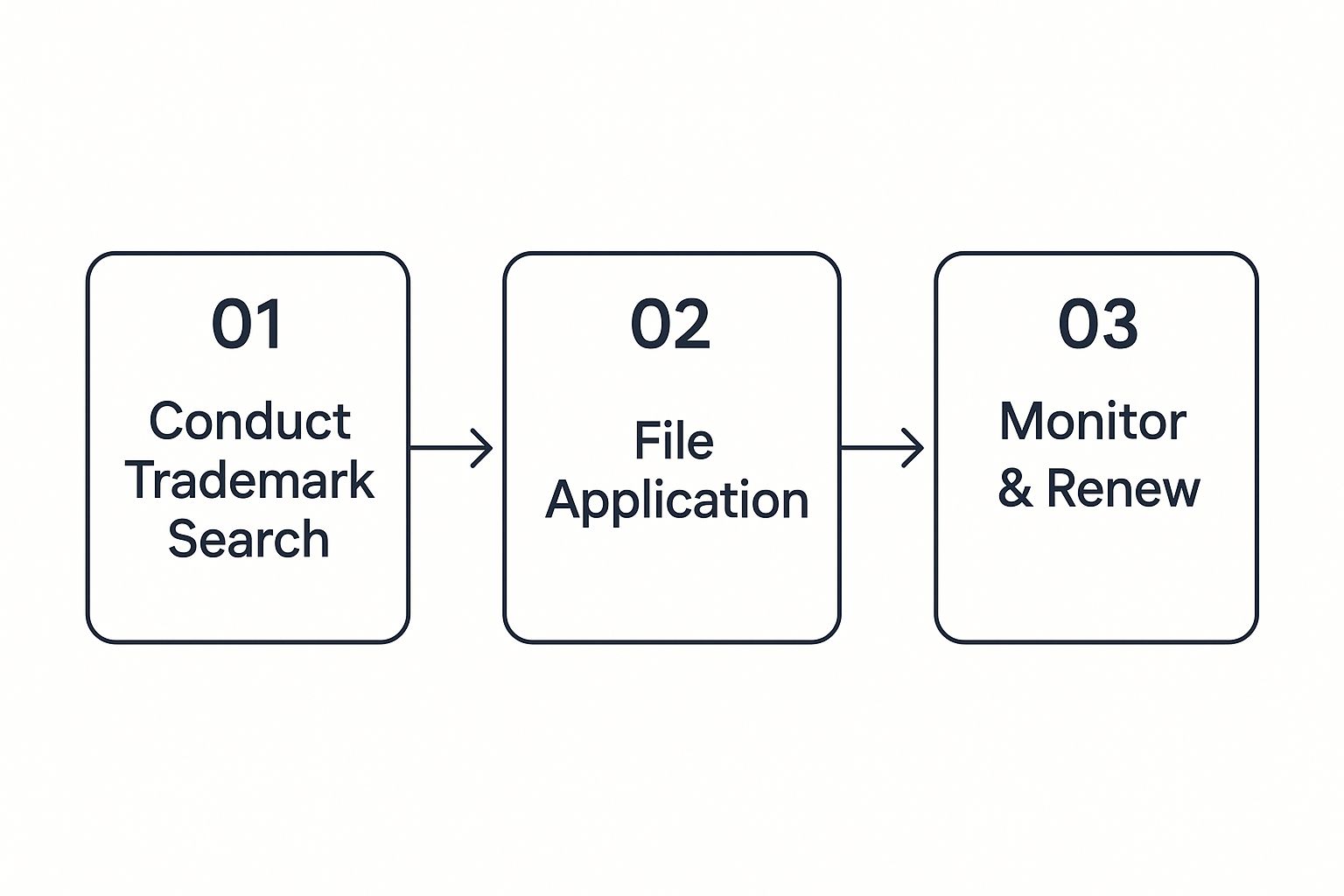
As you can see, once you've done your homework with a search, filing the application is the pivotal step. From there, it’s all about working with the USPTO and then maintaining your brand's protection for the long haul.
Standard Character vs. Special Form Mark
One of the first forks in the road is deciding whether to file for a Standard Character Mark or a Special Form Mark. This choice directly impacts how broad your protection is, so it’s a big one.
A Standard Character Mark protects the name itself, period. It doesn't matter how it's styled. This covers the word or phrase in any font, color, or design imaginable. For most artists, this is the best first move because it provides the widest possible protection. For instance, trademarking "The Velvet Echo" as a standard mark protects those words, not one specific logo.
A Special Form Mark, often called a stylized or logo mark, protects a particular visual design. If you have a unique logo that includes your name, you’d file for this to protect that specific graphic. This is much more targeted and won't protect your name if you use it in a different style.
My advice? Start with the Standard Character Mark. It's the most strategic play. You can always file a separate application for your logo down the road once your visual branding is more locked in.
Choosing Your Correct Trademark Class
Next up, you have to tell the USPTO exactly what goods or services your stage name is used for. This is done by selecting specific "classes." Getting this right is absolutely critical—your trademark only protects you within the classes you register.
For musicians and performers, two classes are usually non-negotiable:
- Class 41 (Entertainment Services): This is for your live gigs. Think concerts, festival appearances, and speaking engagements.
- Class 9 (Sound Recordings): This one covers your recorded music, like digital downloads on Spotify, vinyl records, and CDs.
You can file in one or both. If you're a gigging artist who also drops albums, you'll almost certainly need to file for both to be fully covered.
Proving You Use the Name in Commerce
This is where a lot of artists stumble. You have to prove to the USPTO that you are actively using your stage name as a brand to sell something. A simple signature on a photo just won't fly. Your name needs to act as a source identifier—something that tells the public, "This music or this show comes from you."
The U.S. has specific rules for this. For recorded music, you have to show evidence that your name is used as a brand on at least two different creative works. For example, you can't just submit a CD and its digital version; you need proof of two distinct releases, like two different albums or singles. You can dig into the nitty-gritty of these requirements on the .
The USPTO needs to see your stage name functioning like a brand, not just a name. The evidence you submit, known as a "specimen," must clearly show this connection between your name and your services or goods.
So what does good evidence look like?
- For Class 41 (Entertainment): A flyer for a show, a screenshot of a ticketing page (like on Eventbrite), or a poster for an upcoming concert where your name is featured prominently.
- For Class 9 (Recordings): The album art for a single on Apple Music or Spotify, the cover of a CD you're selling, or the label on a vinyl record.
By carefully selecting your mark type, choosing the right classes, and gathering strong evidence, you build a much stronger application from the get-go. You can dive even deeper into this in our guide on the six-step process of applying for a trademark in the US.
Expanding Your Protection to a Global Audience

In a world where your next fan could be streaming your music from Berlin or Tokyo, limiting your brand protection to just the U.S. is a shortsighted move. As your career grows, so does your audience. Securing your trademark stage name internationally isn't just for superstars; it’s a smart, forward-thinking strategy for any artist with global ambitions.
Thinking globally from the start prevents some major headaches down the road. Imagine discovering a popular artist in another country is already using your name, effectively blocking you from touring or selling merch there. Proactive international filing ensures your brand remains yours, no matter where your music takes you.
Using the Madrid Protocol for Global Reach
Navigating international trademark law sounds like a complicated and expensive mess, but there’s a system designed to simplify it: the Madrid Protocol. This international treaty is a game-changer. It lets you file for trademark protection in multiple member countries through a single application and one set of fees.
Instead of hiring lawyers in every single country and filing a mountain of separate applications, you can extend the protection of your home country’s trademark to over 130 territories. This streamlined approach saves a significant amount of time and money, making global brand protection much more accessible for growing artists.
How to Prioritize Your International Filings
With so many countries to choose from, where should you even start? You have to be strategic. You don't need to file everywhere at once. Focus your resources where they'll have the most impact.
Here's how I tell my clients to think about it:
- Follow Your Fanbase: Where are your listeners? Jump into your Spotify for Artists or YouTube Analytics and see which countries have the highest concentration of fans. That’s your low-hanging fruit.
- Target Key Music Markets: Prioritize major music hubs like the UK, Germany, Japan, and Australia where you might tour or license music in the future.
- Consider Emerging Markets: The global trademark landscape is always shifting. Countries like Mexico, Indonesia, and Brazil are seeing huge growth in new filings, highlighting their economic importance and increasing competition for unique names. You can dive deeper into these trends in the latest World Intellectual Property Indicators report.
Your international filing strategy should mirror your career goals. If you're planning a European tour next year, securing your trademark in the EU should be a top priority. Always think one step ahead of your music.
By expanding your protection, you're not just filing paperwork; you're building a global brand. Just remember that international filing means navigating different classes and requirements, which can vary from your domestic application. To get a better handle on this, check out our guide on what international classes mean for musicians. Smart international trademarking is a powerful investment in your future.
What to Do After Your Trademark Is Approved
Getting that official registration certificate from the USPTO is an incredible feeling. You’ve put in the work, navigated the process, and finally secured your brand. But this isn't the finish line; it’s more like the starting block for the next phase of ownership. Your job now shifts from applicant to active brand protector.
A registered trademark is a powerful asset, but only if you actually maintain and defend it. Simply having the registration on file isn’t enough. You have to actively use it in public, keep an eye on the marketplace, and be ready to enforce your rights to keep its value from fading away.
Use It or Lose It: The Importance of the ® Symbol
Your first and easiest job? Start using the registered trademark symbol: ®.
This little symbol is a huge deal. It puts the entire world on notice that your trademark stage name is officially registered with the U.S. Patent and Trademark Office. When you use the ®, you're signaling to other artists, venues, and businesses that you hold exclusive, nationwide rights to your name for the goods and services you listed in your application. It's a surprisingly effective deterrent that can stop potential copycats before they even try.
Think of the ® symbol as a "No Trespassing" sign for your brand. It clearly marks your territory and warns others that you are prepared to defend it. If you fail to use it, you could weaken your position if you ever need to take legal action down the road.
Make it a habit to add the ® to your name everywhere you can. Some key spots include:
- Your official website header and footer.
- Social media bios and profiles.
- Album art and digital music releases.
- Merchandise like t-shirts, posters, and hats.
- Event flyers and promotional materials.
Ongoing Maintenance and Renewals
Your trademark registration doesn’t last forever on its own. The USPTO needs you to prove you're still actively using your name in commerce by filing specific maintenance documents at set intervals. Missing these deadlines is one of the most common—and frankly, heartbreaking—ways artists lose their hard-won trademark rights.
Here are the key milestones you absolutely need to track:
- Declaration of Use (Section 8): You must file this between the fifth and sixth years after your registration date. You'll need to submit fresh evidence (what we call "specimens") showing how you're currently using the name.
- Declaration of Use and Application for Renewal (Sections 8 & 9): This is a combined filing due between the ninth and tenth years, and then every 10 years after that for as long as you use the mark.
Set calendar reminders for these dates the moment you get your certificate. While the USPTO often sends reminders, the ultimate responsibility is yours. If you fail to file these documents, your trademark will be cancelled. No exceptions.
Enforcing Your Exclusive Rights
The final piece of the puzzle is enforcement. The USPTO doesn’t police the market for you; that's your job. You have to monitor for anyone who might be using a confusingly similar name. This requires active vigilance.
I recommend setting up alerts on Google and social media to track mentions of your stage name. If you find someone infringing on your mark, the first step is typically sending a cease and desist letter. This is a formal letter, usually drafted by an attorney, demanding they stop using the name and explaining the legal consequences if they refuse.
This process becomes even more vital as you navigate complex agreements in the music industry. As your career grows, your trademark can become a major point of negotiation. Understanding these dynamics is crucial. You can learn more by reading about the trademark issues that can arise in recording contracts. Protecting your name is an ongoing commitment, but it’s one that secures your brand’s future and legacy.
Your Stage Name Trademark Questions Answered
When artists get serious about protecting their brand, a handful of questions always come up. These are the details that can feel confusing and sometimes even stop you from taking that next step. Let's break them down with some direct, no-fluff answers.
How Much Does It Actually Cost?
This is almost always the first question on an artist's mind, and for good reason. The total cost to trademark your stage name really comes down to two main expenses: government filing fees and attorney fees.
USPTO Filing Fees: You can't get around these. They are paid directly to the government and, as of right now, usually fall between $250 to $350 per class of goods or services. If you're an artist who releases music and also performs live, you'll likely file in two classes—Class 9 for recorded music and Class 41 for live entertainment. That means you'll be paying that fee twice.
Attorney Fees: This is where the numbers can change a lot. Some lawyers offer flat-fee packages that can range from a few hundred dollars to a couple of thousand. While it's tempting to cut this corner, a good trademark attorney does way more than just fill out a form. They're doing a deep-dive search to make sure your name is actually available, giving you strategic advice, and handling any pushback (called an "office action") from the USPTO.
Can I Trademark My Real Name?
Yes, you absolutely can trademark your real name, but it comes with a condition. The USPTO often sees a personal name as "merely descriptive" at first. To get it registered, you have to prove it has acquired distinctiveness.
In plain English, this means you need to show that the public doesn't just see your name as your name, but as a brand associated with your specific type of entertainment. Think of someone like Taylor Swift. Her name isn't just a name anymore; it's a global brand that immediately makes you think of her music and performances. That's the level of brand recognition you need to demonstrate.
What Is the Difference Between ™ and ®?
This is a simple one, but getting it wrong has real consequences.
The ™ Symbol: You can start using the ™ (trademark) symbol right away, on your own. It's an informal way of signaling to the world that you're claiming that name as your brand. The key thing to remember is that it offers zero federal legal protection. It’s basically just a heads-up.
The ® Symbol: This is the one that matters. You can only use the ® (registered) symbol after the USPTO has officially approved and registered your trademark. Using it before you have that federal registration is illegal, so don't jump the gun.
The ™ symbol says, "I'm claiming this is my brand." The ® symbol says, "The U.S. government agrees this is my brand, and I have the legal muscle to back it up."
How Long Does the Whole Process Take?
Get ready to be patient. Trademark registration isn't an overnight thing. Even if your application sails through without any issues, you're realistically looking at a timeline of 10 to 18 months. If the USPTO has a big backlog or sends back an office action that you need to respond to, it can take even longer.
Navigating the legal side of your creative career can feel overwhelming, but you don't have to do it alone. At Cordero Law, we empower artists by providing clear, strategic guidance on protecting their most valuable assets. If you're ready to secure your brand, let's talk. Learn more about our approach and how we can help at .