
Navigating the use of trademarks in domain names can feel like a high-wire act. Your web address is the digital front door to your business, and your trademark is the sign hanging right above it. They have to work in harmony to build an online presence that's not just strong, but legally defensible.
Why Your Domain Name Is Your Digital Trademark
In the online world, your domain name is more than just a path to your website; it鈥檚 a powerful piece of your brand. When a customer types YourBrand.com into their browser, they aren't just navigating to a page. They are looking for you, and they trust that name to deliver a certain level of quality and authenticity. This is exactly where the rules of domain registration and trademark law intersect.
A trademark's whole purpose is to prevent customer confusion by giving you exclusive rights to your brand name, logo, or slogan for your specific goods or services. A domain name, though technically just a web address, does a very similar job online. Because of this functional overlap, courts and legal bodies often view your domain name as a direct expression of your brand.
The Overlap Between Trademarks and Domains
This connection is so tight that using another company's trademark in your domain name can land you in serious legal hot water. The main issue boils down to whether your domain creates a "likelihood of confusion" for consumers. For example, if you opened a computer repair shop and registered AppleFixers.com, Apple Inc. would almost certainly have a strong trademark infringement case against you.
Why? Because a domain like that piggybacks on their established brand trust to pull in customers, suggesting a partnership or endorsement that simply doesn't exist.
Just because you were the first one to register a domain name doesn't automatically mean you have the right to use it, especially if it infringes on someone else's trademark. The "first come, first served" rule of domain registration has its limits.
To give you a clearer picture, let鈥檚 quickly compare the two.
Trademark vs Domain Name At a Glance
| Aspect | Trademark | Domain Name |
|---|---|---|
| Primary Role | Identifies the source of goods/services | Serves as a unique address for a website |
| Legal Protection | Grants exclusive rights to use a brand identifier | Grants exclusive rights to use a specific web address |
| Geographic Scope | National or international, based on registration | Global |
| Governing Body | Government patent & trademark offices (e.g., USPTO) | Domain registrars accredited by ICANN |
This table is just a starting point. Getting a handle on this dynamic is the first step toward building a digital identity that's truly secure. Your domain isn't just a technical asset; it鈥檚 a strategic one.
To go deeper, check out our detailed guide on the critical relationship between your trademark and domain names. Protecting it means you're protecting the very foundation of your business online.
Understanding Trademark Rights in the Digital Age
A trademark is so much more than a logo or a catchy name. Think of it as your brand's promise to your customers. It's the unique handshake that says, "This is us, you can trust the quality here," and it's what separates you from everyone else out there. This "promise" is exactly what the law protects, and that protection stretches right into the world of domain names.
This legal muscle doesn't just materialize out of thin air. You build it piece by piece every time you use your brand in connection with what you sell. Slap your name on a product, run an ad, put it on your website鈥攅ach action strengthens your legal position. When you officially register that trademark with a government body like the , you're cementing those rights and handing yourself a powerful legal shield.
Trademarks and Use in Commerce
This is where your domain name choices get serious. The simple act of registering and using a domain name that contains someone else's trademark can be legally considered "use in commerce." This is the magic phrase in trademark law.
So, if you go and register PremiumStarbucksCoffee.net, you haven't just bought a web address. In the eyes of the law, you're using the Starbucks trademark in a commercial way, which is the key test for infringement.
The big question is whether your domain creates a "likelihood of confusion." Would a normal person clicking on your link think your site is officially connected to, or approved by, the real brand? If there's even a chance they would, you're standing on very shaky ground.
A trademark's power is directly tied to how unique and well-known it is. The bigger and more established the brand, the more fiercely it can鈥攁nd will鈥攄efend its name from being used in confusingly similar domains.
Real-World Brand Protection
Strong trademark rights give brands the legal standing to go after people who register similar domains, especially if that new domain muddies the brand's reputation or tricks customers. And this isn't just a textbook theory; big companies are always on the lookout for these kinds of infringements.
Take a global tech giant like Ericsson. Their name is known worldwide. If someone registers a domain like Ericsson-Deals.com, Ericsson has every right to use its powerful trademark to argue that this new domain is unfairly cashing in on their hard-earned goodwill.
The whole legal system is set up to stop people from hijacking a brand's reputation. It's about making sure that when a customer types in a domain with a trusted name, they end up at the right place. This is why your choice of a domain name isn't just a marketing move鈥攊t's a significant legal one. Getting a handle on these rights is your first step to steering clear of expensive fights over trademarks in domain names.
Recognizing Threats Like Cybersquatting and Typosquatting
Once you realize your trademark has real power online, you can start to spot the common ways bad actors try to cash in on it. The two biggest headaches you鈥檒l likely run into are cybersquatting and typosquatting. They sound similar, but they鈥檙e two different games played by people looking to profit from your brand's hard-earned reputation.
Cybersquatting is pretty straightforward: it鈥檚 when someone registers a domain name that鈥檚 identical or confusingly similar to a famous trademark with the bad faith intent to profit. The classic move is for the cybersquatter to hold the domain hostage and try to sell it back to you for way more than they paid. Imagine you just announced your new company, and someone instantly registers YourNewBrand.com, knowing you'll eventually come knocking. That's cybersquatting 101.
And don鈥檛 think this is some rare occurrence. It鈥檚 a huge problem. In just one recent year, trademark owners filed over 6,100 cases under the Uniform Domain Name Dispute Resolution Policy (UDRP), a system built specifically to combat these kinds of infringements. You can get a sense of these .
The Deceptive Power of Typosquatting
Typosquatting is a sneakier, and often more dangerous, type of infringement. This tactic involves registering domains that are just common misspellings of a popular brand. The goal is to catch all the accidental traffic from users who make a simple typing mistake.
Let鈥檚 say a customer is trying to get to a huge online store like Amazon. A typosquatter might scoop up domains like:
- Amazone.com (that extra 'e' is easy to add)
- Amozan.com (a common phonetic slip-up)
- Amazonn.com (a classic double-key press)
These lookalike domains can then be used for some pretty nasty stuff, like installing malware, running phishing scams to steal personal info, or just redirecting your potential customers to a competitor's site. If your customers fall into one of these traps, the damage to your brand's credibility can be serious. At its heart, it鈥檚 a clear attempt to misuse trademarks in domain names.
The goal of both cybersquatting and typosquatting is the same: to leverage your brand's hard-earned reputation for someone else's gain. Recognizing these threats is the first step in defending against them.
Stopping these situations before they blow up is always the best move. To build a solid defense, you have to understand the basics of infringement. For a more proactive approach, you might want to check out our guide on how to avoid trademark infringement. By staying aware of how your trademark can be targeted, you put yourself in a much better position to protect both your customers and your brand鈥檚 integrity.
How to Fight Back with the UDRP Process
Finding out a cybersquatter has registered your brand's name as a domain feels like a brazen digital home invasion. But before you panic, you need to know about a powerful tool built for exactly this fight: the Uniform Domain Name Dispute Resolution Policy (UDRP).
Think of the UDRP as a specialized, fast-track tribunal, not a full-blown, expensive court battle. It was created by the Internet Corporation for Assigned Names and Numbers (ICANN) to give trademark holders a cheaper, faster path to reclaim infringing domains. Instead of navigating the court system, you file a complaint directly with an approved provider like the World Intellectual Property Organization ().
The whole process is pretty straightforward. At its core, you're just following a few key steps to challenge the bad actor.
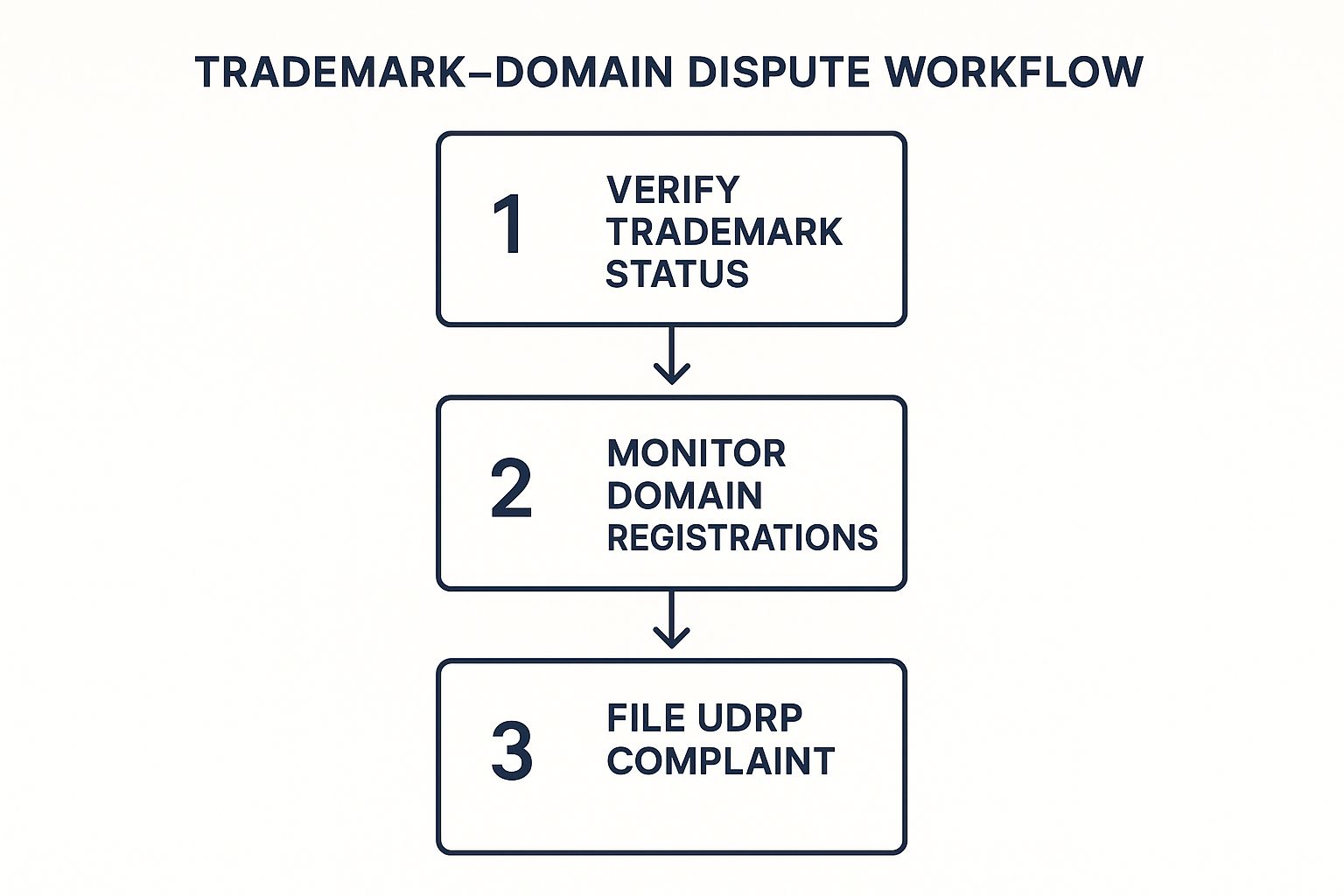
This flow distills the fight into three critical stages, starting with getting your own legal ducks in a row before taking direct action.
The Three Pillars of a UDRP Claim
Winning a UDRP case doesn鈥檛 mean you have to argue complex legal theories. It鈥檚 much simpler. You just need to prove three specific things to the arbitration panel. Nail all three, and your odds of getting the domain transferred to you are very, very good.
The Domain is Identical or Confusingly Similar: First, you have to show the domain is basically the same as, or confusingly close to, a trademark you have rights to. If you have a registered trademark, this is usually the easiest part of the puzzle.
They Have No Rights or Legitimate Interests: Next, you must demonstrate the person holding the domain has no legitimate claim to it. For example, they aren't commonly known by that name, and they aren't using it for a legitimate noncommercial purpose or fair use.
It Was Registered and Used in Bad Faith: This is the big one. You have to prove the domain was registered and is being used in bad faith. This often comes down to showing the squatter's true intent.
What Counts as "Bad Faith"?
"Bad faith" isn't just a hunch; it's proven by specific actions. The UDRP lays out some clear examples of what this looks like in practice.
- Intent to Sell: The squatter registered the domain mainly to flip it back to you鈥攖he trademark owner鈥攆or way more than they paid for it.
- Blocking You: The owner registered the domain just to stop you from getting it, especially if they do this kind of thing a lot.
- Disrupting a Competitor: The squatter is a competitor and is using the domain to mess with your business.
- Causing Confusion: The owner is deliberately trying to lure people to their site by making them think it's associated with your brand.
In a UDRP proceeding, the panel looks at the whole picture. Even if a squatter comes up with a story about their "legitimate" plans for the domain, if their actions scream "I'm trying to profit from your brand," panels usually see right through it.
Successfully proving these three points is how you use the UDRP to protect your trademarks in domain names. It's your best bet for reclaiming your digital turf without the time and expense of a full-on federal lawsuit.
How to Proactively Protect Your Brand Online

While it's crucial to know how to fight back against cybersquatters, the best strategy has always been a strong offense. Instead of waiting for a threat to pop up, you can take proactive steps to build a digital fortress around your brand. This approach will save you from future headaches, legal fees, and potential damage to your reputation.
The very first step happens before you even spend a single dollar on a domain. You must perform a thorough trademark search. This is non-negotiable. It prevents you from accidentally building your brand on a name that another company already owns, which could force you into a costly rebranding nightmare down the line. Think of it as the foundational check that ensures the digital ground you鈥檙e about to build on is solid.
Build a Defensive Domain Portfolio
Once you鈥檝e confirmed your brand name is clear, it鈥檚 time to start thinking defensively. Don't just register your primary .com domain and call it a day. You need to build a protective moat around it by anticipating how others might try to impersonate you or siphon off your traffic.
This defensive strategy involves registering key variations of your brand name before a squatter does. Put yourself in your customers' shoes and think about the most common ways they might misspell your name or the different domain extensions they might try. A strong defensive portfolio usually includes:
- Common Misspellings: If your brand is "Flicker," go ahead and register
Flickir.comandFliker.com. This is your first line of defense against typosquatting. - Different Top-Level Domains (TLDs): Secure the
.net,.org, and.coversions of your domain. This stops others from setting up shop right next door with a confusingly similar web address. - Product or Service Variations: If you sell a unique product like "Chrono-Grips," consider registering domains like
ChronoGripsShop.comorChronoGripsReviews.comto control the conversation around your brand.
By owning these variations, you control the territory. You can simply redirect all of this traffic back to your main website, ensuring that no matter how a customer tries to find you, they land exactly where you want them.
Think Globally, Secure Locally
Your brand鈥檚 ambition should guide your domain strategy. If you have plans to expand internationally or already have a strong presence in a specific country, securing country-code top-level domains (ccTLDs) is a smart, forward-thinking move. Registering YourBrand.ca for Canada or YourBrand.co.uk for the United Kingdom signals a local commitment and, more importantly, protects your trademark in those key markets.
This isn't just about expansion; it's about claiming your digital identity everywhere it matters. Global domain registrations have reached 368.4 million, with huge growth in country-code domains. This trend makes it clear that savvy businesses are securing these assets for their long-term strategic value. You can find more insights on .
Taking these steps is a critical part of protecting your brand and your use of trademarks in domain names. To learn more about securing your web address as a core brand asset, check out our guide on trademarking a domain name.
The Future of Trademarks and Digital Assets
The intersection of trademarks and domains is always in flux. Just when you think you've got it figured out, new technology pops up, creating incredible branding opportunities alongside brand new headaches. While a .com is still the undisputed king for trust and brand recognition, the digital world is getting a lot bigger, and a lot weirder. To stay ahead, you have to understand these new frontiers and what they mean for protecting your brand.
One of the biggest shifts we're seeing is the explosion of industry-specific top-level domains (TLDs). These aren't just lazy alternatives to .com; they're becoming hugely valuable digital real estate. Take the .ai extension, for example. It started as the country code for Anguilla, but its obvious link to artificial intelligence has made its value go through the roof. This is a perfect illustration of how a domain namespace can morph into a multi-million dollar asset, with registration fees soaring and creating massive revenue streams. You can find more insights on this topic by exploring .
New Frontiers in Digital Identity
This evolution is about more than just a few new TLDs. We're in the very early days of entirely new systems for digital identity, and they're going to have major implications for how we think about trademarks in domain names.
These new systems are forcing us to rethink online ownership and branding entirely:
- Web3 Domains: Traditional domains are basically rented from a registrar. Web3 domains (think
.ethor.sol) are different. You own them outright as a non-fungible token (NFT). This gives you a new level of control, but it also opens a Pandora's box of new risks for brand impersonation. - Blockchain-Based Identity: These systems are trying to create a single, secure digital ID for users that works across different platforms, tying together everything from your web addresses to your crypto wallets.
The core problem doesn't really change: how do you protect your brand's identity when the very definition of a "digital address" is up for grabs? As these new systems mature, trademark holders will need to be just as vigilant about monitoring these new spaces as they are about the old ones.
At the end of the day, protecting your brand is no longer a static, set-it-and-forget-it task. It demands a flexible, forward-thinking strategy. Locking down your .com is still step one, but you absolutely have to keep an eye on emerging TLDs and decentralized tech. That's the only way to ensure your trademark stays protected, no matter where your customers decide to look for you online.
Still Have Questions?
Trying to figure out how trademarks and domain names fit together can feel confusing. Let's clear up a few of the most common questions we get from clients.
Can I Just Add a Word to a Trademark and Use It In My Domain?
This is a really risky move. A lot of people think adding a generic word like "shop," "deals," or "reviews" to a big brand's trademark (think something like NikeShoeDeals.com) is a clever workaround. It's not.
The real test, in the eyes of the law, is whether your domain name creates a "likelihood of confusion." In plain English, does it make people think you're officially connected to that brand when you aren't? If the answer is yes, you're likely to lose the domain in a dispute. It's always best to steer clear of this unless you have specific legal advice saying it's okay.
Key Takeaway: Simply tacking a generic word onto someone else's trademark won't protect you. What really matters is whether you're causing confusion for customers.
What's the Difference Between a UDRP and a Lawsuit?
When it comes to fighting over trademarks in domain names, a UDRP and a lawsuit are two completely different beasts.
- UDRP: Think of this as the express lane for domain disputes. It's a faster, cheaper, administrative process built specifically for clear-cut cases of cybersquatting. The only thing you can win is the domain name itself鈥攅ither getting it transferred to you or canceled.
- Lawsuit: This is the full-blown legal battle in a traditional court. It's a much slower and more expensive process, but it allows for things the UDRP doesn't, like seeking financial damages for the harm caused by the infringement.
The right path depends entirely on the specifics of your situation, your budget, and what you're hoping to achieve.
If I Own a Trademark, Do I Automatically Get the Domain Name?
No, and this surprises a lot of people. Domain names are generally handed out on a first-come, first-served basis. Just because you own the trademark for "BrandX," it doesn't mean you automatically get the rights to BrandX.com if someone beat you to it.
But here's the good news: your trademark is your most powerful weapon. It gives you the legal standing you need to challenge that domain owner through a UDRP or lawsuit, especially if you can prove they registered it in bad faith to piggyback on your brand's reputation.
At Cordero Law, we empower entrepreneurs and creatives to protect their most valuable assets. If you're building a brand and need strategic counsel on securing your intellectual property, we're here to help you navigate the process with clarity and confidence. Let's connect and discuss your brand's future.