
Ever wonder how artists like Bob Dylan can sell their life鈥檚 work for hundreds of millions of dollars? The secret is in the immense value locked inside their music catalog. This isn't just about a collection of songs; it鈥檚 a powerful financial engine built from intellectual property rights.
A music catalog is the entire collection of copyrights for a songwriter's or artist's body of work. Think of it less like a playlist and more like a portfolio of valuable assets that generates income over time from all sorts of places, like royalties and licensing deals.
Decoding Your Music Catalog
A catalog is much more than the actual recordings you listen to. It's really the bundle of legal rights tied to each song, covering both the musical composition (the melody and lyrics) and the master recording (the specific version you hear on Spotify or the radio).
These rights are what unlock revenue every single time a song gets played, streamed, sold, or used in a commercial.
The Foundation of Musical Assets
At its core, a music catalog works a lot like a stock portfolio. Each song is an asset that can鈥攁nd often does鈥攑roduce income for decades after it's released. The components that make up this portfolio are what give it such staying power:
- Compositions: This is the underlying song itself鈥攖he notes on the page and the words written by the songwriter.
- Master Recordings: This is the specific, finished audio file of a song. A single composition can have many different master recordings (think of the original, a live version, and a remix).
- Publishing Rights: These are the rights connected to the composition. They鈥檙e typically managed by music publishers.
- Master Rights: These are the rights connected to the master recording, often owned by the record label or sometimes the artist themselves.
To make this crystal clear, here鈥檚 a quick breakdown of what鈥檚 inside a catalog.
Key Components of a Music Catalog at a Glance
This table offers a quick snapshot of the primary rights and assets that form the building blocks of any music catalog.
| Component | What It Represents |
|---|---|
| Compositions | The song's fundamental structure: its melody, harmony, and lyrics. |
| Master Recordings | The specific, final recorded version of a song that is distributed. |
| Publishing Rights | Legal ownership and control over the composition, generating royalties. |
| Master Rights | Legal ownership and control over the master recording, also generating royalties. |
Understanding these distinctions is the first step to seeing how a collection of songs becomes a source of long-term wealth.
A music catalog is a living asset. Its value isn't static; it grows as songs find new audiences through movies, TV shows, and social media, creating new income opportunities long after their initial release.
Historically, these collections have always been mission-critical assets because they generate passive income from sales, streaming, and licensing deals. The high-profile sales of catalogs from legendary artists for nine-figure sums perfectly illustrate the immense financial weight these collections carry.
If you want to dive deeper into these industry-shaping trends, you can explore some fascinating numbers in .
Understanding the Two Halves of a Song
Every song you hear is really two separate things joined together, at least in the eyes of the law. Getting your head around this split is absolutely critical to understanding how money moves in the music industry and why a catalog can be such a valuable asset.
Let鈥檚 try an analogy. Think of your favorite song as a book.
The composition is the story itself. It鈥檚 the words on the page, the plot, the characters鈥攖he core idea. In music, this is the melody, the chords, and the lyrics that a songwriter creates. It's the song's DNA.
The master recording, however, is like one specific audiobook version of that story. It鈥檚 a single, unique performance captured in audio. Just like one book can have multiple audiobooks read by different actors, one composition can have countless master recordings鈥攖he original studio version, a live album take, an acoustic demo, a high-energy remix, you name it.
Publishing Rights: The Story Itself
The rights tied to the composition鈥攖he "story"鈥攁re known as publishing rights. These belong to the songwriter and, if they have one, their music publisher. They have the say over how the fundamental song is used.
This is the intellectual property that generates money every time that song is copied or played for the public. For example, when another artist covers the song or when its sheet music is printed and sold, it's the publishing rights that kick in. Honestly, digging into the world of music publishing is essential for any artist who wants to properly manage their career.
Every time you hear a song on the radio, in a restaurant, or streamed online, two separate sets of rights are being used simultaneously, and two different groups of people are getting paid.
Master Rights: The Recorded Performance
On the flip side, the rights connected to a specific recording鈥攐ur "audiobook"鈥攁re the master rights. These are typically owned by the recording artist, the record label, or whoever fronted the cash for the recording session.
These rights control the use of that particular sound file. When you stream that hit version of a song on Spotify or hear it playing in a movie scene, you鈥檙e hearing the master recording in action. This separation is what creates two completely distinct streams of income from the same song.
Here鈥檚 a simple breakdown of how they differ:
- Who Owns It? Songwriters own the publishing rights. The record label or artist usually owns the master rights.
- What It Covers: Publishing covers the song鈥檚 essential melody and lyrics. Master rights cover a specific recording of that song.
- Real-World Example: When Whitney Houston recorded her legendary version of "I Will Always Love You," she and her label owned the master rights to that powerful recording. But Dolly Parton, who wrote the song, kept her publishing rights and earned a fortune in royalties from the massive success of Houston's cover.
This dual-ownership system is the engine that drives a music catalog's value. It allows one single piece of creative work to generate multiple paydays for multiple people.
How a Music Catalog Actually Makes Money
Thinking of a music catalog as a bundle of rights is the first step, but the real magic happens when those rights start generating cold, hard cash. A catalog is a financial engine with multiple moving parts, each spinning off a different stream of income. These streams are designed to ensure a song can keep earning money from a whole range of sources long after it鈥檚 been released.
The most common ways a catalog makes money come from different types of royalties. In plain English, a royalty is just a payment made to whoever owns the rights for the ongoing use of their asset. For a deeper dive into how those payments are structured, it helps to understand the fundamentals of how music royalties are explained and calculated.
Let's break down the main ways your favorite songs put money in their owners' pockets.
Performance and Mechanical Royalties
Whenever you hear a song playing in public鈥攚hether it's on the radio, in a coffee shop, during a TV show, or at a live concert鈥攊t鈥檚 generating performance royalties. Organizations you鈥檝e probably heard of, like ASCAP and BMI, are called Performance Rights Organizations (PROs). Their job is to collect these fees and distribute them to the songwriters and publishers.
Then you have mechanical royalties, which are earned any time a song is reproduced. This term originally came from the mechanical process of pressing vinyl records or burning CDs. Today, it mostly applies to digital streams and downloads. Every single time you stream a song on Spotify or Apple Music, a tiny fraction of a cent is paid out to the songwriter as a mechanical royalty.
Sync and Print Licensing
One of the most valuable income streams is synchronization licensing, or just "sync" for short. This is what happens when a song is licensed to be used in visual media. Think movies, TV shows, video games, and commercials.
A well-placed song in a hit Netflix series, a memorable Super Bowl commercial, or the soundtrack of a major film can generate a massive, one-time sync fee. This can often be worth more than years of streaming royalties combined.
Lastly, while it's less common in the digital age, print rights generate income when a song鈥檚 sheet music is sold. For composers of classical, jazz, or educational music, this can still be a surprisingly steady source of revenue.
The infographic below breaks down the key elements you have to manage to effectively track and collect all these different income streams.
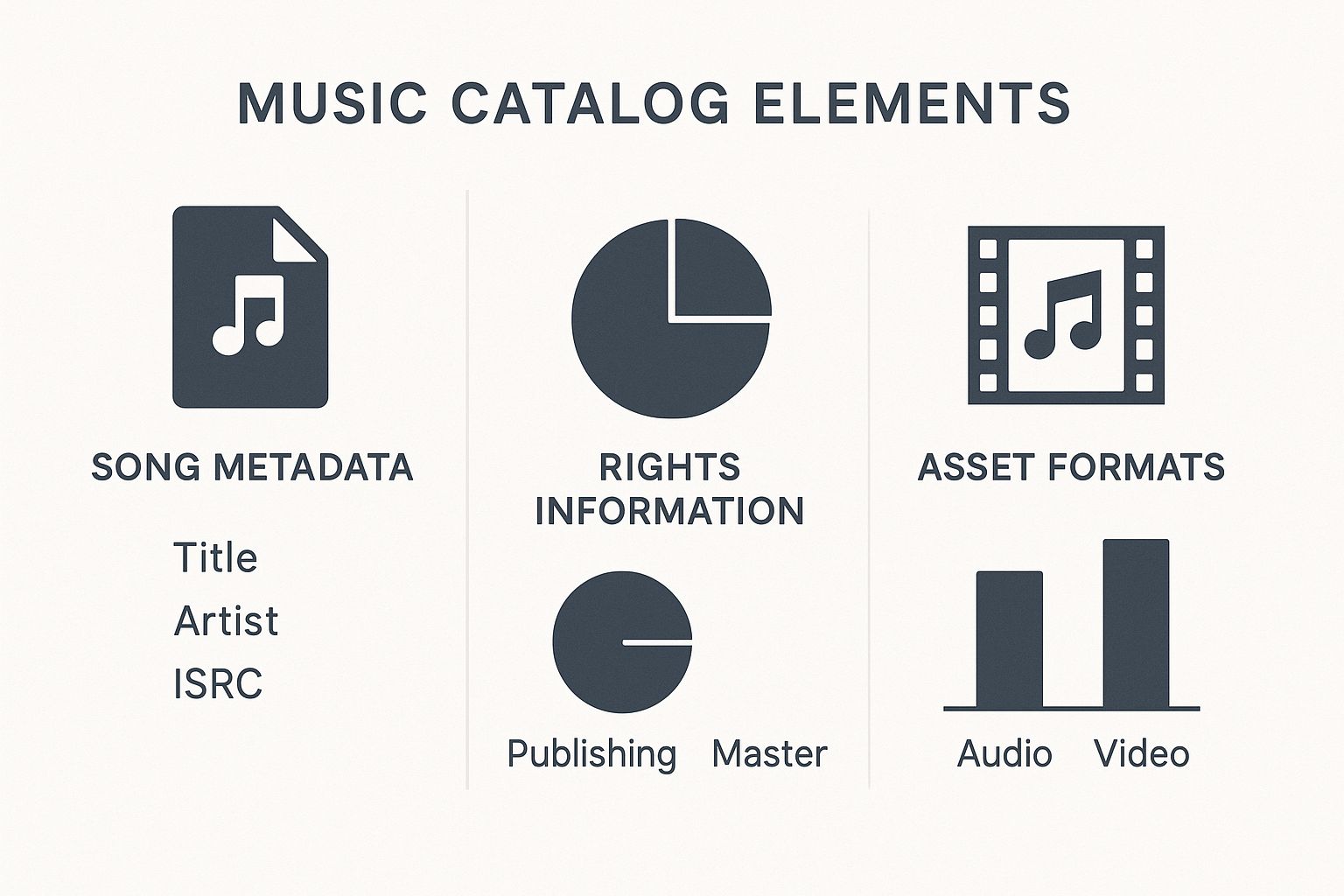
As the visual shows, having organized metadata, crystal-clear rights information, and various asset formats ready to go are all essential pieces of the monetization puzzle.
To really see how these revenue streams come together, let's lay them out side-by-side.
Music Catalog Revenue Streams Explained
| Revenue Stream | Generated From | Example |
|---|---|---|
| Performance Royalties | Public performance of a song | A song playing on the radio, in a restaurant, or at a concert |
| Mechanical Royalties | Reproduction of a song (physical or digital) | A track being streamed on Spotify or purchased on iTunes |
| Sync Licensing | Pairing music with visual media | A song featured in a movie scene, TV show, or video game |
| Print Royalties | Sale of printed sheet music | A pianist buying the official sheet music for a popular song |
Each of these channels represents a distinct opportunity for a song to earn money, highlighting why owning a diverse catalog can be such a powerful asset.
Music catalogs are huge drivers of the global music economy, especially with the explosion in streaming. Worldwide streaming revenues have grown massively, which just underscores how valuable owning a catalog is鈥攁fter all, these services depend entirely on this content. To stay ahead of the curve, it's worth exploring and how the industry continues to evolve.
Why Music Catalogs Are So Valuable Today
What makes a collection of songs worth hundreds of millions of dollars? The simple answer is that the music industry, and investors, have started looking at music in a whole new way. A music catalog isn't just art anymore; it's seen as a predictable and surprisingly tough financial asset, almost like real estate or a stock portfolio.
This incredible value comes from one thing: the power to generate steady, long-term income from royalties. An investor can buy a catalog and get paid every time a song is streamed, played on the radio, or used in a movie. It creates a stable, passive stream of cash flow.
The Science of Catalog Valuation
Figuring out what a catalog is worth is a mix of art and hard numbers. At its core, the calculation uses a multiple of the catalog's average annual earnings. For example, if a catalog consistently brings in $1 million per year, an investor might pay a 15x multiple for it, landing the final price at $15 million.
But that multiple isn't just pulled out of thin air. It鈥檚 shaped by a few key things that show how strong a catalog is and whether it has real staying power:
- Song Age and Timelessness: Older, classic hits that have already proven they can stick around for decades often get higher multiples. These "evergreen" songs aren't easily shaken by passing trends.
- Artist's Cultural Impact: Catalogs from iconic artists with a massive, dedicated global fanbase are considered premium assets. You can bet their music will find its way to new generations of listeners.
- Income Stream Diversity: A catalog making money from all over鈥攕treaming, sync licensing, physical sales鈥攊s way more stable and less risky than one that depends entirely on a single source.
- Genre and Consistency: Some genres, like holiday music or rock anthems, have incredibly predictable earning patterns year after year, which makes them highly attractive to investors.
A music catalog's true value is rooted in its predictability. Unlike a new startup, a 20-year-old hit song has a long history of earnings, allowing investors to forecast its future performance with a high degree of confidence.
A Surge in Investment and Growth
The recent boom in catalog sales isn't a fluke; it shows a growing confidence in music as a solid asset class. The global music industry has been on a steady upward climb, fired up by the explosion of streaming and the unexpected comeback of physical formats.
The market has ballooned, with over 443 million people worldwide holding paid music streaming subscriptions in recent years. That massive user base is what directly fuels a catalog's revenue. At the same time, physical sales like vinyl have shown they're not going anywhere, with the format seeing continuous growth and a notable 5% increase in vinyl sales in one recent year. To get the full picture of this market expansion, you can learn more about these global music industry trends.
This growth across different formats proves that a well-managed catalog can pull in money from every corner of the industry. For artists, this means their body of work is more than just a creative legacy鈥攊t's a serious financial asset that can secure their future for decades.
How to Manage and Grow a Music Catalog
Owning a music catalog is a lot like planting a tree; its real value doesn't just appear overnight. It comes from consistent care and smart decisions over time. To make it flourish, you have to actively manage your songs and hunt down new opportunities. It's about shifting your mindset from just creating art to running a dynamic music business.
The first step, and the one you can't skip, is proper administration. This means getting every single song correctly registered with the right organizations. If you don't do this, you're literally leaving money on the table. Think of it as setting up a bank account for your music鈥攊f you skip that step, any deposits have nowhere to go.
Secure Your Royalties and Ownership
Before you can even think about growth, you have to protect what's already yours. This involves a few non-negotiable administrative tasks to make sure you get paid for your work and that your ownership is crystal clear.
Register with a PRO: You need to join a Performance Rights Organization like ASCAP, BMI, or SESAC. These are the groups that collect performance royalties for you whenever your songs are played in public鈥攐n the radio, in a restaurant, at a concert, you name it.
Register with The MLC: The Mechanical Licensing Collective is who pays out mechanical royalties from streaming services in the U.S. to songwriters and publishers. This is a critical step for capturing your piece of the streaming pie.
Finalize Your Split Sheets: A split sheet is just a simple agreement that spells out who owns what percentage of a song. Getting this down in writing as soon as a song is finished prevents massive headaches and disputes down the road. For a complete guide, learning the essentials of a songwriter split sheet is a must for any collaborator.
Proactive Strategies for Catalog Growth
Once your administrative house is in order, you can get to the exciting part: expanding your catalog鈥檚 reach and revenue. This is all about actively finding new ways for your music to be heard and, more importantly, used.
One of the most powerful strategies is to work with a music publisher or a sync agent. It's their entire job to pitch your songs for synchronization (sync) licenses鈥攚hich means getting your music placed in movies, TV shows, commercials, and video games. A single great sync deal can bring in a significant upfront fee and introduce your music to a massive new audience all at once.
A catalog isn鈥檛 a static archive; it's a collection of opportunities waiting to be activated. The goal is to continuously find new contexts where your songs can connect with listeners and create value.
And don't sleep on the power of modern promotion. Collaborating with social media influencers to use a track in their content can breathe new life into an older song, sometimes causing it to trend and generate a whole new wave of streaming revenue. To pull this off, understanding how to approach is absolutely vital.
By combining rock-solid administration with creative, forward-thinking promotion, you can turn your collection of songs into a valuable asset that pays dividends for years to come.
Your Music Catalog Is Your Lasting Legacy
We've spent this guide breaking down what a music catalog is鈥攆rom the nuts and bolts of master and publishing rights to all the ways it can make you money. But when you zoom out from the royalty statements and sales figures, you see something much bigger. Your catalog is the permanent, living story of your creative journey.
Think about it. Each song is a snapshot in time, capturing a specific feeling, a message, or a moment of pure inspiration. Put them all together, and you have a body of work that connects you to your audience in a way almost nothing else can. This isn't just an asset to manage; it's your cultural footprint, one that can echo for generations to come, finding new life in movies, unexpected social media trends, and the playlists of fans who haven鈥檛 even been born yet.
Your music catalog is your most powerful legacy. It ensures that the art you create today continues to resonate, inspire, and provide for you and your family long into the future.
This is why active management鈥攆rom getting your registrations right to hunting down sync opportunities鈥攊s so much more than a business strategy. It鈥檚 an act of preservation. You鈥檙e making sure your voice isn't lost to time. By really understanding and controlling your rights, you鈥檙e not just building a career; you're building an enduring legacy. Every track you release adds another chapter to that story, solidifying the incredible value you are building with your art.
A Few Lingering Questions
Even after you get the basics down, a few common questions always seem to surface when artists start digging into music catalogs. Let's clear up some of that lingering confusion with straightforward answers.
What Is the Difference Between a Music Catalog and a Discography?
A lot of people throw these terms around interchangeably, but they're fundamentally different things.
Think of a discography as a simple list. It's a historical record of every recording an artist has ever released鈥攁ll the albums, singles, and EPs. It's the "what."
A music catalog, however, is the bundle of legal rights attached to those songs. It鈥檚 the ownership鈥攕pecifically the master and publishing rights鈥攖hat gives you the power to actually earn money from the music. An artist can have a massive discography but own a tiny fraction of their music catalog if they signed away their rights early in their career.
How Long Does Copyright Last for a Song in a Catalog?
This is the big one, because the length of copyright is what gives a music catalog its incredible, long-term value. While the laws can get a little tricky depending on the country, the rule of thumb in the United States for songs created after January 1, 1978, is pretty generous.
Copyright protection lasts for the life of the last surviving author, plus an additional 70 years. This massive timeframe is what turns a song into a true generational asset, ensuring it can generate income for a creator's family long after they're gone.
For works that are considered "made for hire," the term is even different: 95 years from the first publication or 120 years from its creation, whichever comes first. This long lifespan is a huge reason why investment funds are so eager to snap up valuable catalogs.
Can an Independent Artist Build a Valuable Music Catalog?
Absolutely. In fact, there鈥檚 never been a better time for independent artists to build and control their own assets. By holding onto full ownership of both your master rights (for the sound recording) and your publishing rights (for the underlying song), you are building your own music catalog with every single track you release.
Each new song you write and record adds another valuable asset to your portfolio. Here's how to actively build its value from the ground up:
- Proper Registration: You have to diligently register every song with Performance Rights Organizations (like or ) and . If you don't, you're leaving money on the table.
- Strategic Distribution: Get your music on every platform that matters. Using a good distribution service maximizes your reach and opens up streams of mechanical royalty income.
- Hunt for Licensing Deals: Don't just wait for opportunities to come to you. Proactively pitch your music for placement in films, TV shows, video games, or commercials. This can bring in significant upfront sync fees and introduce your music to a whole new audience.
By taking these steps, an independent artist can methodically build a catalog that provides a steady, passive income stream and grows into a major financial asset over time.
Protecting and managing your music catalog isn't something you should do alone. The team at Cordero Law specializes in entertainment and intellectual property law, helping artists secure their rights and maximize their legacy. Visit us at to learn how we can empower your creative journey.