
So, can you actually trademark your own name? The short answer is yes, you absolutely can. But—and this is a big but—it’s not as simple as just filing some paperwork.
The U.S. Patent and Trademark Office (USPTO) has a specific rule: your name has to be used to sell goods or services. It needs to function as a brand. Think of it this way: your name on your driver's license is just you. But your name on a product, a book, or a consulting service? Now we're talking about a brand. That's the difference between 'Oprah Winfrey' the person and 'Oprah Winfrey' the media empire.
Understanding When a Name Becomes a Brand
The whole thing hinges on a single, crucial idea: use in commerce. Your name has to become a "source identifier," which is just a fancy legal way of saying customers see the name and immediately connect it to your product or service. That's the moment your personal name crosses the bridge to become a legally protectable brand.
Let's say you're a fantastic chef named Maria. Just being known around town as "Chef Maria" isn't enough to get a trademark. But the second you start selling a line of "Chef Maria's Gourmet Sauces" or offering "Chef Maria's Cooking Classes," your name is doing more than just identifying you. It's now identifying a commercial product, and that's exactly what the USPTO is looking for.
The Core Requirements for Trademarking a Name
The USPTO isn't in the business of handing out trademarks just because you have a name. To get their stamp of approval, you have to prove your name is acting like a real brand.
Here’s what they’ll look for:
- Use in Commerce: This is non-negotiable. You have to provide real-world proof (what lawyers call a "specimen") that your name is out there, actively selling something. This could be a picture of your product's packaging with your name on it or a screenshot from your website where clients can book your services.
- Distinctiveness: Your name has to stand out in your field. If your name is incredibly common, like "John Smith," you might hit a wall. You'd likely have to prove your name has achieved significant public recognition (known as "secondary meaning") before it can be trademarked.
To put it simply, here is a quick breakdown of how the USPTO views a name.
Personal Name vs Brand Name Quick Comparison
| Attribute | Personal Use (Not Trademarkable) | Commercial Use (Trademarkable) |
|---|---|---|
| Primary Function | Identifies you as an individual | Identifies the source of goods/services |
| Example | "Jane Doe" on a social media profile | "Jane Doe's Financial Planning" services |
| Legal Status | No exclusive rights to the name | Can grant exclusive rights in your industry |
| USPTO View | Primarily a surname; needs more | A brand that can be protected |
This distinction is the key to a successful trademark application. You have to demonstrate that your name has made the leap from the "Personal Use" column to the "Commercial Use" column.
The ability to trademark a personal name depends significantly on its use in commerce and distinctiveness. The refusal rate can be high because common or purely descriptive names lack distinctiveness.
For many entrepreneurs and creators, securing a trademark for their name is a natural step in . It's a powerful move to lock down your identity as your influence grows. Ultimately, this is a vital piece of the puzzle for /blog/2025/protecting-my-business-name and making sure your brand stays yours.
Alright, so you're thinking about trademarking your name. Smart move. But before the U.S. Patent and Trademark Office (USPTO) stamps their approval, your name has to clear two major legal hurdles. Think of them as the bouncers at the door of Club Trademark.
The first bouncer is checking for distinctiveness. This is a fancy way of saying your name has to be unique enough to actually function as a brand in your market. It can't just describe what you do or be so common that it blends into the background.
For instance, trying to trademark "John Smith Accounting" is going to be a tough sell. It’s a very common name attached to a generic service. But, if you get a little creative with something like "J. Smith Financial," or an even more unique name, you're in a much better position. The whole point is that when a customer hears that name, they think of you and nobody else.
The Likelihood of Confusion Test
The second, and arguably bigger, hurdle is what lawyers call the likelihood of confusion test. The USPTO’s main job here is to make sure consumers don't get mixed up. If your name is too close to an existing trademark in a similar field, your application is dead on arrival.
Picture this: two different jewelry makers both want to operate under the name "Elena Stone." A customer looking for one could easily stumble upon the other, buy something, and create a messy situation for both brands. That's exactly what the USPTO wants to prevent.
At its heart, this test asks one simple question: Would the average person think the products or services from both brands are coming from the same company? The USPTO will look at everything from how similar the names sound to how related the products are.
This is why you absolutely must do a thorough search before you even dream of filing that application. Seriously. Taking this step first can save you a mountain of headaches and wasted money by catching obvious conflicts right out of the gate. And while you're focused on your name, can give you a better grasp of how all your brand assets fit together.
Nailing both distinctiveness and steering clear of confusion are non-negotiable. Get these two things right, and you've laid the groundwork for a solid trademark application.
How to Make Your Name Legally Distinctive
So your name isn't as unique as "Beyoncé" or "Oprah." That's okay! A lot of massive brands are built on relatively common names. The trick is making your name legally distinctive. It's all about teaching the public to connect your specific name with your specific products or services, and nobody else's.
This whole process is about building what the USPTO calls secondary meaning. Think of it like a nickname that just sticks. At first, "Walt Disney" was just a guy's name. But over decades of movies, theme parks, and merchandise, that name came to mean a global entertainment empire. That's secondary meaning in a nutshell.
You don't need a century-old company to get there. It boils down to consistent use, smart marketing, and public recognition. When customers see your name and their first thought is your business—not just you as a person—you're on the right track.
Practical Ways to Build Distinctiveness
If you're just starting out, you can get ahead of the game by strategically positioning your name to build this distinctiveness from day one. Here are a few methods that actually work:
Combine Your Name with Other Words: This is a classic. "Kate Spade" is a fairly common name, but "Kate Spade New York" immediately ties it to a specific style and place, making it way more unique.
Create a Unique Logo: Sometimes, a picture is worth a thousand words—and a trademark registration. Pairing your name with a memorable logo creates a combined mark that’s much easier to protect than the name all by itself.
Use an Unusual Surname: If you're lucky enough to have a less common last name, you might be able to trademark it on its own. Think "Ford" or "Kellogg." This is still a high bar to clear, but it's a legitimate path for some.
The goal is to shift your name from being "merely a surname" in the eyes of the law to a powerful brand identifier. It’s about creating a unique commercial impression that separates you from everyone else sharing your name.
Before you sink a bunch of money into one of these strategies, you've got to do your homework. The last thing you want is to find out someone else already has rights to a similar name. To avoid that headache, you'll need to learn how to do a trademark search and clear the path for your brand.
Your Step-By-Step Guide To The Application Process
Ready to make it official? The journey to trademarking your name can feel like a legal maze, but when you break it down, it's really just a series of manageable steps. Think of it as building a legal fortress around your brand, one brick at a time. The whole thing requires careful prep and attention to detail, but it’s much less scary when you know the path.
Your first, and arguably most important, move is a comprehensive trademark search. This isn’t a quick Google search. You need to get into the U.S. Patent and Trademark Office (USPTO) database and dig for any names that could be "confusingly similar" to yours in a related field. Trust me, skipping this step is one of the biggest reasons applications get shot down right out of the gate.
Preparing Your Application
Once you’re confident the coast is clear, it's time to gather your proof. The USPTO wants to see that you’re actually using your name in business, and this evidence is called a specimen. This can’t just be a business card or a letterhead; it has to show your name directly tied to the sale of your goods or services.
Here are a few solid examples of what a good specimen looks like:
- A photo of your product packaging with your name clearly displayed.
- A screenshot from your website where people can actually click to buy your services.
- A tag or label physically attached to clothing or another product you sell.
This infographic lays out the basic flow of the whole registration process.
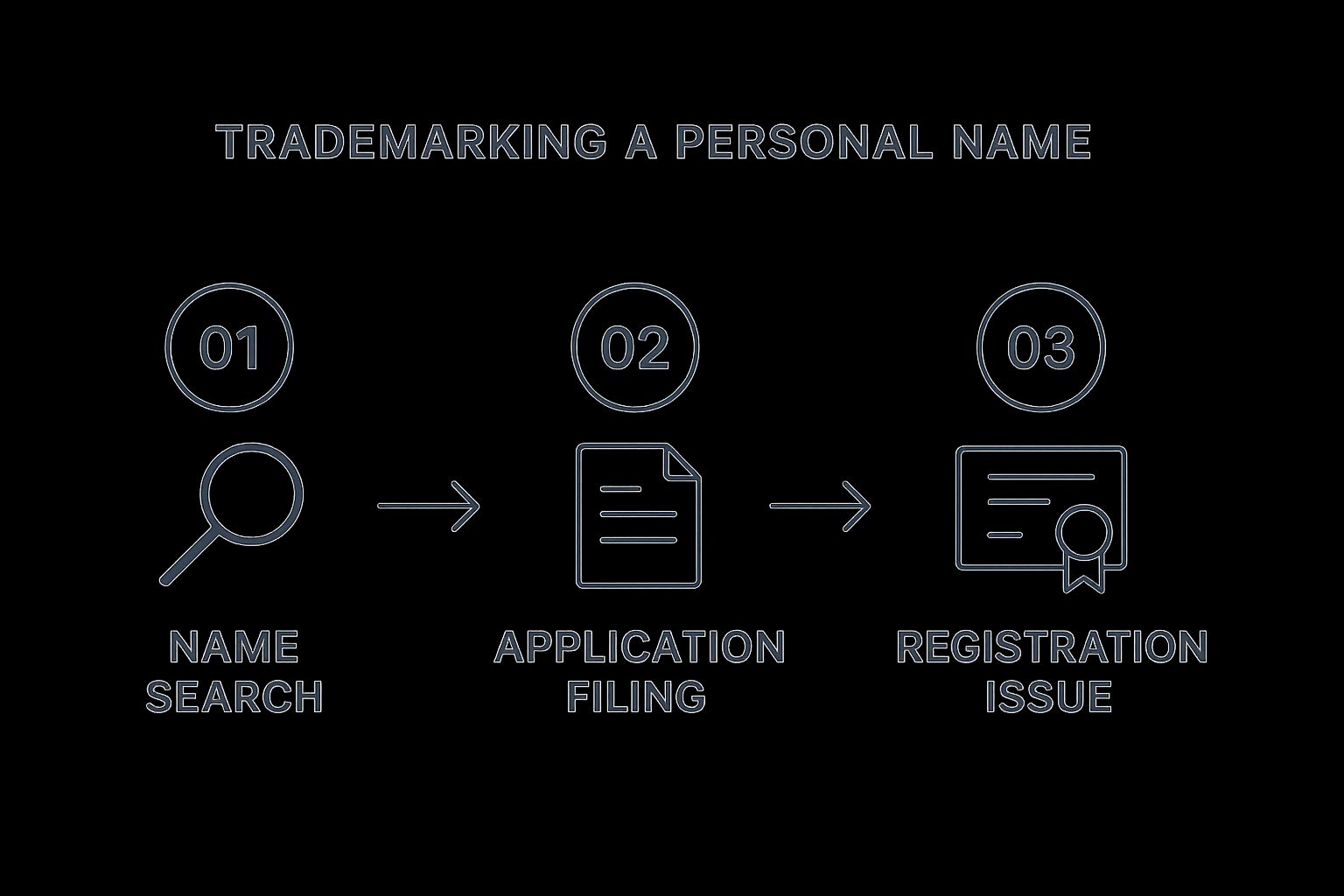
Each stage builds on the one before it, from getting the initial clearance to finally getting that registration certificate. For artists and creators, the specimen is especially critical; our guide on how to trademark an artist name digs into more specific advice on this.
Filing And Responding
With your search done and specimen in hand, you can file your application through the USPTO’s online system. You’ll need to correctly identify the specific "class" of goods or services your name covers. Then, be prepared to wait. An examiner will review your file, and that can take several months.
If the examiner bumps into an issue, you’ll get what's called an "Office Action." Don't panic—this isn't a final rejection. It's a request for more info or an explanation of why they think there’s a problem. You’ll have a specific amount of time to respond and argue your case.
Key Takeaway: The trademark process is a marathon, not a sprint. Doing your homework up front, from a thorough search to having a strong specimen, is the best thing you can do to make the whole process smoother and more successful.
And this isn't just a U.S. thing; the drive to protect personal brands is exploding globally. A recent analysis showed that Mainland China filed a staggering 6.76 million trademark applications, dwarfing the U.S. total of around 566,938. This just goes to show a worldwide trend of people locking down their brand identities in an increasingly crowded market. .
Common Mistakes That Can Derail Your Application
Navigating the trademark application process can feel like a minefield. The good news is that most rejections I see stem from a few common, totally avoidable mistakes. Knowing what these pitfalls are ahead of time saves you a ton of time, money, and frustration down the road.

One of the biggest blunders is filing for a name that the USPTO considers "merely a surname." If you're trying to trademark just your last name—think "Smith" for a line of clothing—it's almost guaranteed to be denied. Why? Because you have to prove it has gained "secondary meaning" in the marketplace, showing the public directly connects that name with your specific products or services.
Another frequent error is doing a lazy or incomplete trademark search. A quick Google search just isn't going to cut it. If you move forward without a deep dive into the federal database and end up stepping on an existing trademark, your application is dead on arrival. It's a waste of time and money.
Ignoring Famous Names and False Connections
This is a particularly sensitive area. Trying to trademark something like "Taylor Swift's Guitar Picks" would be rejected in a heartbeat. The USPTO is very protective against any name that might falsely suggest a connection, endorsement, or sponsorship with a well-known person.
The whole point is to prevent the public from being tricked into thinking a celebrity is behind your product when they have nothing to do with it. You always have to ask yourself: could my chosen name create a false association in a customer's mind?
Even if your intentions are innocent, the legal test is whether the public is likely to be confused or deceived. The fame of the person and the commercial impression of your mark are key factors in this decision.
Finally, a simple but critical mistake is providing a weak or improper specimen. This is your real-world proof that you're actually using the name in commerce. It's not a concept; it's evidence.
Here's what not to submit:
- Business Cards or Letterhead: These just show your business exists. They don't prove the name is being used on a product for sale.
- Internal Memos or Invoices: These aren't public-facing and fail to demonstrate use in the marketplace.
- A Mockup of a Future Product: The use has to be real and current, not just an idea you have for the future.
Steering clear of these specific errors dramatically improves your chances. Thinking about can you trademark your name really means planning ahead to avoid these common roadblocks.
Your Top Questions About Name Trademarks, Answered
When you're trying to trademark your own name, things can get confusing fast. The whole process feels personal, and the stakes are definitely high. Let's clear up some of the most common questions people have when they ask, "can I really trademark my name?"
Think of this as your straightforward guide to getting more confident about protecting your brand.
How Much Is This Going To Cost?
The final price tag is a mix of government fees and, if you hire one, lawyer fees. The basic filing fee with the USPTO (using their TEAS Plus system) will usually run you a few hundred dollars for each class of goods or services you're claiming. But that's just the starting point.
I always recommend hiring a trademark attorney. They'll do a deep dive to see if your name is even available and help you navigate the tricky application process. Legal fees can range from a few hundred to several thousand dollars, depending on how complicated your situation is. It's best to think of this as a critical, long-term investment in your brand's future.
Can I Trademark My Name If Someone Else Already Has It?
Yes, it's actually possible. It all boils down to one key question: is your use of the name likely to confuse customers in the marketplace?
Let's say you want to trademark 'Alex Chen' for your new tech podcast. If another 'Alex Chen' already has a trademark for a local bakery, you're probably in the clear. The USPTO looks at a few key things to decide:
- How similar are the names themselves?
- How closely related are the products or services?
- Are you marketing to the same people through the same channels?
If your businesses operate in totally different worlds, you've got a strong argument for getting your own registration.
The whole point of trademark law is to protect consumers. As long as the public won't get the two of you mixed up, two brands with the same name can often exist side-by-side with registered trademarks.
What's The Difference Between The TM and R Symbols?
This is a big one, and using them correctly is crucial. These symbols signal very different legal statuses.
You can start using the â„¢ symbol the minute you start using your name in business. It's basically a public heads-up that you're claiming that name as your brand, even if you haven't filed any paperwork yet. Think of it as putting a "dibs" on your name.
The ® symbol, on the other hand, is the real deal. It's legally protected and you can only use it after the USPTO has officially approved and registered your trademark. Slapping the ® on your name without a federal registration is actually against the law. This little symbol gives you much stronger legal protection across the entire country.
Navigating the world of intellectual property is one of the most important things you can do to build a lasting brand. At Cordero Law, we specialize in helping entrepreneurs and creatives protect what's theirs. If you're ready to secure your name and build your business on a solid legal foundation, we're here to help. Learn how we can help protect your brand today.