
Think of writing a business contract less like a legal chore and more like creating a detailed roadmap everyone agrees on before the journey starts. It's about getting all the key details down on paper: who's involved, what the exact scope of work is, how payments will be handled, and what happens if things don't go as planned.
Why an Ironclad Contract Is Your Best Business Tool

Before we get into the how, let's talk about the why. A well-written contract isn't just a stuffy formality; it's the very foundation of a solid professional relationship. It鈥檚 what takes your agreement from a simple handshake to something legally real and enforceable.
We've all heard the horror stories. That freelance project spiraling out of control with "scope creep," where the client keeps tacking on new tasks without bumping up the budget. Or a business partnership that sours because nobody bothered to define roles and responsibilities from day one. These common business nightmares? A clear, upfront agreement can prevent most of them.
A Roadmap for Success and a Safety Net for Disputes
At its core, a contract is a mutual roadmap. It's your way of making sure everyone is on the exact same page about deliverables, timelines, and compensation. This proactive clarity is your first and best line of defense against the kind of misunderstandings that can poison relationships and tank projects.
But it's more than just a guide. A strong contract is also your safety net. It gives you a pre-agreed process for what to do when things inevitably go sideways.
"A contract is proactive communication. It forces you to have the tough conversations upfront, which is far easier than having them when a conflict has already started."
Trust me, this foresight will save you an incredible amount of time, money, and stress down the line. It isn't about mistrust; it's about building a foundation of professional respect and clarity.
The Foundation of Modern Business
Contracts aren't just for big corporations. They're the engine of modern commerce, governing a huge slice of business activity. Industry estimates show that somewhere between 60% and 80% of all B2B transactions are managed through contracts.
Yet, despite their importance, a shocking number of businesses feel their contract processes are a mess. This points to a huge gap between what's needed and what's actually being done. If you're looking to get ahead of the curve, it's worth exploring some contract management best practices.
Learning how to write a solid business contract is a fundamental skill. It empowers you to:
- Set Clear Expectations: Define exactly what will be done, by when, and for how much. No more guessing games.
- Minimize Risk: Protect your business from financial hits, liability issues, and nasty disputes.
- Build Trust: Show clients and partners you're a professional who is organized and serious about their commitments.
- Ensure Enforceability: Create a document that gives you actual legal recourse if the other party doesn't hold up their end of the deal.
Setting the Stage Before You Start Writing

Jumping straight into a contract template without a clear plan is like trying to build a house without a blueprint. Sure, you might end up with something that stands, but it won't be the solid, reliable structure you and the other party actually need. I've seen it time and time again: the best agreements come from critical conversations that happen long before anyone types a single word.
Think of this pre-drafting stage as your investigative phase. Your goal is to get so clear on the nuts and bolts of the deal that the contract practically writes itself, perfectly reflecting the unique arrangement you鈥檝e made. A generic, copy-and-pasted form just can't do that.
Laying this groundwork ensures every clause you eventually include has a real purpose, tied directly to a conversation you've already had. It kills assumptions from the get-go and sets a much more collaborative tone for the whole relationship.
Laying the Foundation with Key Questions
Before you can write a solid business contract, you have to know what questions to ask. The quality of your final document is a direct result of the quality of the information you gather upfront.
Start by mapping out the absolute core of your deal. Having a simple framework for these initial talks helps you gather every necessary piece of the puzzle so nothing gets missed.
Your pre-drafting checklist should hit these key points:
- Project Goals: What does a "win" look like for everybody involved? Get super specific about the desired outcome, not just the list of tasks.
- Key Stakeholders: Who actually has the final say? Pinpoint the people with the legal authority to sign off on the contract to avoid frustrating delays later.
- Core Deliverables: What, exactly, is being delivered? Make a detailed list to crush any ambiguity about the scope of work.
- Firm Deadlines: Are there critical dates or milestones? Map out a realistic timeline with specific dates for each major phase.
- Payment Structure: How and when will money change hands? Nail down whether it鈥檚 a flat fee, an hourly rate, or milestone-based payments, and clarify the invoicing process.
Having these conversations upfront might feel a bit meticulous, but trust me, it's the single best way to head off future disputes. A little clarity now is far cheaper and less stressful than a legal battle later.
Turning Conversation into a Concrete Plan
Once you've had these discussions, get your notes organized into a clear outline. This doesn't need to be a formal legal document; it's just a summary of all the points you've agreed on. For example, a freelance designer might create a simple table outlining 3 design concepts, 2 rounds of revisions, and final file delivery by a specific date.
This outline becomes your north star when you start the actual writing process. It makes sure the legal language you choose is anchored to the real-world, practical agreement you and the other party have shaken hands on. By doing this homework first, you shift from just filling in a generic template to crafting a bespoke contract that genuinely protects your interests and helps build a great business relationship.
Building Your Contract Clause by Clause
Alright, now for the main event鈥攁ctually putting the contract together. I like to think of it like building with Legos; each clause is a different block with a specific purpose. They all need to click together just right to create something strong and stable that won't fall apart under pressure.
Let's cut through the intimidating legal jargon for a minute. The real key is understanding what each of these essential clauses does and why you absolutely need it. When you get the "why," the document transforms from a stuffy list of rules into a practical roadmap for your entire business relationship.
This simple infographic breaks down the core steps.
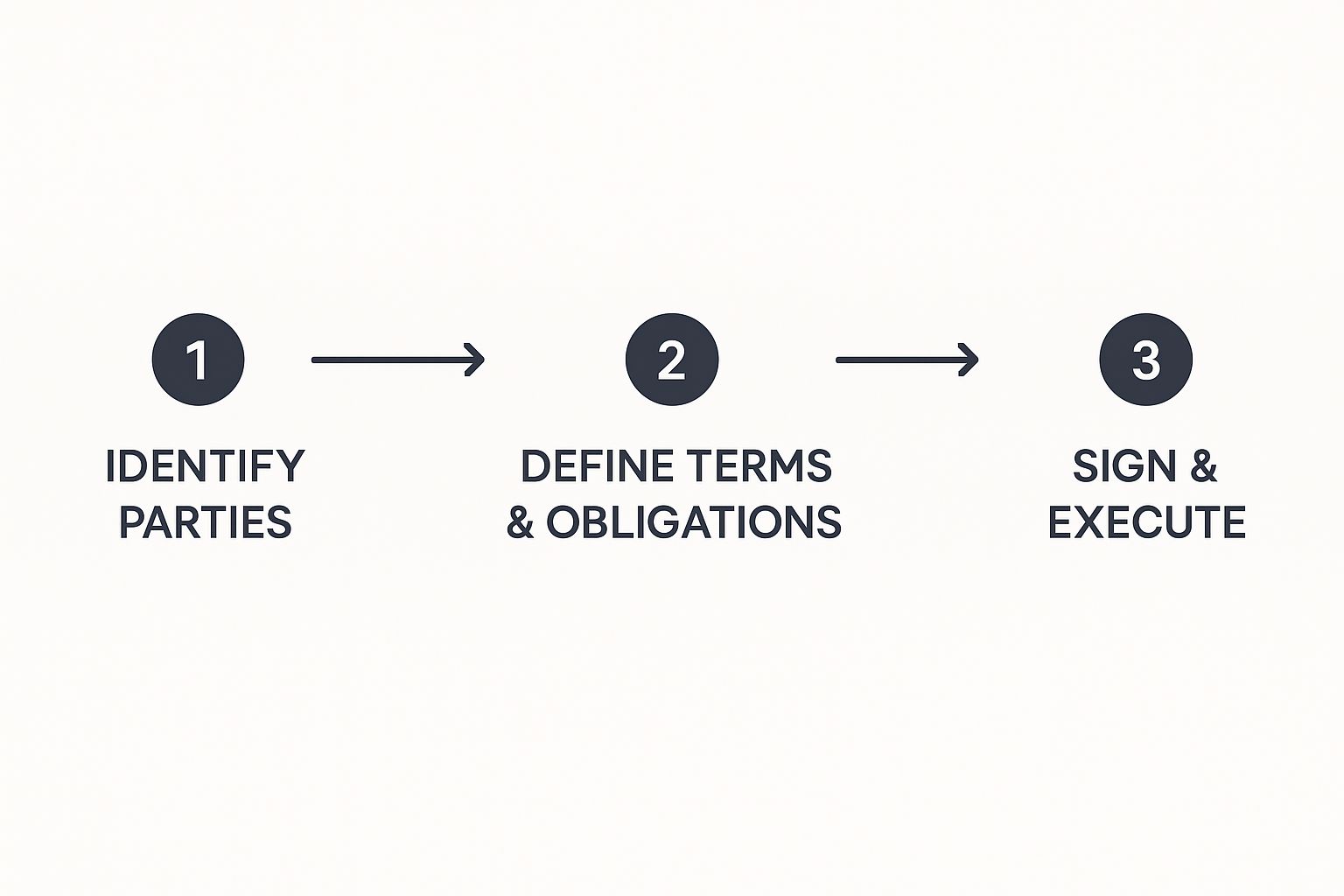
As you can see, everything starts with identifying who's who before you even get into the nitty-gritty of what everyone has to do.
Defining the Scope of Work
This is, without a doubt, the most important clause in any service-based agreement. The Scope of Work (SOW) is where you get hyper-specific about what you will and, just as importantly, will not do. Any ambiguity here is a wide-open invitation for scope creep.
Don't just say, "The designer will create a new website." That's asking for trouble. Get granular. A solid SOW looks more like this:
- Design and deliver a 5-page responsive WordPress website.
- Pages include: 91吃瓜网, About, Services, Blog, and Contact.
- Includes two rounds of revisions on the initial design mockups.
- Excludes: copywriting, logo design, and ongoing website maintenance.
See the difference? This level of detail leaves zero room for misinterpretation. The client knows precisely what they鈥檙e getting, and you're protected from those endless "just one more thing" requests. When bringing on freelancers, looking at a well-drafted can be a great model for this kind of specificity.
Nailing Down Payment Terms
Getting paid is kind of the whole point, right? This clause makes sure there's a clear process for it. Don't just list the total fee; map out the entire payment lifecycle. You've got a few common options:
- Net-30/Net-60: This is standard in many industries, but it can be brutal on cash flow for smaller businesses. You do the work and then cross your fingers for 30 or 60 days.
- Milestone Payments: This is my go-to for longer projects. You get paid in chunks as you hit specific stages (e.g., 25% on signing, 50% on first draft delivery, 25% on project completion).
- Retainer: An excellent model for ongoing work. The client pays a set fee each month to keep you on call, giving you predictable income and them guaranteed access to your expertise.
Pro Tip: Always specify how you want to be paid (bank transfer, credit card, etc.) and what the penalty is for late payments. A simple late fee of 1.5% per month is often enough to motivate clients to pay on time.
Protecting Your Information and Ideas
Okay, let's talk about the essentials that protect everyone's assets. A solid contract will always have clauses for Confidentiality and Intellectual Property (IP). These aren't just boilerplate; they have real teeth.
To help you get a clear picture, here鈥檚 a quick breakdown of some of the most critical clauses you'll want to include.
Key Contract Clauses and Their Purpose
| Clause | What It Does | Why It's Important |
|---|---|---|
| Scope of Work (SOW) | Clearly defines all deliverables, services, and tasks to be completed. | Prevents "scope creep" and ensures both parties have the same expectations. |
| Payment Terms | Outlines the cost, payment schedule, methods, and late fee penalties. | Ensures you get paid on time and avoids awkward financial conversations later. |
| Confidentiality | Prevents either party from sharing sensitive business information. | Protects your trade secrets, client lists, and proprietary processes. |
| Intellectual Property | Determines who owns the final work product and under what conditions. | Clarifies ownership of creative work, code, or other assets created. |
| Termination | Spells out the conditions under which the contract can be legally ended. | Provides a clear, professional exit strategy if the relationship sours. |
Each of these clauses serves as a pillar holding up your agreement. The Confidentiality clause is your shield, preventing the other party from blabbing about sensitive info they learn while working with you. The IP clause is your title deed, clarifying who owns the final work product. For a freelance writer, this might state the client owns the article only after final payment. For a deeper look at how these are worded in different situations, you can check out more contract clause examples.
Finally, every good contract needs an escape hatch. The Termination Clause outlines exactly how and why the agreement can be ended by either person鈥攚hether it's for a major screw-up (breach of contract) or simply with a 30-day written notice for any reason. This gives you a clean way to part ways if things just aren't working out.
Future-Proofing Your Agreements for Uncertainty

A decent contract works the day you sign it. A truly great one, however, is built to withstand whatever comes next. The reality is that we're operating in a world full of supply chain nightmares, sudden economic pivots, and other surprises that can derail a deal in an instant.
The key is to think past the ink drying on the page and anticipate the roadblocks that might pop up down the line. This isn鈥檛 about being pessimistic; it's about being strategic. Geopolitical tensions and shifting global policies mean a well-drafted agreement is more than just a document鈥攊t鈥檚 one of your most critical tools for risk mitigation. You can read more about these .
This all boils down to shifting from a reactive to a proactive mindset when you sit down to draft a contract.
Modernizing the Force Majeure Clause
You鈥檝e probably seen the force majeure clause buried somewhere in a contract. It's the "act of God" section that covers things like hurricanes and earthquakes. For a long time, this was just standard boilerplate language. Not anymore. Today's world demands a much broader, more realistic definition of what can go wrong.
Think beyond natural disasters. It's time to get specific about the real-world crises that could affect your business:
- Pandemics and Public Health Crises: A lesson many of us learned the hard way since 2020.
- Major Supply Chain Failures: What happens if a critical supplier suddenly goes belly-up? Spell it out.
- Significant Government Actions or Sanctions: Absolutely essential if you鈥檙e doing any kind of international business.
By beefing up this clause, you're creating a clear game plan for pausing or even ending the agreement if a truly unforeseeable event makes it impossible to continue. Having that clarity ahead of time is the bedrock of solid contract risk management.
Simply relying on generic "act of God" language is no longer enough. A modern force majeure clause should explicitly name the types of disruptions that could realistically impact your project, providing a clear and actionable path forward when chaos hits.
Specifying Governing Law and Jurisdiction
I know, this part sounds like boring legal jargon, but trust me, it鈥檚 non-negotiable鈥攅specially if your partners or clients are in different states or countries. The Governing Law clause simply answers the question: "Which state's or country's laws will we use to interpret this contract?"
Right alongside it, the Jurisdiction clause decides where any potential lawsuit would have to be filed. Without these two pieces, a simple disagreement could mushroom into an incredibly expensive and confusing legal battle fought on unfamiliar turf. Nailing this down upfront can save you a world of headaches later on.
Reviewing and Finalizing Your Contract
Getting the first draft done feels like a huge win, but don't pop the champagne just yet. The final phase鈥攔eviewing, negotiating, and signing鈥攊s where a good draft becomes an ironclad agreement. This is your last chance to catch small mistakes before they can turn into massive headaches.
Treat this stage with the seriousness it deserves. Rushing to get a signature is a classic mistake that can undo all your hard work. Think of it as proofreading a critical email, but with much, much higher stakes.
The Art of the Self-Audit
Before you even think about sending the contract to the other party, you need to put on your most critical hat and review your own work. It's amazing what a fresh pair of eyes can find. I always recommend stepping away from the document for at least a few hours, if not a full day, before diving back in.
When you do, read it from the perspective of someone trying to find a loophole. Ask yourself these tough questions:
- Is there any vague language? Words like "reasonable," "timely," or "sufficient" are a recipe for disaster. Get specific. Replace them with hard numbers, dates, and metrics.
- Do all the sections line up? Double-check that the payment terms actually match the deliverables in the Scope of Work. Little inconsistencies create confusion and open the door for disputes.
- What's missing? Go back to your initial notes from your discussions. Did every single point you agreed upon make it into the final document?
This self-audit is your first and most important line of defense. It helps you send over a professional, well-thought-out document that sets a positive, competent tone for the final negotiations. For a solid reference point, you can compare your draft against a basic contract template for services to see if you鈥檝e missed any standard clauses.
Navigating Negotiations Like a Pro
It's extremely rare for a contract to be signed without any requested changes. When the other party comes back with redlines or questions, don't take it personally. This is a normal鈥攁nd frankly, healthy鈥攑art of the process. It shows they're taking the agreement just as seriously as you are.
The key to a successful negotiation is to understand the "why" behind their request. Are they worried about the payment schedule? Do they need more clarity on who owns the intellectual property?
Approach negotiations with a collaborative mindset. The goal isn't to "win" but to reach a mutual agreement that both parties feel good about. A contract that feels one-sided is often the first one to be challenged in court.
Listen to their concerns, calmly explain your reasoning, and always look for a middle ground. Often, a simple clarification or a minor tweak is all it takes to get everyone comfortable and ready to move forward.
Making It Official The Right Way
Once all the terms are agreed upon, it鈥檚 time to get it signed. In today's world, digital signatures are widely accepted and legally binding for most agreements, thanks to laws like the federal E-Sign Act. Platforms like or provide a secure and verifiable way to get this done efficiently.
After it's signed, don't just file it away and forget about it. Securely store the final, executed copy in a place where both you and any key members of your team can easily access it. A shared cloud folder is perfect for this. This final step is what makes all your hard work pay off, creating an enforceable agreement that truly protects your business.
The Most Common Questions I Get About Writing Contracts
When you're knee-deep in a deal, a lot of tricky questions can pop up about the contract itself. It's totally normal. Here are some of the most frequent questions I see, with straightforward answers to help you cut through the confusion.
One of the first things that comes up, especially for entrepreneurs, is the cost. What if you just can't afford a lawyer right now? While I'll always say an attorney is the safest bet, you're not completely stuck. High-quality templates from reputable legal sites can serve as a starting point, but you absolutely have to customize them for your specific situation. Just know the risks and think of it as a temporary fix.
Another big one I hear all the time is about digital signatures. Are they actually legit?
Are Digital Signatures Legally Binding?
Yes, in most places, they absolutely are. Thanks to laws like the E-Sign Act here in the United States, electronic signatures carry the same legal weight as a good old-fashioned ink signature.
To make sure your e-signature holds up, just follow a few best practices:
- Use a Reputable Service: Stick with well-known platforms like or . They provide a secure, verifiable audit trail showing who signed, when, and where.
- Confirm Intent: The signing process should make it crystal clear that the person clicking "sign" intends to be legally bound by the terms in the document.
- Keep Your Records: Always save the final, executed copy along with the signature certificate the service provides. Store it somewhere safe.
Using digital signatures makes finalizing agreements so much faster and more efficient, and you don't have to sacrifice any legal validity to do it.
What if We Need to Change a Signed Contract?
This happens way more than you'd think. Business needs pivot, project scopes expand, and suddenly the original terms don't quite fit anymore. So what do you do when someone wants to change a contract that's already signed? You definitely can't just scribble on the original or shake on a change over the phone.
A signed contract is a legally binding document. To make any changes, you need to do it formally with a written "amendment" or "addendum" that is signed by both parties. This creates a clear, official record of the new agreement.
Let's say a client wants to add another deliverable to a project you're working on. You'd draft a simple amendment. It should clearly reference the original contract's date, spell out the new terms (like the extra deliverable and the additional payment), and include a sentence confirming that all other terms of the original agreement are still in full effect.
This formal process protects everyone involved and keeps your agreement solid and enforceable, no matter what new directions your project takes.
Navigating the world of business agreements can feel overwhelming, but you don't have to go it alone. At Cordero Law, we specialize in providing clear, strategic legal counsel to entrepreneurs and creatives just like you. Schedule a consultation with us today to make sure your contracts are built to protect both your vision and your business.