
Ever wonder who makes sure your favorite musician actually gets paid when their song hits the charts? Or who navigates the legal maze so a blockbuster movie can be made without getting sued? That’s entertainment law in action.
It's not some standalone legal field, but a unique blend of contract, intellectual property, and business law, all tailored specifically for the creative industries.
A Practical Guide to Entertainment Law

Think of an entertainment lawyer as the producer of the legal world. They're the ones managing all the critical behind-the-scenes pieces—like contracts, rights negotiations, and payment structures—that allow a creative vision to come to life and succeed commercially. It's the essential framework that protects both the art and the artist.
At its core, entertainment law is a specialized service. It takes established legal principles and applies them to the very specific, often unusual, scenarios you find in creative fields. Instead of dealing with typical business assets like inventory, it governs intangible, yet incredibly valuable, assets: a songwriter’s melody, a screenwriter’s script, or a performer’s public image.
More Than Just Contracts
While contracts are a huge part of the job, the practice is way more diverse than just paperwork. It touches every single stage of a creative project, from the initial spark of an idea all the way to global distribution.
This includes things like:
- Securing Rights: Making sure a film production has the legal green light to use a specific song in a scene or to adapt a best-selling novel.
- Protecting Creations: Formally copyrighting a musician's album to prevent theft or trademarking a band's name and logo so no one else can use it.
- Structuring Deals: Negotiating fair and clear terms for a YouTuber's brand partnership or an author's publishing deal.
This field is crucial because the entertainment industry is a massive economic engine. The global market is projected to be worth around $2.8 trillion in 2025, with North America leading the charge at about 39.3% of that share. This just goes to show how much financial and creative work is riding on a solid legal foundation. You can dig into more of the numbers in this .
For a quick breakdown, here’s a simple table that shows how different legal areas apply directly to the entertainment world.
Entertainment Law At a Glance
This table offers a quick summary of the core functions of entertainment law, helping you grasp the main concepts immediately.
| Core Legal Area | What It Protects | Example in Entertainment |
|---|---|---|
| Contract Law | Agreements and Obligations | An actor's multi-film deal with a studio or a band's recording contract with a label. |
| Intellectual Property | Creative Works and Brand Identity | Copyrighting song lyrics and compositions; trademarking a movie title or logo. |
| Business Law | Company Structure and Operations | Setting up a production company as an LLC or negotiating financing for a new film. |
| Right of Publicity | A Person's Name and Likeness | Managing an athlete’s endorsement deals or an actor’s use in advertising. |
Essentially, each of these areas works together to build a protective shield around creative work and the people who make it.
Simply put, entertainment law is the legal backbone that allows creatives to build sustainable careers. It transforms artistic passion into a protected, profitable profession by ensuring everyone's rights and responsibilities are clearly defined from the start.
Ultimately, this legal specialty empowers creators, giving them the confidence and security they need to share their work with the world.
The Four Pillars of Entertainment Law
To really get what entertainment law is all about, it helps to break it down. Think of it like building a house for your creative career; you need a solid foundation and strong support beams to make sure everything stands up to the pressures of the industry. In the creative world, these supports are the four pillars of entertainment law.
Each one protects a different, vital aspect of your work. They all work together, creating a legal framework that makes sure your art is not only protected but can also make you money. It's how you turn a great idea into a real, defensible asset.
Pillar 1: Contracts and Agreements
At the absolute heart of the entertainment business, you'll find contracts. These aren't just paperwork; they're the legally binding blueprints for every single project. They spell out the who, what, when, and—most importantly—how much of any creative deal. A good contract makes sure everyone is on the same page and that promises are actually kept.
A classic example is a band signing their first record deal. That contract will lay out everything from album delivery dates and royalty splits to marketing promises and tour support. Without a crystal-clear, properly negotiated contract, that dream opportunity can turn into a legal nightmare real fast. Getting these agreements right is critical, and you can dive deeper into the key clauses in our guide to contracts for entertainment professionals.
Pillar 2: Intellectual Property
If contracts are the blueprint, then intellectual property (IP) is the actual property—the thing you've created that has value. IP law is what protects the intangible products of your mind, giving you ownership over your ideas once they're in a fixed form. For any creator, this is arguably the most important pillar of them all.
There are two main types of IP protection you need to know:
- Copyright: This is your shield for original creative works. We’re talking about a song's lyrics and melody, a finished screenplay, or a published book. It grants you the exclusive rights to copy, sell, and perform your work.
- Trademark: This protects the things that identify your brand—symbols, names, and slogans. Think of a band's logo or a movie's iconic title font. Trademarking these assets stops other people from using them.
By locking down your IP, you get to control how your work gets used and, crucially, you ensure you're the one who profits from it.
A creator's intellectual property is their primary currency. Protecting it is not just a legal formality; it is the fundamental step in building a sustainable career and lasting legacy in the entertainment industry.
Pillar 3: Business Structures
As your career starts to take off, so does the need to get organized. This pillar is all about setting up the right legal entity to manage your income, expenses, and liability. Just operating as an individual freelancer exposes you to some serious personal financial risk if a project goes south.
Forming a business entity, like a Limited Liability Company (LLC) or an S-Corporation, builds a legal wall between your personal life and your creative business. This is huge. It means your personal assets (like your house or car) are protected from business-related debts or lawsuits. It also opens up tax advantages and gives you a professional way to manage finances, hire people, and sign bigger deals.
Pillar 4: Publicity and Privacy Rights
This final pillar is all about protecting your public identity. Your Right of Publicity is the right to control how your name, image, and likeness (NIL) are used for commercial purposes. In plain English, it means someone can't just slap your photo on a t-shirt or use your name in an ad without your permission—and without paying you for it.
On the flip side, privacy rights protect you from unlawful snooping into your personal life. These laws help artists draw a line between their public persona and their private world. Knowing how to defend these rights is key to managing your personal brand and reputation.
This infographic breaks down the different professional roles that help manage all these legal and business pillars.
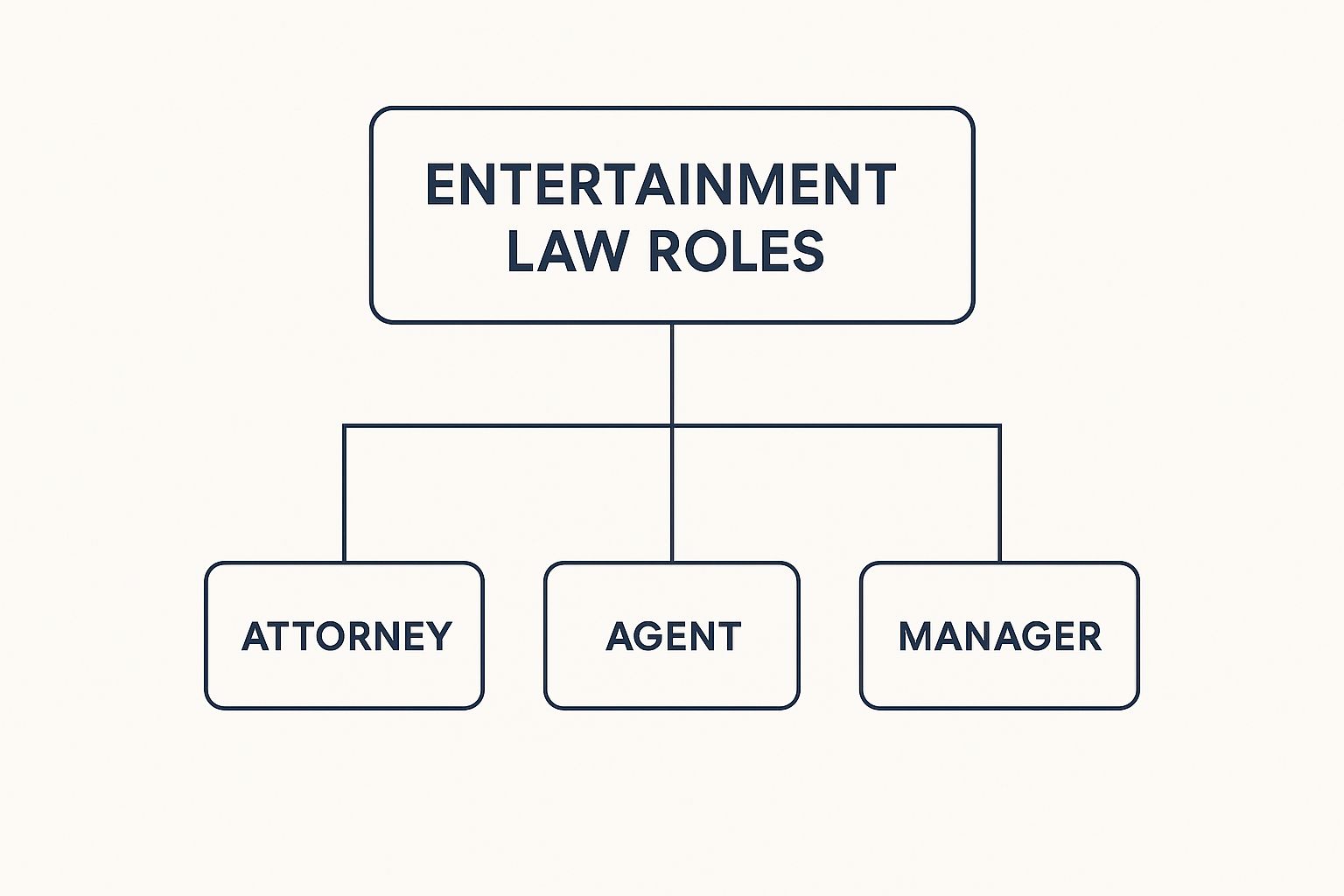
As you can see, an attorney, agent, and manager form a core team, with each person handling a different piece of the puzzle, from negotiating contracts to landing gigs.
When Do You Need an Entertainment Lawyer?
Knowing what entertainment law is becomes truly powerful when you know when to actually use it. A lot of creators make the mistake of waiting until a problem blows up. But the best time to get legal advice is the moment a real opportunity lands on your desk.
Bringing a lawyer in isn't a sign of trouble; it's a strategic move. It means you're building your career on a solid foundation, not just hoping for the best.
Think of it this way: you wouldn't build a house without a blueprint. An entertainment lawyer drafts that blueprint for your deals, making sure every part is constructed properly right from the start. This proactive approach is what helps you sidestep costly mistakes and lock in your long-term success.
When Opportunity Knocks
The second a casual chat turns into a formal offer with a contract attached—that's your cue. That’s the time to call for legal backup. Signing an agreement without a lawyer reviewing it is one of the biggest gambles a creative can take.
Here are a few moments when getting legal counsel isn't just a good idea, it's essential:
- Signing Your First Big Contract: That record deal, publishing agreement, or production contract? It's going to define your rights and your paycheck for years.
- Negotiating A Brand Deal: A YouTuber landing a sponsorship needs to nail down the specifics on usage rights, payment schedules, and what’s expected of them to protect their channel and reputation.
- Securing Project Funding: An indie filmmaker raising money has to navigate some seriously complex financing agreements that dictate who owns what and how profits get split.
- Selling or Licensing Your Rights: An author selling film rights to their novel needs an expert to handle the option agreement, purchase price, and any future royalties.
In each of these situations, an entertainment lawyer’s job is to see past the immediate excitement of the deal. They dig into the long-term implications, fighting to make sure the contract protects your creative control, your money, and your future career options.
Beyond the Dotted Line
But legal guidance isn't just for the big, flashy deals. An expert can add massive value at all kinds of stages in your journey.
For instance, understanding the difference between a work-for-hire agreement and a licensing deal can mean the difference between owning your creation and giving that ownership away forever. Many of these agreements are packed with details that are easy to miss. Knowing correctly is a specialized skill that protects both the musician who made the track and the filmmaker using it.
A lawyer’s job is to translate that dense legal language into plain English you can actually use. They become your advocate, your negotiator, and your strategist, making sure you know exactly what you're signing. Learning more about what an entertainment lawyer does day-to-day can show you just how their skills become your advantage.
Ultimately, their help transforms a potentially risky situation into a secure milestone for your career.
Navigating the New Rules of Digital Entertainment

The entertainment industry doesn't run on physical media and traditional broadcast schedules anymore. Let's be real, it hasn't for a while. Today's world is all about streaming services, viral clips on social media, and content pushed by algorithms. This massive shift has created a whole new set of legal headaches that simply weren't a thing a decade ago.
For creatives, this new territory is both a huge opportunity and a massive risk. While digital platforms give you incredible access to a global audience, they also open up a can of worms when it comes to rights, royalties, and ownership. The law is still playing catch-up.
The Streaming Revolution and Its Legal Hurdles
The move to digital streaming has completely flipped the script on how we watch—and pay for—content. Global revenues from video-on-demand platforms shot past $165 billion in 2025, a crazy jump from just $56 billion in 2019. This explosion creates a ton of legal work, from managing the rights for massive content libraries to hammering out fair deals for international distribution.
This new model brings a few key challenges to the forefront:
- Geoblocking and Territorial Rights: How do you actually enforce a licensing deal that says a movie can only be shown in North America when the internet is, well, global? It's a real puzzle.
- Royalty Calculations: Streaming platforms use complex, often secret, algorithms to figure out what they owe creators. This makes it incredibly tough for artists to check the math and make sure they're being paid fairly.
- Content Piracy: As soon as your work is digital, it's a target for illegal distribution. Protecting its value requires constant legal effort and vigilance.
As these platforms get bigger and more powerful, it's crucial to understand the basics of making content in this new environment. For anyone curious about a deeper dive, it's helpful to know these days.
AI and the Future of Creative Ownership
Artificial intelligence is the latest curveball in entertainment law, and it’s raising some fundamental questions about what it even means to be an "author." Can a piece of art spit out by an AI be copyrighted? Who owns it—the person who typed in the prompt, the company that built the AI, or maybe no one at all?
The U.S. Copyright Office has been pretty clear that copyright protection is for works of human authorship. This means a work created entirely by an AI, without any creative human input, can't be copyrighted. This simple rule is already changing how creators are using these powerful new tools.
This legal gray area is a big deal for artists. If a musician uses an AI to generate a melody or a writer uses it to help draft a scene, the ownership of that final piece can get blurry, fast.
Knowing how to properly register your intellectual property has never been more important. For a clear breakdown, check out our guide on how to copyright your work and make sure your human creativity stays protected. These issues really highlight why having an expert in your corner is essential for anyone creating in today's entertainment world.
Real Benefits of Working with a Lawyer
Let's be real: hiring a lawyer can feel like a huge expense, especially when you're just starting out. But I've seen it time and time again—it's one of the smartest investments you can make in your creative future. This isn't about putting a roadblock in your process. It’s about bringing a strategic partner into your corner whose entire job is to protect your work, your money, and your career.
A good lawyer does way more than just glance at contracts. They're your advocate, your strategist, and your defender in an industry where the fine print can literally make or break you. They make sure your passion is built on a solid legal foundation, so you can get back to doing what you do best: creating.
Protecting Your Creative Vision
Picture this: a filmmaker pours years of their life into a passion project. They finally land a distribution deal, but they breeze past a few lines in the contract. Turns out, a poorly worded clause gives the studio the final cut. Just like that, the film’s powerful, nuanced ending gets swapped for something more “marketable.” Their artistic vision is gone.
This is exactly what an entertainment lawyer is there to prevent. They fight for clauses that lock in your creative control, making sure the final product is the one you intended to make. They are the guardians of your "why," ensuring your voice isn’t drowned out by the business side of things.
This applies to every creative field you can think of:
- Musicians: Making sure you own your master recordings and have the final say on how your music gets used in ads or films.
- Authors: Keeping creative input on the film adaptation of your novel, so your characters don't get completely changed.
- YouTubers: Controlling how a sponsor integrates their message without wrecking your channel's authentic vibe.
Securing the Compensation You Deserve
Here's a classic, tragic industry story I've heard variations of for years. A young songwriter signs their first publishing deal, completely stoked about the advance check. They skim the royalty clauses, not having a clue what "cross-collateralization" means. Fast forward a few years—their songs are major hits, but they've seen almost no money. Why? Because all their royalties are being used to pay back a bunch of unrelated label expenses.
A lawyer's job is to hunt down these financial traps. They dig into royalty statements, negotiate fair payment structures, and make sure you aren't signing away a lifetime of earnings for a small check upfront. They fight to get you paid what you're truly worth.
Avoiding Career-Ending Mistakes
Sometimes, the most valuable thing a lawyer does is tell you which deals to walk away from. In the excitement of a big opportunity, it's easy to miss the red flags they've been trained to spot—like an exclusivity clause that locks you up and prevents you from taking other gigs, or a contract with a ridiculously long term.
These pros provide the objective, clear-headed perspective you need when the stakes are high. By steering you away from just one bad deal, a lawyer can save your entire career from a disastrous setback. That kind of foresight is what separates a flash-in-the-pan success from a sustainable, lifelong career built on your own terms.
Your Questions About Entertainment Law Answered
Diving into the legal side of your creative career can feel like a maze. I get it. But getting straight answers to your questions is the first real step toward making smart, confident decisions that will shape your future. Let’s tackle some of the most common questions I hear from artists and entrepreneurs.
Getting clear on this stuff helps you protect your work, your money, and your peace of mind.
When Is the Right Time to Hire a Lawyer?
Honestly? The absolute best time to bring in an entertainment lawyer is before you sign anything important.
Think of it like this: you wouldn't start building a house without a solid blueprint. Getting legal advice the moment a real opportunity lands in your lap is the smartest move you can make. It’s about being proactive, not reactive, and it saves you a world of headaches down the road.
You should pick up the phone when a deal starts getting serious. I’m talking about moments like:
- You’ve been offered a record deal or a music distribution agreement.
- Someone wants to option the film rights to your book or script.
- A major brand wants to talk partnership or sponsorship.
- You're about to sign with a manager or an agent.
Hiring a lawyer early on isn't a sign of mistrust—it's a sign of professionalism. It almost always saves you a ton of money and stress in the long run by making sure your deals are structured correctly from the jump.
Can I Just Use an Online Contract Template?
I know it’s tempting. Online templates seem cheap and easy, but they come with some serious risks. Using a generic, one-size-fits-all template for a creative deal is like trying to open a custom-built lock with a key you bought at a gas station. It probably won’t fit right, and it definitely leaves you exposed.
Those cookie-cutter documents just don't have the industry-specific clauses you need to truly protect yourself. They can't possibly account for your unique situation, the specifics of your project, or the state laws that apply, leaving your creative work and your future earnings vulnerable.
What Is the Difference Between an Entertainment Lawyer and a General Business Lawyer?
A general business lawyer is great for standard corporate stuff, but the entertainment industry is its own world. It has its own language, its own customs, and its own unwritten rules. An entertainment lawyer brings that specialized, insider knowledge to the table.
Their expertise covers things a generalist might see once in a blue moon, like:
- Royalty Structures: Knowing exactly how income from streaming, sales, and licensing is supposed to be calculated and paid out.
- Talent Agreements: Writing and negotiating contracts for actors, directors, and artists with terms that are standard for the industry.
- Intellectual Property Norms: Understanding the common practices for protecting and licensing creative works in film, music, or publishing.
This isn't just a small difference; it's critical. You need someone who lives and breathes this stuff every day.
How Much Does an Entertainment Lawyer Cost?
Legal costs can definitely vary, but most entertainment attorneys work with a few common fee structures. The key is to find an arrangement that makes sense for you and what you need to get done.
Typically, you'll see one of three models:
- Hourly Rate: You pay for the time the lawyer spends working on your case. Simple as that.
- Flat Fee: A single, upfront price for a specific task, like reviewing one contract. You know the cost before they start.
- Percentage Basis: The lawyer takes a percentage (usually 5-10%) of a deal they helped you negotiate. This is pretty common for bigger deals where your lawyer is acting more like an agent or manager.
Always, always have a clear conversation about fees before any work begins. Transparency is everything. It ensures you understand the investment and can find a structure that fits your budget.
At Cordero Law, we believe legal advice should empower you, not intimidate you. We break down the complicated legal stuff into clear, actionable advice so you can make the best decisions for your creative career. Learn more about our approach and how we can help protect your vision.