
So, what exactly are mechanical royalties? Think of them as the fees paid out to a songwriter, composer, or publisher any time a copy of their music is made. This isn't just about old-school formats like physical vinyl records or CDs; it covers digital downloads and even every single interactive stream on platforms like .
Demystifying the Song's Blueprint
Picture a song’s core melody and lyrics as its architectural blueprint. In the music world, this blueprint is called the musical composition. A mechanical royalty is the payment owed to the blueprint's owner every single time someone reproduces it.
Years ago, this was pretty straightforward. If a record label wanted to press 10,000 vinyl records of a song, they owed the songwriter a mechanical royalty for each of those 10,000 copies. Simple.
Today, the principle is the same, but the "copies" are almost always digital. Every time someone buys your track from iTunes or streams it on-demand from a service like Apple Music, a temporary digital reproduction is created. And you guessed it—that triggers a mechanical royalty.
Composition vs. Master Recording
To really get a handle on mechanical royalties, you first have to understand the two separate copyrights that exist in every recorded song: the composition and the master recording.
A common point of confusion for new artists is thinking one copyright covers the entire song. In reality, the song you write and the track you record are two distinct pieces of intellectual property, each earning different types of royalties.
The composition is the song itself—the notes, melody, and lyrics. The master recording, on the other hand, is the specific recorded version of that song. Think of Whitney Houston’s iconic version of “I Will Always Love You.” That’s a master recording. But the original composition? That was written and is owned by Dolly Parton.
This distinction is everything because mechanical royalties are paid only for the use of the composition. Getting this difference is a foundational step in navigating the often-confusing world of music publishing. If you want to go deeper, you can explore this guide on the basics of music publishing explained for artists.
Let's break it down a bit further to make it crystal clear.
Composition vs Master Recording At a Glance
The table below lays out the key differences between these two fundamental copyrights. Understanding this is crucial for tracking down all the money your music earns.
| Copyright Type | What It Protects | Who Owns It | Royalty It Earns |
|---|---|---|---|
| Composition | The song's melody, lyrics, and musical arrangement (the "blueprint"). | Songwriter(s) and/or Music Publisher(s). | Mechanical Royalties, Performance Royalties. |
| Master Recording | A specific audio recording of a song (the "final product"). | Recording Artist(s) and/or Record Label(s). | Master Royalties, Digital Performance Royalties. |
In short, the composition is the idea, and the master is the finished audio file you hear. Mechanical royalties are tied directly to that original idea—the blueprint.
How Mechanical Royalties Actually Reach You
Knowing you're owed money is one thing. Understanding how it actually gets from a listener's earbuds into your bank account is another story entirely. The path a mechanical royalty takes can seem like a maze, but it follows a pretty clear trail managed by specific organizations built to make sure you get paid. Let’s follow the money.
So, let's say someone streams your song on Apple Music in the United States. That single stream is technically a "reproduction," which is the trigger for a mechanical royalty. At the end of every month, Apple Music crunches the numbers to figure out the total amount it owes in mechanical royalties based on its revenue and all the streams that happened on its platform.
They don't just start writing out individual checks to millions of different songwriters. That would be impossible. Instead, they bundle all that detailed usage data together and send one massive payment to a central collection society.
The Role of Collection Societies
You can think of a mechanical rights organization (or MRO) as a central sorting facility for all this royalty money. They're typically not-for-profit groups with a huge job: collecting all the royalties from digital service providers (DSPs), figuring out which songwriters and publishers to match them to, and then sending out the payments.
In the U.S., the main organization handling this is The Mechanical Licensing Collective (The MLC). The MLC was actually established by law to create a blanket license for streaming services, which makes it easier for them to pay for the music they use. The MLC collects those royalties and pays them out to publishers and self-administered songwriters.
The MLC is an indispensable piece of the modern music puzzle. Before it existed, billions (with a "b") in mechanical royalties from streaming services went unpaid simply because the DSPs couldn't figure out who the correct rights holders were for every single song. The MLC was created to solve that massive data headache.
Here’s a simple look at how the process works from start to finish:
- Music is Used: A fan streams your track, downloads it from a store, or even buys a physical copy like a vinyl record.
- Data is Reported: The platform (like Spotify) or the record label reports this usage data to the right collection society (like The MLC).
- Royalties are Collected: That service then pays the total mechanical royalties it owes over to the collection society.
- Funds are Distributed: The society takes that data, identifies you (or your publisher) as the correct rights holder, and pays out your cut.
This visual breaks down that simple journey from a song being played to you getting paid.
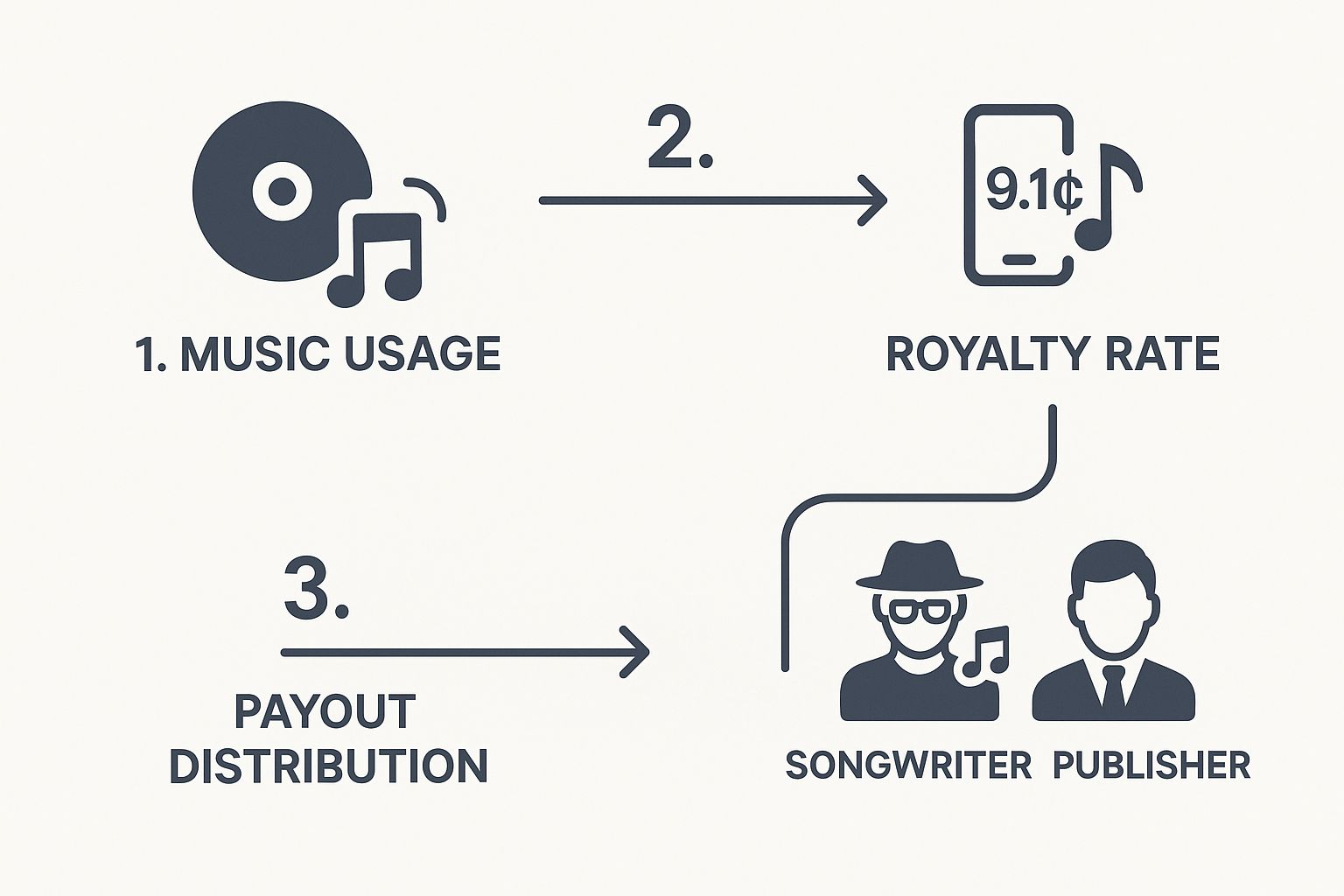
As you can see, every reproduction—whether it’s digital or physical—kicks off a chain reaction that's supposed to end with songwriters and publishers getting paid their fair share.
Getting Your Money
For this whole system to work, there's one critical step: your songs have to be properly registered. If The MLC doesn’t have the data telling them a song belongs to you, your royalties end up as "unclaimed." They'll hold onto that money until you or your publisher steps up to claim it. This is exactly why affiliating with the right organizations and making sure your song data is clean and accurate is so important.
The money flows from the user to the platform, from the platform to the collection society, and finally to your publisher, who then pays you. If you’re self-published, you’ll get both the songwriter's and the publisher's share of the money paid directly from the collection society.
How Your Royalty Checks Are Calculated Today

The way your mechanical royalties get calculated has shifted dramatically. Back in the day, the math was simple and predictable, tied directly to how many records you sold. Today, streaming has flipped the script, introducing a system that’s a lot more dynamic—and frankly, a lot more confusing for most songwriters.
Understanding this change is the first step to making sense of your royalty statements. The old model was built on a straightforward, legally mandated rate for every single unit sold.
The Old Model: Fixed Rates
For physical products like CDs and vinyl, and even for permanent digital downloads from places like iTunes, the calculation is refreshingly simple. A government body sets what’s called a statutory mechanical rate. It’s just a fixed fee paid for each copy that's made and sold.
In the United States, this rate has been a clear benchmark for years. The current statutory rate is 9.1 cents per copy for songs under five minutes long. If your song runs longer than that, the rate is 1.75 cents per minute.
Think about it this way: if a record label pressed 10,000 CDs with your song on it, they owed you (or your publisher) $910 in mechanical royalties. Simple, direct, and easy to track.
The New Model: Streaming's Revenue Share
Streaming, however, threw that entire fixed-rate model out the window. Platforms like Spotify and Apple Music don't pay a flat fee per stream for mechanicals. Instead, they use a complex revenue-sharing model.
Here’s a quick breakdown of how it works:
- Total Revenue Pool: Every month, a streaming service adds up all the money it made from subscriptions and ads.
- Royalty Allocation: They set aside a percentage of that total revenue for all the rights holders, which includes the mechanical royalty payments for songwriters and publishers.
- Pro-Rata Share: That big pool of money is then divided up based on your song's share of the total streams on the platform for that month.
The most important takeaway is this: a single stream does not have a fixed value. Its worth changes every single month based on the platform's total earnings and the total number of streams across the entire service.
This is why your earnings can jump up and down so much. For instance, a stream from a premium subscriber is worth more than one from a free, ad-supported user because they contribute more to that initial revenue pool. That’s just one of many moving parts that affect your final check.
This variability is exactly why it's so important to understand all your different income streams. To see how all these pieces fit together, check out our guide on how music royalties work.
Why Your Streaming Payouts Vary
Several factors can make your per-stream mechanical royalty rate change from one statement to the next, creating a financial picture that is much less predictable than the old physical sales model.
Keep these variables in mind:
- Listener's Subscription Type: A stream from someone paying a monthly fee will always generate more revenue than a stream from a free, ad-supported listener.
- Listener's Country: Payout rates are all over the map. They differ significantly from one country to another based on local subscription prices and ad markets.
- The Platform Itself: Every streaming service negotiates its own royalty rates. A stream on Apple Music might pay differently than one on Spotify.
At the end of the day, your streaming mechanical royalty check is your tiny slice of a massive, constantly shifting financial pie.
Understanding Mechanical vs Performance Royalties
This is probably the single most confusing part for artists trying to get paid, but it's essential to get it right. If you don't understand the difference between mechanical and performance royalties, you're absolutely leaving money on the table. So, let’s clear it up.
Think of your song as a book you wrote. A mechanical royalty is like the fee you get every single time a printing press churns out a physical copy of your book to sell. On the other hand, a performance royalty is the fee you earn when someone reads your book out loud to an audience. One is for making the copy, the other is for the public broadcast.
Here's where it gets interesting: when someone streams your track on a service like Spotify, both things happen at the same time. The service makes a temporary digital copy of the song on the listener's device (that’s your mechanical royalty) and it's publicly performed for that listener (that’s your performance royalty). Because two different rights are being used, you need two different types of organizations to collect your money.
Who Collects What for You
Since these are two completely distinct rights, they are managed by separate organizations. Getting this right is non-negotiable if you want to collect everything you're owed.
- Mechanical Royalties are handled by mechanical rights organizations (MROs). In the U.S., the big one for streaming is The Mechanical Licensing Collective (The MLC).
- Performance Royalties are collected by performing rights organizations (PROs), which you've probably heard of: ASCAP and BMI are the main players.
You have to be signed up with organizations in both camps to get paid for a single stream. A PRO like BMI has nothing to do with your mechanicals, and The MLC won't touch your performance royalties. They stay in their own lanes.
Understanding these distinctions is fundamental. It's not just about two royalty streams; it’s about recognizing that artists and labels also earn their own separate royalties from the master recording, collected by organizations like SoundExchange.
To really get a handle on how digital performance royalties work for the recording side of things, it's worth taking a minute to learn more about what SoundExchange does and why independent artists should join. This adds another piece to the puzzle, but it's a critical one for maximizing your income from digital radio and similar services.
Key Differences at a Glance
To make this totally clear, let's put it all in a simple table. This should help you visualize exactly what triggers each payment and who's responsible for getting that cash into your pocket.
Mechanical vs Performance Royalties Key Differences
| Feature | Mechanical Royalties | Performance Royalties |
|---|---|---|
| What Triggers It? | The reproduction of a song (streams, downloads, physical copies). | The public broadcast of a song (radio, TV, live venues, streams). |
| What It Pays For | The right to use the musical composition (the song's "blueprint"). | The right to publicly perform the musical composition. |
| Who Collects It (US) | The MLC, Harry Fox Agency (HFA). | ASCAP, BMI, SESAC, GMR. |
| Who Gets Paid | Songwriters and Music Publishers. | Songwriters and Music Publishers. |
Seeing it laid out like this really highlights how different these income streams are, even though they can be generated by the exact same action, like a stream on Apple Music. They're triggered differently, pay for different rights, and are collected by entirely separate entities. Your job as a creator is to make sure you're set up to collect both.
How Global Streaming Flipped Mechanical Royalties on Their Head
When platforms like Spotify and Amazon Music hit the scene, they didn't just change how we listen to music—they blew up the entire system for mechanical royalties. The old way of doing things, paying a set rate for every CD pressed or song downloaded, became a relic almost overnight. The whole financial model had to scramble to catch up with a world where music wasn't owned, but accessed.
This was a huge shift, and it created a massive headache. Instead of tracking a few thousand physical copies, the industry was suddenly dealing with billions of streams, generating trillions of tiny data points. The old way of doing things just couldn't keep up. A modern solution was needed, and fast, to make sure songwriters were getting paid for all this new activity.
A New Royalty Model Emerges
Streaming platforms don't pay a fixed fee per stream for mechanicals. We've moved into a revenue-sharing world. This means services pay mechanical royalties based on a percentage of their total revenue after they've covered certain costs. This complete overhaul changed how royalties are calculated and paid out across all the major music markets. You can get more insights on the differences in .
This new model ties your income directly to how well the platform is doing. As services like Spotify or Apple Music get more subscribers and pull in more ad revenue, the total pot of money available for songwriters gets bigger. So, your mechanical royalty for one single stream isn't a static number; it’s a tiny slice of a much larger, constantly fluctuating financial pie.
The MLC: A Modern Answer to a Modern Problem
To handle the insane complexity of paying out streaming mechanicals in the U.S., a new player entered the game: The Mechanical Licensing Collective (The MLC). The MLC was created by the Music Modernization Act of 2018 specifically to tackle the enormous job of collecting royalties from digital services and getting them to the right songwriters and publishers.
Think about it—before The MLC, countless mechanical royalties just sat there, unpaid. Why? Because streaming services often couldn't figure out who to pay. They had the usage data but couldn't connect it to the correct rights holders.
The MLC’s homepage gets right to the point, highlighting its mission to serve creators and make sure they get the money they've earned. It acts as the central hub for U.S. digital audio mechanicals, promising accuracy and transparency for its members.
By building a massive, comprehensive database of musical works and offering a single "blanket" license to streaming services, The MLC helps ensure that the money generated from all those streams actually finds its way back to the creators. It's a much cleaner and more transparent system built for the high-volume reality of the digital music age.
An Artist's Checklist to Collecting Your Royalties
Knowing what mechanical royalties are is one thing, but actually getting that money into your bank account is the real goal. It takes a few deliberate moves to turn that knowledge into income. This simple checklist breaks down the non-negotiable tasks every songwriter needs to tackle to make sure no money gets left on the table.
Think of it as setting up your music business for success. Just like a coffee shop needs a cash register to take payments, you need the right registrations in place to collect your earnings. Skipping these steps is one of the most common—and costly—mistakes an independent artist can make.
Register Your Compositions Correctly
Before anyone can pay you, the system has to know who you are and what you own. This is the bedrock for collecting not just mechanicals, but performance royalties too.
Join a Performing Rights Organization (PRO): First things first, you have to affiliate with a PRO like ASCAP or BMI. They’re the ones who collect your performance royalties, which are a separate—but equally important—income stream that runs alongside your mechanicals.
Register Every Single Song: Once you're a member, you have to register each and every one of your songs with your PRO. This means getting all the details right: songwriter splits, any alternate titles, and publisher info. If you don't do this, your PRO has no way to track your public performances and pay you for them.
Quick heads up: PROs only handle performance royalties. To get your U.S. streaming mechanicals, you'll need to link up with a different, more specialized organization.
Connect with Mechanical Collection Societies
Okay, this is where we get straight to the money this guide is all about. You need to make sure the organizations in charge of mechanical royalty payouts know your work exists. A huge part of any artist's checklist is getting a handle on their rights, especially as technology changes the game. We're already seeing situations with , which shows how crucial this is.
Sign Up with The Mechanical Licensing Collective (The MLC): If you're in the U.S., The MLC is your go-to. They are tasked with collecting and paying out mechanical royalties from streaming services. Registering your catalog with them is 100% free and absolutely essential if you want to get paid from platforms like Spotify and Apple Music.
Look into a Publishing Administrator: For a small cut, services like or CD Baby Pro will register your songs with collection societies all over the world. This is a game-changer for collecting global mechanical royalties, saving you a mountain of paperwork and ensuring you capture income from every territory where your music is played.
Quick Answers to Common Questions About Mechanical Royalties
Let's run through a few scenarios that pop up all the time for artists trying to get a handle on mechanical royalties. Think of this as the practical, real-world application of everything we've talked about so far.
Do I Earn Mechanicals on My Own Cover Song?
Yes and no. It’s a bit of a head-scratcher, but it makes sense once you break it down.
When you record and release a cover song, you’re creating your own unique sound recording (the master). You, as the performing artist, absolutely earn royalties from that master. But because you didn't write the underlying song—the composition—you actually owe mechanical royalties to the original songwriter and their publisher for the right to reproduce their work.
So, you'll be paying mechanicals out for using their composition, while collecting master royalties on your specific performance of it.
Who Pays Mechanicals for Physical Products?
When it comes to physical goods like vinyl, CDs, or cassettes, the responsibility for paying mechanical royalties falls squarely on whoever is manufacturing the product. Nine times out of ten, this is the record label.
The label figures out how many units they're pressing up—let's say 1,000 vinyl records—and pays the songwriters (or their publishers) the statutory mechanical rate for every single copy. This payment happens upfront, before a single record is sold.
Does YouTube Generate Mechanical Royalties?
Absolutely. YouTube is a huge source of mechanical royalties, even though it works a little differently than a traditional stream or sale.
Every time a video using your composition gets viewed, it can generate ad revenue. A slice of that revenue is paid out as a mechanical royalty, usually tracked and collected through YouTube's own system. This isn't just for your official music videos, either. It applies to fan-made videos, lyric videos, and even other people's covers of your song, which is why it's such a vital income stream to keep an eye on.
Trying to piece together the legal side of your music career can feel overwhelming. Cordero Law focuses on providing strategic advice to artists and creative entrepreneurs, making sure you not only understand your rights but can use them to build a sustainable career. Empower your music journey by learning more at .