
Ever heard the phrase "renting an idea"? That's a licensing agreement in a nutshell. It's a formal, legally binding contract that lets one person (the licensee) use the intellectual property of another (the licensor) in exchange for a fee.
You get to use someone else's creation under a specific set of rules without actually owning it, and the creator gets paid. It鈥檚 that simple.
Unpacking the Core Concept of a Licensing Agreement
At its heart, a licensing agreement is a powerful tool for teamwork and growth. It carves out a legal path for creators, inventors, and brand owners to make money from their assets without having to manage the entire production and sales circus themselves.
Let's say you've developed some groundbreaking software. Instead of trying to build a massive company from scratch to sell it, you could license it to a big, established tech firm. They take on the marketing and distribution, and you collect a percentage of the profits鈥攚hat we call royalties. It's a classic win-win.
Who Uses Licensing Agreements?
This legal framework is everywhere, in just about every industry you can think of. It could be a local artist letting a clothing company print their design on t-shirts, or a global pharmaceutical giant licensing a drug patent. The principle is exactly the same.
Before we get too deep, it helps to have a quick cheat sheet. Here's a simple breakdown of the key players and pieces in any licensing deal.
Licensing Agreement at a Glance
| Element | Description | Simple Analogy |
|---|---|---|
| The Licensor | The owner of the intellectual property (IP). The creator or rights holder. | The landlord who owns the house. |
| The Licensee | The party granted permission to use the IP. | The tenant who rents the house. |
| The IP | The specific asset鈥攍ike a patent, trademark, copyright, or trade secret. | The house itself. |
| The Royalties | The payment structure, often a percentage of sales or a flat fee. | The monthly rent payment. |
As you can see, the core idea is pretty straightforward. It鈥檚 all about granting permission for a price, and the agreement is the rulebook that everyone has to follow.
The global impact of these deals is immense. The worldwide revenue from licensed products and services recently hit a staggering $369.6 billion. That number shows just how fundamental this business practice is to the modern economy. For a deeper dive, you can check out the full findings from the Global Licensing Industry Study to see the sheer scale.
A licensing agreement is fundamentally about permission. The licensor retains full ownership of their intellectual property while granting the licensee a conditional, temporary right to use it within agreed-upon boundaries.
Think of it this way: you鈥檙e handing someone the key to your property, not the deed. This distinction is critical. It protects your ownership while opening up new ways to make money and expand your brand's reach. The agreement makes sure both sides are crystal clear on the scope, duration, and financial terms, which saves a lot of headaches and potential disputes down the line.
Exploring Different Types of Licensing Agreements
Not all licensing deals are built the same. Far from it. The type of agreement you sign can completely change your level of control, how much money you make, and your entire business plan. Figuring out these differences is the first real step to making a deal that actually works for you.
The biggest choice you'll have to make right out of the gate is whether to go with an exclusive or non-exclusive license.
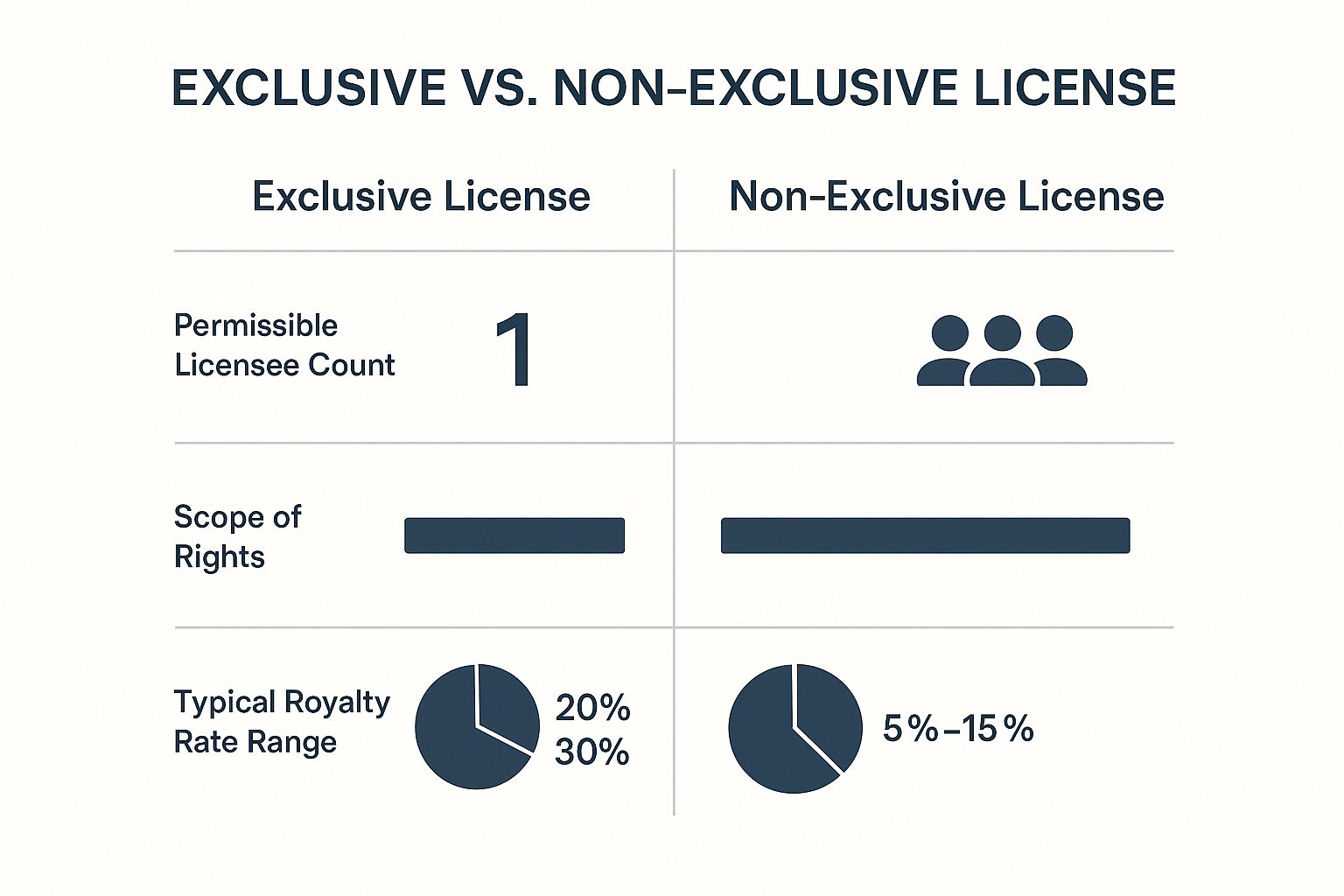
Think of an exclusive license like giving someone the only key to your house. You're trusting one partner, and one partner only, with your intellectual property. A great example is when a huge movie franchise gives a single toy company the exclusive rights to make all the action figures. This blocks every other competitor, creating a really focused partnership that usually means higher royalty rates and guaranteed minimum payments for the person granting the license.
On the flip side, a non-exclusive license is like making a bunch of copies of that key and handing them out. This lets you give permission to several different companies at the same time. You see this all the time with software developers who license a toolkit to countless app creators. The royalty from each individual deal might be smaller, but this strategy is all about getting your IP out there as widely as possible and creating multiple streams of income.
Exclusive vs. Non-Exclusive Licenses Compared
To really nail down the differences, let's put these two side-by-side. This table breaks down the core features of each, from how many partners you can have to what you can expect from the financials.
| Feature | Exclusive License | Non-Exclusive License |
|---|---|---|
| Number of Licensees | One | Multiple |
| Market Control | High (Licensor has more control over brand) | Low (Less control over how IP is used) |
| Revenue Potential | Higher per-licensee rates, often with minimum guarantees | Lower per-licensee rates, potential for high total revenue |
| Market Penetration | Limited to the reach of a single partner | Wide distribution across multiple partners |
| Licensor's Risk | Higher (Reliant on one partner's success) | Lower (Diversified across multiple licensees) |
| Best For | High-value IP, brand control, deep partnerships | Broad market reach, software, content, stock media |
Choosing between them really comes down to your goals. Do you want a big payout from a single, dedicated partner, or do you want to play the volume game and get your IP into as many hands as possible?
But it doesn't just stop at exclusive vs. non-exclusive. There are a few other structures that offer a bit more flexibility.
- A Sole License is a kind of middle-ground. The licensor agrees to grant rights to only one licensee but鈥攁nd this is the important part鈥攌eeps the right to use the IP themselves. They just promise not to license it to anyone else.
- A Co-Exclusive License is where you grant rights to a small, hand-picked group of licensees, maybe just two or three. This is a solid strategy for targeting different countries or sales channels without just opening the floodgates to everyone.
Term and Scope Variations
Another layer to all this is how long the deal lasts and where in the world it applies. A perpetual license gives someone rights forever. This is pretty rare and something you should think very, very carefully about before agreeing to.
What鈥檚 much more common is a term-limited license, which has a clear end date鈥攕ay, three or five years鈥攐ften with the option to renew if things are going well.
The structure of an intellectual property licensing agreement is not one-size-fits-all. The right choice depends entirely on your strategic objectives, whether that鈥檚 maximizing revenue, controlling brand perception, or achieving rapid market growth.
Agreements also define a territory, which spells out the specific countries or regions where the licensee is allowed to operate. You could, for instance, give one partner exclusive rights for North America while signing a non-exclusive deal with another company for the European market.
To get a complete picture of how all these pieces come together, you can learn more about crafting an intellectual property licensing agreement and see how each clause functions to protect you. Getting these terms right from the start ensures your IP works for you without exposing you to unnecessary risks.
Anatomy of a Strong Licensing Agreement
When you get past the legal jargon, a truly solid licensing agreement isn't just a restrictive document. It's a strategic roadmap for a successful partnership. Getting a handle on its anatomy is the key to protecting your interests and making sure everyone's on the same page from day one.
A strong agreement cuts through the noise and provides absolute clarity. It鈥檚 about anticipating potential bumps in the road and laying out fair solutions before they ever become real problems. Let's break down the essential pieces that form the backbone of any good licensing deal.
The Grant of Rights Clause
This is the absolute heart of the agreement. The Grant of Rights clause is where you spell out exactly what the other party is allowed to do with your intellectual property. Trust me, being vague here is a recipe for disaster, so this section needs to be incredibly specific.
This is the part of the contract that answers critical questions like:
- What can they do? Are they allowed to manufacture, sell, advertise, or maybe even modify the IP?
- What can鈥檛 they do? Are there specific restrictions, like preventing them from bundling your IP with other products?
For instance, a graphic designer鈥檚 Grant of Rights might let a clothing brand print a specific design on t-shirts, but explicitly forbid them from putting it on mugs or posters. This kind of precision stops "scope creep" dead in its tracks and protects your IP from being used in ways you never intended.
Defining Term and Territory
No partnership is meant to last forever, and very few are global from the get-go. The Term clause defines how long the agreement will last鈥攕ay, a fixed period of three years with an option to renew. This gives both sides a clear timeline and a natural point to reassess if the partnership is working.
Then you have the Territory clause, which sets the geographical boundaries for the licensee. An author might grant a publisher the rights to sell their book in North America, while licensing the translation rights to a completely different publisher in Europe. This simple clause prevents partners from stepping on each other's toes and lets you build out a global strategy one piece at a time.
A well-drafted agreement doesn鈥檛 just grant permissions; it creates a framework of clear limitations. Defining the scope, duration, and geographical area of the license is fundamental to maintaining control over your intellectual property.
Royalties and Payment Structure
This is where you get down to the money. The Royalties clause details precisely how the licensor (that's you, the IP owner) gets paid. There are a few common ways this is structured, like a percentage of gross or net sales, a flat fee for every unit sold, or an upfront lump-sum payment.
This section also needs to nail down a few other crucial details:
- Payment schedule: When are royalties due? Is it quarterly? Monthly?
- Reporting requirements: How will the licensee report their sales figures to you?
- Audit rights: Do you have the right to look at their books to make sure the royalty payments are accurate?
Having crystal-clear terms here is non-negotiable. It's the foundation of a healthy financial relationship.
Quality Control and Termination Clauses
Your brand's reputation is everything. A Quality Control clause is your safety net, giving you the right to approve product samples before they hit mass production. This is how you ensure the licensee's work meets your standards and doesn't tarnish the brand you've worked so hard to build.
Finally, every good agreement needs an exit strategy. That's the Termination clause. It specifies the conditions under which either party can walk away, such as failing to meet sales targets or a major breach of the contract. A clear termination process is a crucial safety net if the partnership just isn't working out.
To really get this right, it helps to cross-reference these clauses against a comprehensive .
Weighing the Benefits and Risks of Licensing

A licensing deal can look like a golden ticket. It's a chance to open doors to new markets and bring in cash without the usual heavy lifting of manufacturing and distribution. But let's be clear: it鈥檚 a major business decision with real stakes.
Signing on the dotted line means handing over a degree of control over your creation. So, before you jump in, it's crucial to understand both the incredible upsides and the potential pitfalls.
Let's weigh both sides of the scale.
The Major Benefits of a Licensing Agreement
For the owner of the intellectual property (the licensor), the advantages are often immediate and powerful. You get to tap into a partner鈥檚 existing infrastructure鈥攖heir factories, their distribution networks, their marketing teams鈥攕aving yourself a fortune.
This creates a new, often passive, revenue stream. Think about it: you earn royalties from your idea while someone else handles the day-to-day grind. It鈥檚 a fantastic way to scale your reach and break into new geographical markets you couldn't possibly access on your own.
Here are the most compelling benefits:
- New Revenue Streams: You start generating income through royalties and licensing fees with minimal extra investment on your part.
- Expanded Market Reach: Instantly tap into your licensee's established distribution channels and loyal customer base.
- Reduced Costs and Risks: You get to avoid the massive expenses and headaches tied to production, marketing, and logistics.
- Increased Brand Awareness: Your brand or product gets in front of a much larger audience, boosting recognition and credibility.
There are many ways for businesses to generate revenue from their IP, including various . Licensing offers one of the most direct paths to turn a great idea into real income.
Understanding the Potential Risks
Of course, no business deal is without its risks. The biggest worry for most creators is the loss of control. Once you license your IP, you're entrusting your brand's reputation to another company.
If your partner cuts corners, puts out a shoddy product, or provides terrible customer service, it鈥檚 your name that gets dragged through the mud.
Imagine a famous fashion designer who licenses their name for a new fragrance line. They're betting that the licensee will maintain the brand's luxurious image. A poorly executed, cheap-smelling perfume could dilute the brand's value overnight.
The greatest risk in any licensing agreement is choosing the wrong partner. A licensee鈥檚 failure to perform not only sinks your potential royalties but can also inflict long-term damage on your brand鈥檚 reputation.
Then there's the financial risk. Relying solely on royalties can lead to unpredictable income, since your earnings are directly tied to your partner's sales performance. If their efforts fall flat, so does your paycheck.
In a worst-case scenario, a poorly written contract could even lead to disputes over who owns what down the road, creating a legal nightmare. This is why careful vetting and an ironclad agreement are absolutely essential.
How to Negotiate Your First Licensing Deal
Jumping into your first licensing negotiation can feel like a high-stakes game. But it doesn't have to be. With the right game plan, it becomes a structured process for building a real partnership. This isn't about winning a battle; it鈥檚 about creating a relationship where everyone benefits. The real work starts long before you ever sit down at the table.
Your first move is thorough preparation. That means doing a deep-dive into potential licensees. What鈥檚 their reputation in the market? Are they financially stable? How have they handled other people's intellectual property in the past? A partner with a solid track record is far more likely to do right by your brand.
Before you even think about reaching out, you need to know your walk-away points. What are your absolute non-negotiables? Maybe it's a specific royalty rate, strict approvals on quality control, or hard limits on where your IP can be used. Knowing your deal-breakers ahead of time gives you a massive confidence boost and keeps you focused during the actual talks.
Outlining the Core Terms
Once you've found a partner you trust and made contact, the next step is to draft a term sheet. Think of this as the blueprint for your final contract. It鈥檚 a non-binding document that lays out the main business terms of the deal.
A solid term sheet gets right to the point. It should cover:
- Scope of the License: Make it crystal clear if the license is exclusive or non-exclusive.
- Financials: Lay out the proposed royalty rate, any upfront fees, and minimum guarantees.
- Term and Territory: State exactly how long the deal will last and the specific geographical regions it covers.
- Key Responsibilities: Briefly outline who is responsible for what, like manufacturing or marketing.
Getting this document right ensures both sides are on the same page before you pour time and money into drafting the full legal agreement.
The negotiation process is a dialogue, not a monologue. The goal is to understand the other party's needs and find a middle ground that serves both your interests, turning a simple transaction into a strategic alliance.
Seeking Expert Legal Counsel
This last step isn鈥檛 just a recommendation鈥攊t鈥檚 essential. Hire an experienced IP attorney. Trying to navigate the maze of a licensing agreement on your own is a huge risk. A good lawyer will protect your interests, spot potential loopholes, and make sure the final contract is rock-solid. To sharpen your skills even further, check out these proven contract negotiation strategies that can help you lock in the best possible terms.
It鈥檚 also worth noting how technology is changing the game. AI-powered tools are now being used to analyze massive datasets, leading to 27% better outcomes in licensing choices compared to old-school methods. On top of that, option-based deals鈥攚hich allow for smaller initial investments鈥攈ave jumped by 40% in the past year, giving both sides more flexibility. You can find more on .
Licensing Agreements in the Real World
Let's move away from the abstract and see how these agreements actually play out. You see them everywhere, from the medicine you take to the movies you watch.
In the pharmaceutical world, licensing deals are a powerful tool for sharing the massive costs and risks of Research & Development. A smaller biotech startup, for instance, might discover a groundbreaking molecule but lack the funds for extensive clinical trials. They can license that molecule to a global pharma giant, tapping into deep pockets and established distribution networks to bring it to market.
This strategy is fueling incredible growth. Just look at South Korea, where biopharmaceutical licensing agreements recently skyrocketed by 113%, reaching $7.86 billion in a single year-to-date period. Over a five-year span, the total value of these deals topped $29.4 billion, with international firms making up 79% of the agreements. You can .
How Character Merchandising Drives Revenue
Ever wonder how movie characters end up on everything from lunchboxes to action figures? That鈥檚 all thanks to character licensing. Entertainment franchises build entire empires by licensing their beloved characters out.
A blockbuster film might grant an exclusive license to a single toy company, creating a frenzy for the "official" action figures. On the other hand, they could grant non-exclusive licenses to a dozen different apparel brands, flooding the market with t-shirts and hoodies. Both strategies are incredibly lucrative.
- Rapid Market Entry: Licensees already have the retail channels and shelf space ready to go.
- Brand Amplification: Your favorite characters pop up on collectibles, clothing, and video games, keeping the brand top of mind.
- Risk Distribution: The studio gets to collect royalties without getting into the messy business of manufacturing and distribution.
"Character licensing can transform a film into a billion-dollar brand," says a top entertainment executive.
This isn't just for movies. In the gaming industry, licensing is the engine of innovation. A developer might license their game engine, essentially handing over a "digital toolbox" that allows countless indie studios to create brand-new games on their platform.
- Find a solid platform or piece of intellectual property.
- Hammer out a clear agreement on royalties and support.
- Give developers the documentation and branding rules they need to succeed.
Technology Licensing Ecosystems
Tech giants do this all the time. By licensing their APIs (Application Programming Interfaces) and software libraries, they empower third-party developers to build entire ecosystems of apps around their core product. Think about how many apps connect to your Google or Apple account鈥攖hat's the power of a licensing ecosystem.
Let's compare these strategies side-by-side:
| Industry | Strategic Goal | Outcome |
|---|---|---|
| Pharma | Risk Mitigation | Shared R&D costs and faster approvals |
| Entertainment | Pure Revenue Growth | Multibillion-dollar merchandise empire |
| Technology | Ecosystem Expansion | Thousands of third-party applications |
In every case, licensing is about more than just a contract; it's a strategic move to align incentives, share risk, and accelerate growth.
These examples just scratch the surface, especially in creative fields. For a deeper dive, check out our guide on licensing artwork to see how artists and designers use these same principles.
As you can see, licensing is a versatile strategy that businesses use to achieve very different goals.
Common Questions About Licensing Agreements
Even with a solid grasp of the basics, a few practical questions always seem to pop up when you鈥檙e thinking about licensing your own work. Let's tackle some of the most common ones head-on.
Think of this as your quick-reference guide for those final, nagging questions that come up before you dive in.
Do I Really Need a Lawyer?
Yes. Full stop. Trying to draft or sign a licensing agreement without a lawyer to save a few bucks is like trying to perform your own surgery. It鈥檚 a massive, unnecessary risk.
An experienced IP attorney does way more than just fill in a template. They鈥檙e your strategic partner.
They will help you:
- Spot loopholes you would never see, protecting your long-term interests.
- Negotiate better terms, especially when it comes to royalties and creative control.
- Make sure the agreement is actually enforceable in court if things go south.
Look at it as an investment, not an expense. A solid contract drafted by a pro can save you from a world of financial pain and legal headaches down the road.
What Is the Difference Between Licensing and Franchising?
This one trips a lot of people up, but the difference is pretty simple once you break it down.
Licensing is all about permission. You're giving someone else the right to use a specific piece of your intellectual property鈥攍ike a patent, trademark, or song鈥攊n their business.
Franchising, on the other hand, is a much deeper dive. A franchisee isn't just using a logo; they are buying into an entire, proven business system. This includes the branding, the day-to-day operational playbook, and ongoing support from the main company. A franchisee operates as the brand (think McDonald's), while a licensee simply uses a piece of the brand.
How Are Royalty Rates Calculated?
There's no magic formula here. Royalty rates are almost always a product of negotiation and depend on a bunch of different factors.
The final royalty rate is a balancing act. It reflects the value your IP brings to the table versus the risk the licensee is taking on. Industry standards give you a ballpark, but the final number is hammered out in negotiation.
Here are the key things that move the needle:
- Industry norms: What鈥檚 standard in software is totally different from what鈥檚 normal in the fashion world.
- Exclusivity: An exclusive license is a bigger deal, so it commands a much higher royalty rate.
- Brand strength: A well-known, trusted brand can ask for a premium.
- Profit margins: How much money can the licensee realistically make from the final product? This is a huge piece of the puzzle.
You鈥檒l often see rates structured as a percentage of net sales (a 3-10% range is common in many industries), a fixed fee for every unit sold, or even a one-time lump-sum payment upfront.
Navigating the world of intellectual property requires a dedicated partner. At Cordero Law, we empower creators and entrepreneurs by working with them, not just for them. If you're ready to protect your ideas and build a strong legal foundation, let's connect. Learn more about our approach at corderolawgroup.com.