
Using a trademark in a domain name is a smart branding move, but it's vital to know they aren't the same thing. Think of your trademark as your brand's unique identity and your domain name as its street address online. Just registering one doesn't automatically give you rights to the other.
Understanding Trademarks and Domain Names
Welcome to the digital world, where your domain name is pretty much the front door to your brand. Here, we'll break down the crucial relationship between these two separate but deeply connected assets.
Imagine your trademark is your unique brand name, like 'Apex Gadgets.' Your domain, 'apexgadgets.com,' is simply its official location on the web. A common mistake is thinking that owning a domain gives you trademark rights. In reality, a domain is just a lease on a web address.
A trademark, on the other hand, is a legal shield for your brand's identity. It stops others from using a similar name for similar products or services. You can get a deeper dive into this by exploring the basics of trademarks in our detailed guide here: /blog/2015/9/20/trademarks-101-the-basics-of-trademarks.
The Source of Common Conflicts
This is where things get messy. Owning the trademark for 'Apex Gadgets' doesn't mean you automatically own every variation like 'apexgadgets.net' or 'apex-gadgets.store.' This gap is where problems like cybersquatting pop up鈥攚hen someone registers a domain in bad faith, hoping to profit from your brand's reputation.
And this isn't a small problem. By the end of 2018, total top-level domain registrations hit about 348.7 million worldwide. Out of that, .com and .net names alone made up roughly 153 million. That staggering number shows just how competitive it is to lock down a brand's online identity.
A registered trademark gives you the right to use your brand name across all mediums. However, it doesn鈥檛 grant exclusive rights to a word or phrase鈥攊t only protects its use in connection with the specific goods or services you offer.
Why Proactive Protection Matters
You can't just react to these issues; you need a proactive game plan. With so many domains being registered every day, someone, somewhere, could register one that steps on your brand's toes, whether they mean to or not. This is exactly why protecting your intellectual property has become a must-do for business survival.
To get the full picture of the legal framework that holds all this together, it鈥檚 worth checking out a comprehensive .
At the end of the day, understanding both trademarks and domains is step one in building a brand that lasts. This knowledge empowers you to guard your digital turf, avoid customer confusion, and carve out your space in the market. Being proactive about brand protection isn't just a good idea anymore; it's a core business necessity.
Navigating the Legal Risks and Key Laws

Using someone else's trademark in your domain name is a bit like building your house on land you don't own. Sooner or later, you're going to run into some serious trouble. Understanding the legal side of this isn't just for lawyers; it's a must for anyone trying to build a brand online.
These laws exist for a reason: to stop consumers from getting confused and to protect businesses from people unfairly piggybacking on their hard work. When you're picking a domain, it's critical to know how to so you can build a brand that's bulletproof from the start.
This knowledge helps you make smarter choices that will protect your brand's future.
Unpacking the Anticybersquatting Consumer Protection Act
One of the big players in domain name law, at least in the United States, is the Anticybersquatting Consumer Protection Act (ACPA). This federal law was passed back in 1999 specifically to give trademark owners a way to fight back against cybersquatters.
Think of the ACPA as the legal system's answer to digital land-grabbing. It goes after people who register or use a domain name that's identical or confusingly similar to a protected trademark, all with the "bad-faith intent" to profit from the brand's reputation.
And the penalties for breaking this law are no joke. A trademark owner can take a cybersquatter to federal court and could win:
- The transfer or cancellation of the domain name.
- Actual damages and any profits lost because of the infringement.
- Statutory damages, which can range from $1,000 to $100,000 for each domain name.
This gives brands a powerful tool to take back their online identity and get significant financial compensation from people who misuse it.
The Critical Element of Bad Faith Intent
The whole ACPA case really boils down to one key idea: bad faith intent. This is the "smoking gun" that separates an innocent, coincidental registration from deliberate cybersquatting. Bad faith isn't about an accidental overlap; it's about a calculated plan to cash in on another brand's good name.
So, how does a court figure out if someone acted in bad faith? The ACPA actually lays out a list of factors they can look at.
Indicators of Bad Faith:
- The person registering the domain has no intellectual property rights to the name.
- The domain isn't the person's legal name or a name they're commonly known by.
- They have a pattern of selling domains without ever using them for a real business.
- They used fake contact information when they registered the domain.
- They've registered a bunch of other domains that are identical or similar to existing trademarks.
For example, registering nkie-shoes-deals.com to sell knockoff sneakers is a textbook case of bad faith. The person is clearly using a misspelled version of a famous trademark to trick customers and make money off Nike's brand.
Proving bad faith is the key to winning a cybersquatting claim. It turns a simple domain dispute into a clear-cut case of illegal activity, opening the door for legal action and serious financial penalties under the ACPA.
Understanding the Financial and Reputational Consequences
The fallout from improperly using a trademark in your domain goes way beyond just losing the name. The legal and financial damage can be absolutely devastating, especially for an individual or a small business.
Imagine getting a cease-and-desist letter from a massive corporation's legal department. Just hiring an attorney to write a response can be expensive. If it turns into a full-blown lawsuit, the costs can quickly skyrocket into the tens or even hundreds of thousands of dollars.
And that's not even counting the damage to your reputation. Being branded a cybersquatter can destroy the trust you've built with customers and make it nearly impossible to do business online. At the end of the day, the risk is simply never worth the reward.
How to Spot and Defend Against Cybersquatting
Think of cybersquatting as digital trespassing. Someone sees the value in your brand, registers a domain name that piggybacks on your trademark in domain name, and then tries to cash in on your reputation. This isn't just an annoying coincidence; it's a deliberate play to siphon off your customers or tarnish your brand's good name.
These bad actors aren't just registering your exact brand name, either. They've got a whole bag of sneaky tricks designed to confuse your audience and profit from all your hard work. Knowing what those tactics are is the first step to building a solid defense.
Common Faces of Cybersquatting
Cybersquatting isn't a one-size-fits-all problem. It shows up in a few different forms, each with its own angle but all sharing the same goal: exploiting your brand's goodwill.
Direct Trademark Infringement: This is the most blatant type. Say you own the trademark and operate on
yourbrand.com. A cybersquatter registersyourbrand.netoryourbrand.store, often with the sole intention of selling it back to you for a ridiculously inflated price.Typosquatting (or URL Hijacking): A classic move that preys on simple typing errors. A squatter might register something like
gooogle.comoramazn.com, hoping to catch users who fumble a popular web address. These sites are often traps, hosting malware, phishing schemes, or even ads for your competitors.Grievance Sites: Sometimes, the goal isn't profit鈥攊t's to cause harm. Someone might register a domain like
yourbrandsucks.comto post negative or defamatory content. While some of these sites can be protected under free speech, they often cross the line into trademark infringement if they're designed to create consumer confusion.
With the explosion of new domain extensions, cybersquatters have more turf than ever to register infringing names. You can read more about how new domains create ongoing problems with cybersquatting in our related article. This reality makes staying vigilant more critical than ever.
Your Checklist for Spotting Cybersquatting Activity
So, how can you tell if a domain is just a harmless coincidence or a clear case of bad-faith cybersquatting? You have to put on your digital detective hat and look for specific clues. These red flags usually reveal the registrant's true intentions.
Use this checklist to investigate any suspicious domains:
Check the Website's Content: What鈥檚 actually on the website? If it鈥檚 just a parked page cluttered with ads (especially for your direct competitors), that鈥檚 a huge red flag. Legitimate businesses build real websites.
Look for For-Sale Banners: Does the page scream, "This domain is for sale"? Cybersquatters often buy domains with the primary goal of flipping them to the trademark owner for a hefty profit.
Investigate Redirects: Type the domain into your browser and see where it takes you. If it immediately sends you to a competitor鈥檚 site, a sketchy adult site, or a page full of spam, you're almost certainly dealing with a cybersquatter.
Analyze the Registrant's Behavior: Does the domain's owner have a history of registering domains that are confusingly similar to well-known trademarks? A pattern of this behavior is powerful evidence of bad faith.
Cybersquatting is fundamentally about intent. A legitimate business might coincidentally have a similar name in a different industry, but a cybersquatter's actions will almost always reveal a plan to profit from confusion or sell the domain back to the rightful owner.
Cybersquatting Red Flags vs Legitimate Use
It's important to remember that not every similar-sounding domain is an act of cybersquatting. A local coffee shop named "Star Beans" probably isn't infringing on the "Starbucks" trademark. The real difference comes down to intent and the likelihood of confusing the public.
To help clear things up, here鈥檚 a quick comparison table to distinguish a bad-faith registration from a legitimate one.
| Indicator | Potential Cybersquatting (Bad Faith) | Likely Legitimate Use (Good Faith) |
|---|---|---|
| Website Content | Parked page with ads, competitor links, or malware. | A fully developed website for an unrelated business. |
| Domain's Purpose | Offered for sale to the trademark owner at a high price. | Used for a genuine business in a different industry. |
| Owner's History | A pattern of registering domains similar to known brands. | No history of trademark-related domain registrations. |
| Email Use | Used to send phishing emails pretending to be your company. | Used for legitimate business communications. |
By actively watching for these red flags and understanding the different ways cybersquatting can manifest, you can spot threats early. This proactive approach is the best way to defend your trademark and protect the online territory you've worked so hard to build.
Resolving Domain Disputes with the UDRP
When someone registers a domain name that steps on your trademark, a full-blown federal lawsuit isn't your only option. Think of the Uniform Domain Name Dispute Resolution Policy (UDRP) as a specialized, streamlined court just for these kinds of conflicts. It was specifically designed to be a faster and more affordable alternative to a lengthy, expensive legal battle.
This process has become the go-to for trademark owners all over the world. In fact, thousands of UDRP cases are filed every year by brands looking to protect their intellectual property online. You can get a sense of the global scale of these disputes from the .
At its core, the UDRP is an administrative proceeding, not a courtroom drama. Its one and only job is to figure out who has the rightful claim to a specific domain name.
What Is the UDRP Process?
The UDRP process gives you a clear path for getting your domain back when you find someone cybersquatting on your trademark. This infographic lays out the typical stages, from spotting the problem to getting a final decision.
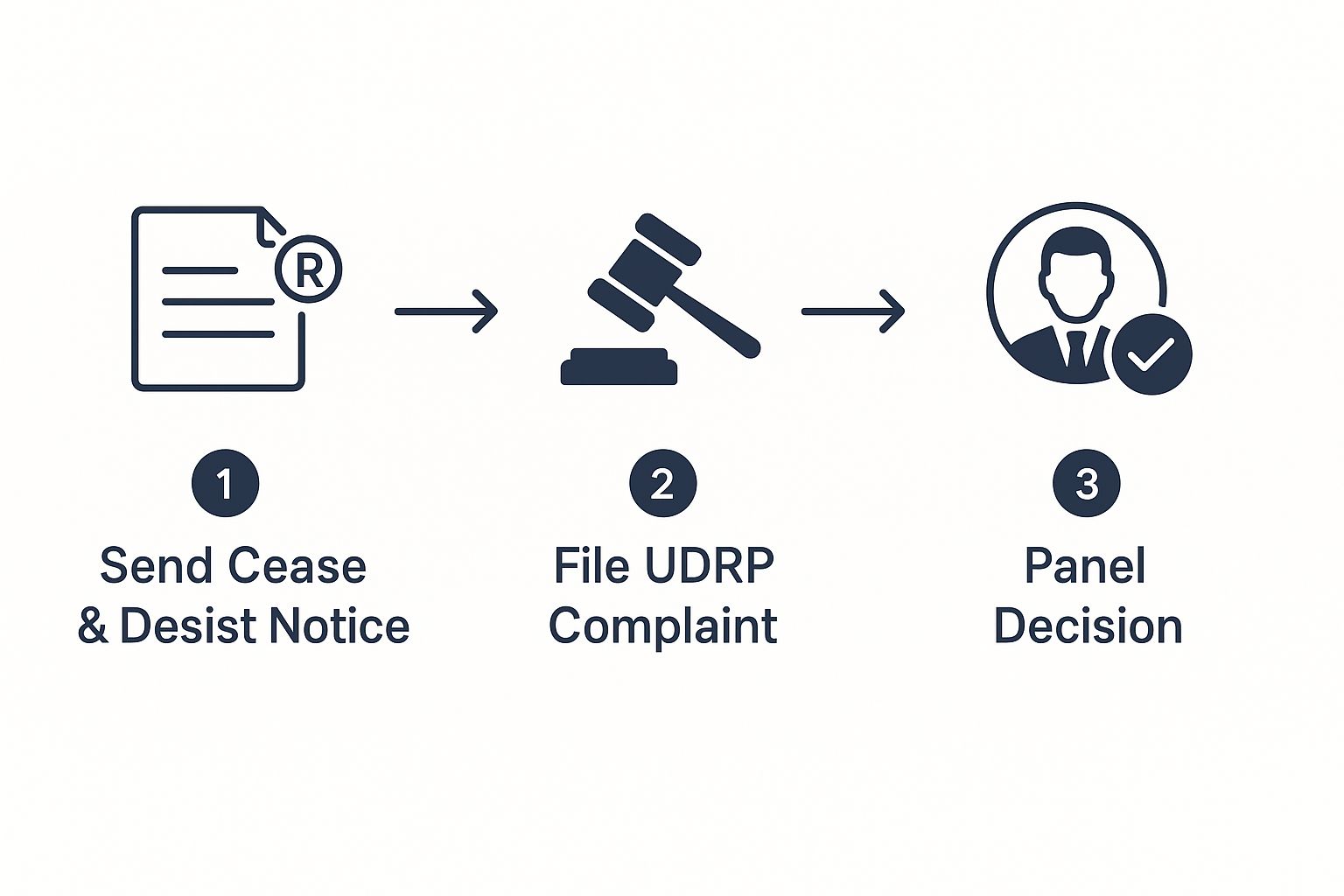
As you can see, the whole thing is structured to move efficiently from identifying the infringement to a final outcome, making it a powerful tool for any brand owner.
But winning a UDRP case isn't as simple as just saying the domain is yours; you have to prove it. The burden falls entirely on you, the complainant, to build a convincing case based on three very specific elements.
The Three Pillars of a UDRP Claim
Let鈥檚 imagine you own a popular local bakery called "Sweet Blooms." You've got a registered trademark for the name and you run your business from sweetbloomsbakery.com. One day, you discover someone has registered sweet-blooms.com and is just using it to send visitors straight to your biggest competitor鈥檚 website.
This is a classic cybersquatting scenario, and it's exactly what the UDRP was made for. To get that domain back, you'll have to prove three things to the arbitration panel.
The Domain Is Identical or Confusingly Similar to Your Trademark: First, you have to show that the domain is so close to your trademark that it's bound to confuse customers. In our bakery example,
sweet-blooms.comis without a doubt "confusingly similar" to your "Sweet Blooms" trademark. The panel will look at the domain name and your registered mark side-by-side.The Registrant Has No Rights or Legitimate Interests: Next up, you need to prove that the person who registered the domain has no good reason to own it. Do they operate a business by that name? Is it their legal name? If they're just piggybacking on your brand's reputation, it's pretty clear they have no legitimate interest.
The Domain Was Registered and Is Being Used in Bad Faith: This is the knockout punch. You must prove the registrant knew about your trademark and grabbed the domain specifically to profit from it in a malicious way. Redirecting your potential customers to a competitor is a textbook definition of bad faith.
To succeed in a UDRP proceeding, you must satisfy all three of these requirements. If you fail to prove even one of them, the panel will rule against you, and the cybersquatter gets to keep the domain.
From Complaint to Resolution
So, let's follow our bakery owner's journey. After finding the infringing domain, she decides to file a UDRP complaint through an approved provider like the .
First, she gets her evidence together: a copy of her trademark registration, screenshots showing the shady redirect to her competitor, and proof that her own website has been active for years.
Next, she drafts the complaint, carefully laying out how the cybersquatter鈥檚 actions hit all three of the UDRP elements. Once she files it, the clock starts ticking. The domain owner gets a chance to respond, but frankly, in most clear-cut cybersquatting cases, they don't even bother.
Finally, an impartial panelist reviews all the evidence. Seeing the undeniable trademark rights, the total lack of legitimate interest, and the obvious bad faith, the panelist rules in her favor. The domain registrar is then ordered to transfer sweet-blooms.com over to her.
This entire process usually wraps up in about two months鈥攁 tiny fraction of the time a lawsuit would take. For a small business, this speed and lower cost make the UDRP an invaluable tool for protecting your trademark in a domain name and keeping your brand鈥檚 reputation safe.
A Proactive Playbook for Domain Name Protection

When it comes to protecting your brand online, just reacting to problems after they pop up is a losing game. A good offense is the best defense, and that means being proactive from day one. This isn't just about grabbing an available domain; it's about building a digital fortress around your brand to lock it down for the future.
This forward-thinking mindset is more critical than ever. Millions of domains are registered globally, with millions more added each year, making the competition fierce. This explosion in registrations directly fuels conflicts over trademarks, making a solid protection plan essential for any serious business. If you're curious, you can see the latest domain name registration statistics and see the numbers for yourself.
Start with a Thorough Trademark Search
Before you fall in love with a domain name and hit "register," your very first move needs to be a comprehensive trademark search. Too many entrepreneurs make the costly mistake of buying a domain only to find out later it steps on someone else's existing trademark.
Think of it like checking property records before you buy a piece of land. You need to be sure no one else has a legal claim to that name in your industry. This simple, upfront check can save you from expensive legal battles, rebranding nightmares, and the very real possibility of losing your domain down the road.
A proper search should cover a few key areas:
- Federal Databases: Check the USPTO's (United States Patent and Trademark Office) database for both registered and pending trademarks.
- State Registries: Some trademarks are only registered at the state level, so don't skip this.
- Common Law Searches: This just means searching online to see if other businesses are already using the name, even if they haven't formally registered it.
Build Your Digital Fortress with Defensive Registrations
Once you've cleared your name, don't just register the .com and call it a day. Securing a single domain is like locking your front door but leaving all the windows wide open. A smarter strategy is defensive registration鈥攂uying up common variations of your domain to keep cybersquatters from moving in.
Proactive domain registration isn't an expense; it's an investment in your brand's integrity. By controlling common variations, you prevent customer confusion and block cybersquatters before they can strike.
Think about securing your brand name across these categories:
- Popular TLDs: Register the
.net,.org, and.coversions. If you're in a specific industry, look at extensions like.io,.store, or.ai. - Common Misspellings: Think of all the ways a customer might accidentally type your name. For "QuickBrand," you might also register "QuikBrand" or "QuickBrands."
- Hyphenated Versions: If your domain is
yourbrandname.com, it鈥檚 wise to also registeryour-brand-name.comto prevent a competitor from grabbing it.
Implement Continuous Domain Monitoring
Your work isn't done after registration. Cybersquatters are always on the lookout for an opportunity, so you need to keep watch. Domain monitoring services basically act as your 24/7 security guards, constantly scanning for newly registered domains that are confusingly similar to your trademark.
These services will alert you to potential threats, like someone registering a typo of your domain or using your brand name with a new country-code TLD. This early warning lets you take swift action鈥攍ike sending a cease-and-desist letter or filing a UDRP complaint鈥攂efore any real damage is done. This constant vigilance is a cornerstone of any modern strategy for online brand protection.
Common Questions About Trademarks in Domain Names
The line where trademarks and domain names cross can get pretty blurry, leaving most business owners with a lot of confusion. To cut through the noise, let's tackle some of the most common questions people have when it comes to using a trademark in a domain name. Think of this as your quick-and-dirty FAQ to help you make smarter moves.
We'll break down the stuff that usually trips people up, nail down the key ideas, and give you the straightforward info you need to protect your brand online. Let's get into the real-world situations you're most likely to face.
Can I Use Someone Else's Trademark in My Domain Name?
This is the big one. The short answer? Almost always no, especially if you have any commercial intent. Snapping up a domain with another brand's trademark is a fast track to getting hit with a trademark infringement or cybersquatting claim, and that means serious legal trouble.
Now, the law isn't totally black and white. There are a few very specific exceptions. The one you鈥檒l hear about most is nominative fair use. It鈥檚 a legal concept that says you can use a trademark to talk about the trademark owner's actual product, but only if you follow some strict rules.
For instance, a fan site like ford-bronco-enthusiasts.com or a review blog like latest-iphone-reviews.net could potentially fly. The absolute key is that your site must not create a "likelihood of confusion."
If someone lands on your site and could reasonably think you鈥檙e officially connected to or endorsed by the brand owner, you鈥檝e stepped over the line. That's when the brand owner can start a UDRP proceeding or even file a lawsuit to take that domain right out from under you.
What Is the Difference Between a UDRP and a Lawsuit?
When a trademark fight over a domain name kicks off, you've basically got two paths: a UDRP proceeding or a full-blown lawsuit. They are completely different animals, each with its own price tag, timeline, and potential outcome.
A UDRP is an administrative process, built to be way faster and cheaper than going to court. It's handled by an arbitration panel, not a judge and jury. The only thing a UDRP panel can do is order the transfer or cancellation of the domain. That's it. No money damages are awarded.
A lawsuit, on the other hand, is the real deal. It's usually filed under a law like the ACPA (Anticybersquatting Consumer Protection Act) and it's a formal, complicated, and very expensive court process. It takes a lot longer, but the potential remedies are much broader.
Here鈥檚 a simple way to look at the key differences:
| Feature | UDRP Proceeding | ACPA Lawsuit |
|---|---|---|
| Venue | Online arbitration panel | Federal court |
| Cost | Relatively low (thousands of dollars) | Very high (tens or hundreds of thousands) |
| Speed | Fast (typically around 2 months) | Slow (can take over a year) |
| Remedy | Domain transfer or cancellation only | Domain transfer, financial damages, legal fees |
| Damages | None | Up to $100,000 per domain |
Which one is right? It really depends on what you want to achieve. If you just need to get the domain back quickly without breaking the bank, the UDRP is your best bet. If you want to go after financial compensation for the damage they've caused, a lawsuit is your only option.
Does Owning the .com Domain Protect My Brand on Other TLDs?
Not even close. This is probably one of the most dangerous myths a brand owner can believe. Registering yourbrand.com gives you control over that one specific address, and that's all. It offers zero automatic protection if someone else goes out and registers yourbrand.net, yourbrand.co, yourbrand.store, or any of the hundreds of other Top-Level Domains (TLDs) out there.
Think of it this way: owning the house at "123 Main Street" doesn't stop someone from building a new house at "123 Main Avenue" right next door.
Sure, if a cybersquatter registers your brand on a different TLD to mislead your customers, you can take legal action. But by the time you even find out about it, your brand's reputation could already be taking a hit.
This is exactly why having a defensive registration strategy is so critical. You have to be proactive and buy your brand name across the most important TLDs. It鈥檚 like building a digital moat around your castle鈥攊t keeps the bad guys out and makes sure your customers always find their way to you.
Navigating the complexities of trademark law requires a strategic partner who understands your vision. At Cordero Law, we specialize in intellectual property law, empowering entrepreneurs and creatives to protect their most valuable assets. If you're looking to secure your brand's future, we're here to provide the expert guidance you need.
Schedule a consultation with Cordero Law today to build a powerful brand protection strategy.