
Licensing your intellectual property is like giving someone permission to use your creative work, invention, or brand identity for a specific purpose, under set conditions. The key thing to remember is that you're not selling it. You're essentially renting out your idea, which is a fantastic way to make money from it while still keeping full ownership.
This is a smart, strategic way to monetize your innovations and get your creation in front of more people.
What Is IP Licensing Really About?

Let's use a simple analogy. Imagine you own a house. It's your property, you hold the deed, but you decide to rent it out. Your tenant gets to live there and use the space in exchange for rent, but they have to follow your rules, and they certainly don't own the house.
IP licensing鈥攚hether for a patent, trademark, or copyright鈥攊s the exact same concept.
You, as the creator (the licensor), grant permission to someone else (the licensee) to use what you鈥檝e made. This could be a toy company paying you to feature your cartoon character on their lunchboxes, or a software developer paying to use your patented code in their new app. You always keep ownership; you just earn income from your idea.
The Power of Monetizing Your Ideas
For creators, inventors, and businesses, licensing is an incredibly powerful tool. It鈥檚 how you unlock the real-world value of intangible assets that might otherwise just be collecting dust on a shelf. Instead of taking on the massive task of manufacturing a product yourself, you can let an established company with all the right resources handle the production and distribution. In return, you collect a piece of their sales as a royalty.
This approach brings some serious advantages to the table:
- Generate Passive Income: You can create a steady stream of revenue from royalties without sinking your own money into production or marketing.
- Expand Market Reach: Partnering with other businesses lets you tap into new regions or industries, introducing your IP to audiences you could never reach on your own.
- Reduce Risk: You get to sidestep the huge financial risks that come with manufacturing, marketing, and distributing a product from scratch.
- Strengthen Your Brand: The right partnerships can elevate your brand's visibility and give it more credibility in the market.
By turning ideas into revenue, licensing transforms intellectual property from a concept on paper into a dynamic financial asset.
A Growing Global Market
This isn't some niche strategy for a select few; licensing intellectual property is a massive and booming part of the global economy. The global IP licensing market was valued at around USD 340 billion in 2024 and is expected to soar to nearly USD 580 billion by 2033. That kind of growth tells you just how focused businesses are on monetizing their intellectual assets.
To really understand how valuable IP is, just look at how carefully it's scrutinized in a . Having a solid foundation is everything, and our guide on how to /blog/2025/manage-intellectual-property can help you build it.
Choosing the Right Type of IP License
Deciding to license your intellectual property is a big move, but the work doesn't stop there. Not all licenses are the same, and picking the right one is like choosing the right tool for a job鈥攊t can make all the difference. The type of license you grant will directly shape your control, your revenue, and your future options.
Think of it like this: are you handing over the only key to your house, or are you making copies for multiple people? Each approach has its own benefits and drawbacks. The choice you make will define who gets to use your creation and under what terms, so it's critical to align it with your long-term business goals.
Exclusive vs. Non-Exclusive: The Core Difference
At the heart of any licensing deal is the choice between an exclusive and a non-exclusive license. This decision sets the entire tone for the partnership and determines just how widely your IP can be used.
An exclusive license is the "one and only" deal. You're giving a single licensee the sole right to use your IP. For the term of the agreement, no one else can use it鈥攏ot even you, the owner. This is a high-stakes, high-reward arrangement that usually commands a much higher royalty rate because the licensee gets the whole market to themselves. It鈥檚 a great option when you want to put all your eggs in one basket with a single, dedicated partner.
A non-exclusive license, on the other hand, lets you grant rights to as many licensees as you want, all at the same time. Think of a stock photo you sell over and over; the photographer grants non-exclusive licenses to hundreds of people, earning a little bit from each one. This strategy is perfect for getting your IP out there to the widest possible audience.
A sole license is a clever middle ground. It's like an exclusive license, but with one key difference: you, the licensor, get to keep using the IP yourself. It gives one partner market exclusivity while letting you stay in the game.
To make things clearer, let's break down how these common license types stack up.
Comparing Common IP License Types
This table breaks down the key characteristics of exclusive, sole, and non-exclusive licenses to help you decide which is right for your needs.
| License Type | Who Can Use the IP | Best For Licensor | Best For Licensee |
|---|---|---|---|
| Exclusive | Only the licensee. The licensor cannot use it. | Maximizing revenue from a single, high-value deal. | Gaining a complete market monopoly without competition. |
| Sole | The licensee and the licensor. | Maintaining personal use while granting market rights to a partner. | Having a competitive edge, but sharing the space with the creator. |
| Non-Exclusive | Multiple licensees and the licensor. | Achieving maximum market penetration and wide distribution. | Accessing valuable IP at a lower cost without high-stakes commitment. |
As you can see, the "best" option really depends on what you're trying to achieve with your intellectual property.
Exploring Other Important Variations
Beyond these core types, a few other clauses can dramatically change the nature of your agreement. Knowing these will give you the flexibility to craft a deal that鈥檚 a perfect fit.
Sublicensing Rights: This is a big one. It determines whether your licensee can turn around and license your IP to someone else. Granting these rights can expand your reach in ways you never could alone, but it also means giving up a layer of control over who ends up using your creation.
Cross-Licensing: This is a strategic "you scratch my back, I'll scratch yours" agreement. Two companies agree to let each other use their IP. It's incredibly common in tech, where competitors might need access to each other鈥檚 patents to build complex products without sparking a lawsuit.
Geographic Restrictions: You don鈥檛 have to grant a worldwide license. You can slice up the map and limit a license to a specific city, state, or country. This is a fantastic way to have an exclusive partner in North America and a totally different one in Europe, creating multiple income streams from the same IP.
The kind of IP you're dealing with matters, too. For example, the licensing of trademarks brings its own set of challenges, with a huge focus on protecting brand reputation and quality control. At the end of the day, choosing the right structure is all about balancing your goals for control, revenue, and market reach.
Your Step-by-Step IP Licensing Roadmap
So you鈥檝e decided to license your intellectual property鈥攆antastic! That鈥檚 a huge step. But now for the nitty-gritty: turning that decision into a rock-solid, signed agreement. Looking at the whole process can feel a bit daunting, but it鈥檚 much easier if you break it down into a clear roadmap. Think of it less like one giant leap and more like a series of manageable stages, each one setting you up for the next.
Following a structured path ensures you don鈥檛 miss any of the critical details, from figuring out what you actually have to offer, all the way to managing the relationship long after the ink is dry. This roadmap will walk you through the entire journey, giving you the confidence to handle each phase like a pro.
Step 1: Identify and Value Your IP
Before you can even think about licensing anything, you need to know exactly what you own and what it鈥檚 worth. This first step is all about doing a thorough audit of your intellectual property. Are you licensing a patent for a groundbreaking new gadget, a trademarked brand name that people love, or a piece of copyrighted creative work? You have to get specific.
Once you鈥檝e nailed down the "what," you need to figure out its value. This isn鈥檛 a guessing game. It often involves a formal valuation that looks at market demand, how unique your IP is, and its potential to generate revenue. Having a clear, defensible valuation is your anchor during negotiations鈥攊t鈥檚 how you make sure you鈥檙e asking for what you truly deserve.
Step 2: Find the Right Licensing Partner
Picking the right licensee is like casting the lead in a movie. The right choice can make it a blockbuster, but the wrong one can spell disaster. You鈥檙e not just looking for someone with deep pockets. You need a partner whose business goals, market reputation, and capabilities actually line up with yours.
When you鈥檙e vetting potential partners, keep these things in mind:
- Industry Experience: Do they actually know their way around your market?
- Financial Stability: Are they solid enough to meet the financial promises they make?
- Distribution Network: Can they get your IP in front of the right audience?
- Brand Alignment: Will their use of your IP make your brand look good?
Doing your homework here is non-negotiable. A strong partnership is built on trust and shared goals, so take your time to find a licensee who is just as invested in success as you are.
Step 3: Negotiate the Key Terms
Alright, this is where the deal really starts to take shape. During negotiations, you and your potential partner will hammer out all the specifics of the licensing agreement. It鈥檚 a give-and-take, where both of you should be aiming for a win-win. Don't rush this part; every single clause will have a long-term impact on your income and your control over your IP.
Here are the big-ticket items you鈥檒l be talking about:
- The Grant of Rights: What, exactly, is the licensee allowed to do with your IP? Get crystal clear on the scope.
- Exclusivity: Is this an exclusive deal, a sole license, or non-exclusive?
- Royalty Rates: How do you get paid? It could be a flat fee, a percentage of sales, or some kind of hybrid model.
- Geographic Scope: Where in the world can they use your IP?
- Term Length: How long does the agreement last, and what happens when it鈥檚 time to renew or end it?
This flowchart gives you a great visual of these foundational stages鈥攖he work you do before a deal is ever finalized.
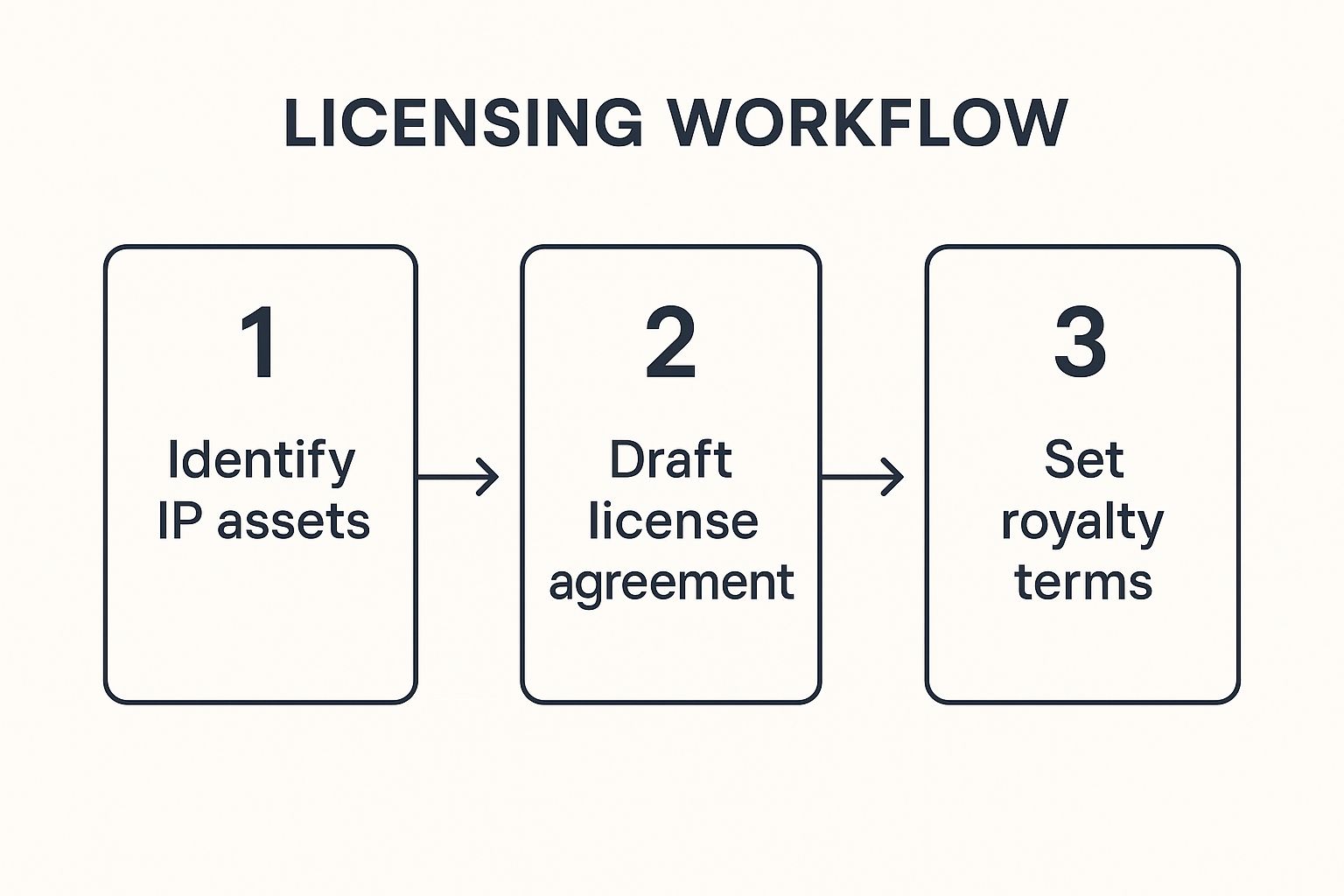
As you can see, a successful licensing journey starts with being perfectly clear on your assets and terms long before you sign anything.
Step 4: Draft and Review the Agreement
Once you鈥檝e reached a verbal agreement on the main points, it鈥檚 time to get it all down in writing. This is where a sharp IP attorney becomes your best friend. They will translate your negotiated terms into a legally binding contract that actually protects you. Seriously, never rely on a generic template or try to wing this on your own.
Spending money on proper legal help at the drafting stage is one of the smartest investments you can make. It saves you from costly misunderstandings and future fights that a poorly written contract can easily cause.
The review process goes both ways. Your legal team and the licensee's will comb through every sentence. Pay extra attention to the definitions, obligations, and termination clauses to make sure the final document perfectly matches what you agreed to.
Step 5: Manage the Ongoing Relationship
Signing the agreement isn't the end鈥攊t's the beginning of a long-term partnership. To make any decision to license intellectual property a true success, you have to manage that relationship effectively. This means keeping the lines of communication open, monitoring performance, and making sure everyone is sticking to the terms of the deal.
Set up a system to track royalty payments and, if it makes sense, schedule periodic audits. A healthy, collaborative relationship will help you solve problems as they pop up and might even open the door for new opportunities or renewals down the road. A great licensing deal is a living thing, and it needs ongoing attention to really flourish.
Negotiating Your Licensing Agreement Terms

The handshake is the easy part. The real work begins when you start hammering out the details of the licensing agreement. This document is the legal bedrock of your entire partnership, and every single clause carries serious weight. Getting these terms right is absolutely essential to protect your interests, maximize what you earn, and sidestep any messy, expensive disputes down the road.
Don't think of negotiations as a battle. It鈥檚 more of a collaborative effort to build a deal that's fair and sustainable for everyone involved. A solid, well-crafted agreement brings clarity to the partnership and sets clear expectations from day one. Let's dig into the most critical terms you'll be dealing with and why each one matters so much.
Grant of Rights and Scope of Use
The Grant of Rights is the heart and soul of the agreement. It spells out exactly what the licensee is allowed to do with your intellectual property. Vague language here is a recipe for disaster. You need to be crystal clear about what rights you're handing over and, just as importantly, what rights you're holding back.
This is also where you'll define the Scope of Use, which basically draws the lines around the license. Think about these key boundaries:
- Field of Use: This is where you limit the licensee to a specific industry or product type. For instance, you could license a character to a toy company for action figures only. That leaves you completely free to turn around and license that same character to a video game developer.
- Territory: This clause carves out the specific geographic area where the licensee can do business. You could grant the rights for North America to one partner and the European rights to another, which lets you create multiple streams of income from the same IP.
- Exclusivity: As we touched on earlier, this determines if the licensee gets to be your one and only partner or just one of many. This single term has a massive impact on the deal's value and your future options.
Keeping the scope narrow and well-defined is smart. It protects your ability to license your intellectual property in other markets or industries, preserving valuable future opportunities.
Royalty and Payment Structures
This is where we talk about how you get paid, so it deserves your full attention. While a simple percentage of sales is pretty common, there are several different ways to structure the compensation. The right model really depends on your IP's value, the industry you're in, and the licensee's business model.
Here are a few common ways to set up payments:
- Percentage Royalty: This is the most popular arrangement. The licensee pays you a set percentage of their gross or net revenue from sales of whatever product uses your IP.
- Upfront Fee: This is a one-time, lump-sum payment you receive the moment the agreement is signed. It gives you immediate cash and lowers your risk if the product doesn't sell as well as hoped.
- Minimum Guaranteed Royalty: This clause is a great safety net. It requires the licensee to pay you a minimum amount each year, no matter how sales are going. This ensures you have a steady income stream even if the product doesn't meet expectations.
Figuring out how to structure these payments goes hand-in-hand with knowing what your asset is truly worth. Take a look at our guide on /blog/2025/how-to-value-intellectual-property to make sure you're negotiating from a position of strength.
Term and Termination Clauses
The Term simply defines how long the agreement lasts. It could be for a fixed period, like five years, or it could be open-ended until one party decides to call it quits. It's also a good idea to include renewal options that can automatically extend the term if certain performance goals are met.
Now, the Termination clause鈥攖his is your escape hatch. It outlines the specific conditions under which either of you can end the agreement early.
This clause is non-negotiable. It must clearly cover situations like a breach of contract, failure to hit sales targets, or even bankruptcy. It gives you a clear exit strategy if the partnership goes south.
Without a strong termination clause, you could find yourself stuck in a dead-end or damaging relationship with no easy way out. The intellectual property licensing market is booming, and you need the flexibility to work with winners. By 2025, the global market was estimated at USD 500 billion and is projected to keep growing, largely driven by R&D in tech and pharma.
As you head into these talks, remember that a compelling proposal can make all the difference. Learning how to will help you present your terms clearly and professionally, setting you up for success.
Common Licensing Mistakes to Avoid
Navigating the world of intellectual property can be a game-changer for your business, but it's not without its landmines. Honestly, one of the best ways to get it right is to learn from where others have gone wrong. When you decide to license intellectual property, steering clear of a few classic blunders can save you a world of headaches, money, and time.
Think of this as your field guide to sidestepping the most common traps. Knowing what to watch out for ahead of time will help you walk into negotiations feeling prepared and confident, ready to make smart, protective decisions.
Neglecting Thorough Partner Vetting
One of the fastest ways to sour a licensing deal is to partner with the wrong company. It's so easy to get swept up by a licensee who sounds enthusiastic or dangles a big upfront payment, but a real partnership goes way beyond the initial handshake. Failing to do your homework on a potential licensee is a massive risk.
You've got to peel back the layers and ask the hard questions:
- Do they have a solid track record in your market?
- Are they financially stable? Can they actually follow through on their commitments?
- Does their brand reputation mesh with yours?
- What's their real plan for getting this product to market?
Just imagine licensing your carefully crafted brand to a company that churns out a cheap, shoddy product. The hit to your reputation could cost you far more than you'd ever make in royalties. Thorough due diligence isn't just a suggestion; it's essential.
Accepting Vague Agreement Terms
A licensing agreement is no place for fuzzy language. Every single term鈥攆rom what rights you're granting to how the deal can end鈥攏eeds to be spelled out in black and white. Vague terms are just loopholes waiting to be exploited, usually at your expense.
For instance, a loosely defined "field of use" could let a licensee wander into markets you never intended, blocking you from making other, more profitable deals down the road.
An unclear contract is basically a pre-written argument. You have to insist on precise language that leaves zero room for guesswork, especially when it comes to payment schedules, performance goals, and exactly how your IP can be used.
Undervaluing Your Intellectual Property
So many creators, especially those new to licensing, sell themselves short. Setting a royalty rate that鈥檚 too low can mean leaving a staggering amount of money on the table over the lifetime of the agreement. Your IP is valuable鈥攜ou deserve to be paid what it's worth.
Before you even sit down at the negotiating table, get a firm handle on your IP's value. That means researching industry benchmarks, looking at similar deals, and maybe even getting a professional valuation. Don't be afraid to stand your ground for a rate that truly reflects your creation's market value. Confidence in your IP鈥檚 worth is your strongest negotiating tool.
Forgetting Performance Milestones
Finally, a huge mistake is leaving out performance milestones or minimum guarantees. Think about it: what happens if your licensee just sits on your IP and never does anything with it? If your entire income is tied to a percentage of sales, you could earn absolutely nothing while your IP is stuck in a dead-end deal.
This is where specific clauses become your safety net:
- Minimum Annual Royalties: This ensures you get a base level of income every year, no matter how sales are going.
- Launch Deadlines: A clause that forces the licensee to get the product on the market by a specific date.
These terms hold your partner accountable and make sure they're actively trying to make the project a success. Without them, you have very little power if a licensee drops the ball.
How Global Trends Are Shaping IP Licensing

The world of intellectual property doesn't stand still. Far from it. Big shifts in technology and global markets are constantly rewriting the playbook, changing how we create, protect, and license intellectual property. If you want to stay competitive and spot new opportunities, you have to understand these powerful currents.
From the explosion of artificial intelligence to our increasingly connected global economy, these forces are creating both new headaches and exciting possibilities. This means adapting your licensing strategy isn't just a good idea鈥攊t's essential for survival and long-term success.
Globalization and Cross-Border Licensing
As businesses stretch across continents, the need for smart cross-border licensing has never been more critical. Think about it: a company in the United States might license its trademark to a manufacturer in Asia or its software to a distributor in Europe. This global chessboard opens up massive new revenue streams, but it also piles on the complexity.
Navigating this landscape means getting a handle on international IP laws, which can be wildly different from one country to the next. A patent that鈥檚 rock-solid in one region might be paper-thin in another without the right filings. That's why successful cross-border deals are built on agreements that account for different legal systems, tax rules, and ways to enforce the contract if something goes wrong.
The global stage offers immense opportunity, but it demands careful planning. A well-structured international license protects your IP everywhere, ensuring your brand and innovations are secure no matter where they are used.
The data from the World Intellectual Property Organization (WIPO) tells a clear story. Since 1990, the number of patents granted globally has jumped nearly fivefold. The global trade of IP assets? It hit an incredible $446 billion in 2022. This explosion shows just how vital a solid global strategy has become. You can to really see the scale of this shift.
The Impact of Emerging Technologies
New tech, especially artificial intelligence, is shaking the IP licensing world to its core. AI isn鈥檛 just a tool anymore; it鈥檚 becoming a creator, churning out everything from software code and music to complex product designs. This development is kicking up some fascinating new questions about who owns what and what can even be licensed in the first place.
This technological wave is changing the game in a few key ways:
- New Licensable Assets: Suddenly, AI models, proprietary algorithms, and curated datasets are becoming hot IP assets ready to be licensed.
- Smarter IP Management: Companies are now using AI-powered tools to do the heavy lifting鈥攖racking IP usage, sniffing out infringement, and making royalty management much more efficient.
- Innovative Licensing Models: We're seeing new deal structures pop up, like pay-as-you-go licenses for AI software, which are designed to fit the unique nature of these technologies.
Keeping up with these changes is how you spot the next big thing. By embracing these trends, you can capitalize on new types of licensable assets and use better tools to manage your portfolio, positioning your IP for growth in a market that never stops evolving.
Frequently Asked Questions About IP Licensing
Even with the best game plan, you're bound to have a few questions as you start exploring IP licensing. It's a big step! So, let's tackle some of the most common things people ask.
Think of this as a quick chat to clear up any final uncertainties. My goal is to get you feeling confident and ready for what's next.
How Much Does It Cost to License Intellectual Property?
This is the big one, and the honest answer is: it depends. There鈥檚 no universal price list for licensing IP. The cost really hinges on how valuable the IP is, the industry you're in, and how exclusive the rights are.
It's almost never just a single, flat fee. More often, you鈥檒l see a payment structure that looks something like this:
- Upfront Fee: This is a lump sum paid right when the deal is signed.
- Ongoing Royalties: Think of this as a commission. The licensee pays a percentage of the revenue they make using your IP, which often falls somewhere between 3% and 10%.
- Minimum Annual Payments: This is a safety net for you. It guarantees a certain amount of income each year, even if sales are slow.
To figure out a fair price, getting a formal IP valuation is your best bet. It gives you concrete data to bring to the negotiating table.
Do I Need a Lawyer for a Licensing Agreement?
Yes. Absolutely, unequivocally, yes. A licensing agreement is a serious legal contract, and a single poorly worded clause can cost you a fortune down the road. Going it alone is just not worth the risk.
An experienced IP attorney is your most important partner here. They鈥檒l craft an agreement that truly protects your interests, clearly defines every term, and makes sure the whole thing will hold up in court. Grabbing a generic template off the internet might feel like you're saving money, but it could leave you wide open to expensive problems later on.
What Is the Difference Between Licensing and Selling IP?
It all boils down to one simple concept: ownership.
When you license your IP, you're essentially giving someone permission鈥攔enting them the right鈥攖o use your creation under very specific rules. You never give up ownership. The goal is to create an ongoing stream of income from royalties.
On the other hand, selling your IP (also called an "assignment") is a complete transfer of ownership. The buyer gets everything, you get a one-time payout, and your connection to the IP ends right there. Licensing is about building a partnership; selling is a final handshake.
At Cordero Law, we don't just represent creators and entrepreneurs鈥攚e empower them. If you鈥檙e ready to turn your intellectual property into a protected, revenue-generating asset, we provide the kind of strategic advice and personal attention you deserve. Let's build a solid legal foundation for your success, together. Find out how we can help at .