
Moral rights are the deeply personal, non-economic rights that tether a creator to their work, long after the copyright might have been sold. Think of them as your creative DNA—an unbreakable bond that ensures you always get credit and can stop your work from being used in a way that tanks your reputation.
Understanding Your Creative DNA
You know that gut feeling of connection you have with something you've poured your heart and soul into? That's the essence of moral rights. They serve as a permanent link between you and your creation, a link that remains even if someone else holds the economic keys to the castle (the copyright). To really get why this matters, it helps to understand and the sheer personal investment that goes into every single project.
Here’s a simple way to look at it: think of a world-famous chef. Even if the restaurant technically owns the recipe for their signature dish, that chef’s name is always associated with it—that's attribution. And you can bet that chef has the right to step in if the restaurant starts serving a sloppy, butchered version of it that would tarnish their good name—that's integrity.
These two ideas are the bedrock of moral rights.
The Two Pillars of Moral Rights
It’s crucial to remember that these rights are completely separate from the financial side of copyright, which can be bought, sold, or licensed. While learning how to copyright your work is all about protecting the economic value, moral rights are about safeguarding your personal legacy and honor.
At their core, moral rights protect a creator's honor and reputation. They affirm that a work is more than just a commercial product; it's an extension of the creator's personality.
This isn't just a feel-good concept; it has serious international legal backing.
The image above highlights Article 6bis of the Berne Convention, a foundational treaty that gives creators the right to claim authorship and, just as importantly, to object to any distortion or modification of their work that could harm their reputation.
To make this crystal clear, let's break down these two core rights.
The Two Pillars of Moral Rights at a Glance
Here’s a quick summary table that cuts right to the chase, explaining the 'what' and 'why' behind these foundational concepts for every creator.
| Moral Right | What It Means for You | A Simple Analogy |
|---|---|---|
| Right of Attribution | Your right to be identified as the creator of your work. | A painter always having their signature visible on their canvas, no matter who owns it. |
| Right of Integrity | Your right to prevent distortion or modification of your work that harms your reputation. | A director stopping a studio from colorizing their classic black-and-white film against their wishes. |
Think of these as your fundamental protections. Attribution ensures you get the credit you've earned, while integrity ensures the work you're credited for isn't twisted into something you'd be ashamed of.
Your Two Essential Creator Superpowers
While the idea of "moral rights" can feel a bit lofty and abstract, it really just comes down to two core protections. Think of them as your creative superpowers. These rights aren't about the money; they're about your personal, lasting connection to your work and your professional reputation. Let's break down the two most important moral rights that serve as the foundation of your protection.
First up is the Right of Attribution, which you might also hear called the right of paternity. This is your fundamental right to be publicly named as the creator of your work. It’s why an author's name is on the book cover, a photographer gets a photo credit, and a musician is listed on an album.
This right makes sure that your name and legacy are forever tied to your creation, no matter who ends up owning the economic side of the copyright. It's your official, respected claim to authorship.
The Right to Claim Your Name
Let's say you're a filmmaker. The right of attribution is what ensures your name appears in the credits as the director. Without it, a studio could theoretically buy your film and release it without ever mentioning you were involved. This right is what stops you from becoming a ghost in your own creative story.
You see attribution in action everywhere:
- A painter’s signature on their canvas.
- A journalist’s byline on an article they wrote.
- A songwriter’s credit in the liner notes of a song.
Getting that credit is absolutely critical for building a career and a professional reputation.
The Right to Protect Your Work's Honor
Your second superpower is the Right of Integrity. This one is arguably even more personal. It gives you the power to object to any distortion, modification, or misuse of your work that could damage your honor or reputation. It’s your shield against seeing your creation twisted into something you never intended.
Imagine it this way: a sculptor creates a beautiful public statue symbolizing peace. The right of integrity would let them object if the new property owner decided to paint the statue with tacky commercial logos, turning a piece of art into a gaudy advertisement. That kind of modification would completely change the work's meaning and, in turn, hurt the artist’s reputation.
This right protects the work itself from derogatory treatment. It acknowledges that a creation is an extension of the creator's personality, and damaging the work also damages the person behind it.
Digging into intellectual property ownership clauses-ownership-clauses) is a great way to see how creators can spell out and maintain this control in their contracts.
The right of integrity is what allows a photographer to stop their moving portrait from being used in a misleading political ad, or a musician to prevent their heartfelt ballad from being butchered in a cheesy, low-budget commercial. It ensures the soul of your work stays intact—protecting both the art and the artist.
How History Shaped Creator Protections
The idea of moral rights didn't just appear out of thin air. It's a concept with deep historical roots, born from a huge shift in how society started to think about creativity. To really get what moral rights are all about, we have to go back to their birthplace in continental Europe, specifically France and Germany.
Long before copyright was a global thing, legal minds in these countries started arguing that an artist's work was more than just a piece of property. They saw it as an extension of the creator's personality—an inseparable part of who they are.
This was a game-changing philosophy. It carved out a space for the personal, spiritual, and reputational link between a creator and their work, saying it deserved its own unique legal protection, totally separate from the economic side of things. This was never just about the money; it was about honoring the artist's personal dignity and vision.
The Birth of Droit Moral
This powerful idea first became law in France. The French Revolution sparked all sorts of new thinking about individual rights, and that naturally extended to creators. The concept of droit moral (that's just French for "moral right") popped up as a way to formally recognize that deep personal connection between an author and their creation.
This principle was cemented into law and became a cornerstone of European legal tradition. The French Copyright Law of 1793 was a landmark piece of legislation, giving authors rights that protected this personal bond. These early laws established that moral rights couldn't be sold or taken away, a concept that would eventually influence laws all over the world. You can dig deeper into these historical foundations on the U.S. Copyright Office website.
The core idea was radical yet simple: an artist's reputation is embedded in their work. To deface the work is to deface the artist.
This European model was a stark contrast to the more commerce-focused copyright systems developing elsewhere, which mostly treated creative works like any other economic asset. The droit moral tradition insisted that the creator's honor was just as important, if not more so.
From National Idea to Global Standard
As these ideas matured, they started getting international attention. It became pretty clear that a universal standard was needed as creative works began crossing borders more and more.
This led to the creation of one of the most important international copyright treaties in history:
- The Berne Convention for the Protection of Literary and Artistic Works (1886): This groundbreaking agreement was the first to formally recognize moral rights on an international stage.
Getting moral rights into the Berne Convention was a monumental step. It required every country that signed on—and there are now over 180 of them—to give creators the right of attribution (getting credit) and the right of integrity (preventing distortion of their work). This treaty effectively exported the European philosophy of droit moral across the globe, shaping how creator protections are understood from Paris to Tokyo. It made sure the answer to "what are moral rights" became a global conversation.
Navigating Moral Rights Across the Globe
Moral rights aren't a universal language; think of them as having distinct dialects across different parts of the world. What it means to have a moral right and what are moral rights in the first place often depends on where you're standing. A creator's protections can change dramatically the moment their work crosses a border, making it absolutely essential to get a handle on this global landscape.
The biggest split comes down to two major legal traditions. On one side, you have civil law countries, like France and Germany. These are the historical champions of moral rights. In these nations, moral rights are often treated as fundamental, almost sacred—inalienable and sometimes even lasting forever as part of a creator's permanent legacy.
On the other side are common law countries, including the United States and the United Kingdom. These systems have historically put economic rights first and have been much slower to formally recognize that personal link between a creator and their work. Their approach tends to be far more limited and specific.
The United States and a Patchwork Approach
The United States is a perfect example of this more cautious, piecemeal approach. Unlike the broad, sweeping protections you find in Europe, the U.S. doesn't have a single, all-encompassing moral rights law that covers every type of creative work.
Instead, protection is scattered across a patchwork of state and federal laws. The most important piece of federal law here is the Visual Artists Rights Act of 1990 (VARA).
VARA gives artists the rights of attribution (to be named as the creator) and integrity (to prevent distortion of their work), but it's crucial to understand its limits. It applies only to a very narrow category of visual art—think paintings, drawings, prints, sculptures, and certain photographs, and only then if they exist as a single copy or in a limited edition of 200 copies or fewer.
This is a huge deal. It means that authors, musicians, filmmakers, and tons of other creators simply aren't covered by VARA. This is a massive departure from the European model, where moral rights typically apply to almost all copyrightable works. For anyone working in fields like music, understanding these jurisdictional differences isn't just trivia—it's a core part of managing your career effectively. You can dive deeper into how these concepts play out by exploring the essentials of music and entertainment law.
Moral Rights A Global Comparison
To really see these differences in action, let's put these legal systems side-by-side and compare how they handle the key aspects of moral rights.
| Feature | European Union (Civil Law) | United States (Common Law) | United Kingdom (Common Law) |
|---|---|---|---|
| Scope of Work | Applies broadly to nearly all copyrighted works (books, music, film, art). | Very narrow; primarily limited to specific works of visual art under VARA. | Applies to most literary, dramatic, musical, and artistic works, and films. |
| Duration | Often perpetual or lasts for the life of the author plus 70 years. | Rights under VARA last for the life of the artist. | Generally lasts for the same term as copyright (life of the author plus 70 years). |
| Waiver | Often considered "inalienable," meaning they cannot be sold or waived. | Moral rights under VARA can be waived in a written agreement. | Moral rights can be waived, which is a common practice in creative contracts. |
As you can see, the protections you have can vary wildly depending on the jurisdiction. What's non-negotiable in Paris might be easily signed away in a contract in Los Angeles.
This image gives a great visual of just how widespread—though varied—the adoption of moral rights laws is around the world.
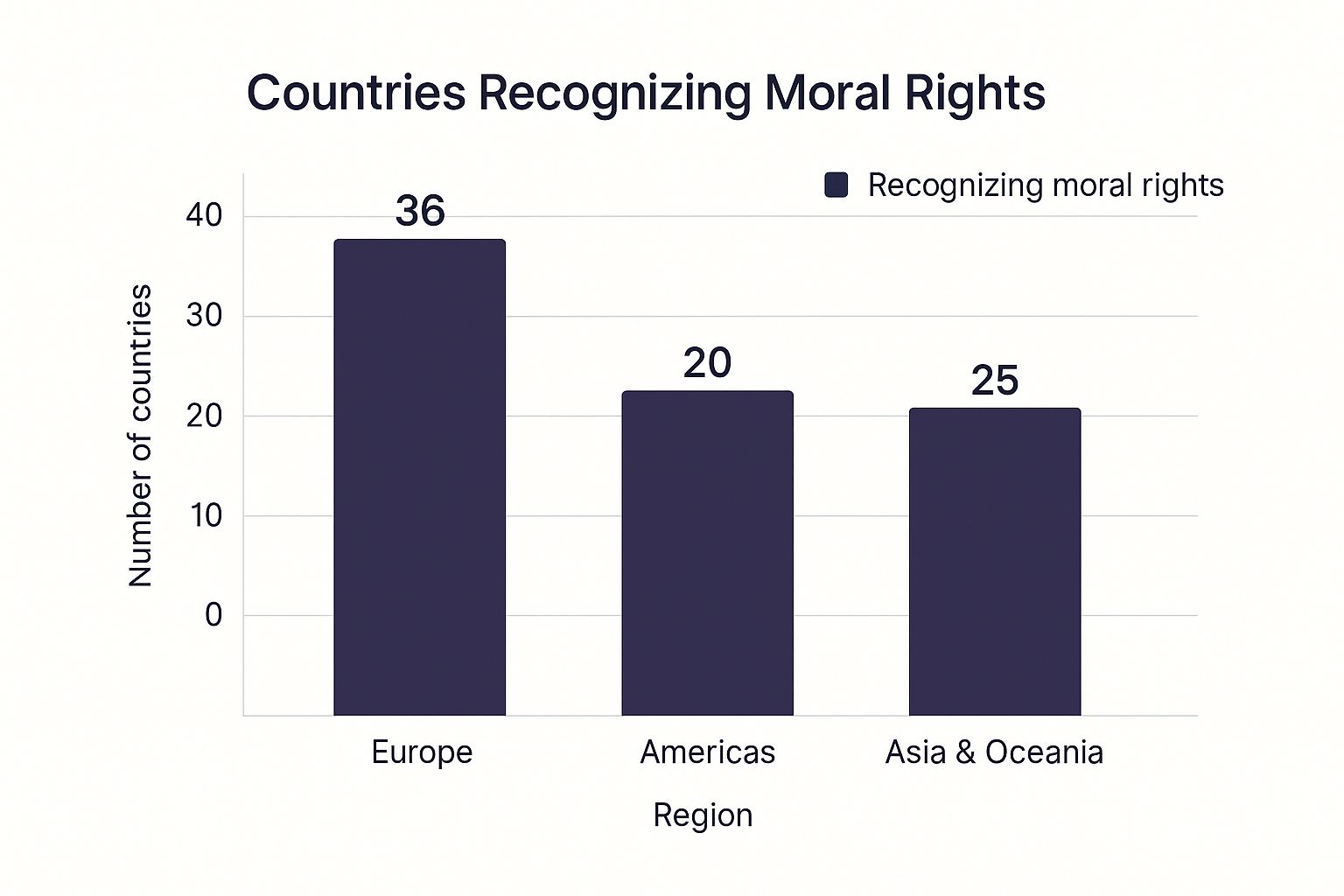
The numbers make it clear: while Europe is the stronghold for these rights, the concept has a major presence globally. This just reinforces why every creator needs to be aware of international standards to fully protect their work and their name.
Moral Rights in Real World Scenarios
Legal theory can feel a bit abstract. But moral rights snap into sharp focus when you see how they play out in the real world. These aren’t just ideas in a textbook; they are powerful tools creators have used to defend their work and reputation in some pretty high-stakes situations.
Looking at actual cases is the best way to move the conversation from legal jargon to tangible consequences. These stories show creators fighting passionately to protect their art’s integrity or simply to get the credit they’re due.
When Street Art Clashes With Commerce
Imagine you’re a well-known street artist. You pour your soul into a vibrant mural, and the next thing you know, it’s the backdrop for a major car commercial—but no one asked your permission, and your name is nowhere to be seen. This isn't a hypothetical; it's a scenario that has landed companies in serious legal trouble.
These kinds of cases usually come down to two key moral rights: the right of attribution and the right of integrity.
When a company uses the artwork without giving credit, they’re denying the artist’s basic right to be known as the creator. Beyond that, slapping a commercial product next to the art can completely change its original meaning, which can damage the artist's reputation in their community.
For artists, this fight is about more than just a paycheck. It’s about controlling their legacy and making sure their work isn't twisted into a message they never intended to support.
Protecting an Artist's Vision From Alteration
The right of integrity is also front and center when a work of art is physically changed without the creator's say-so. In one famous case, a sculptor’s massive public artwork was altered by a building owner years after it was installed. The owner claimed they were just "modernizing" the piece, but the artist argued that the changes effectively mutilated his original creation and damaged his honor.
This type of dispute gets to the very heart of moral rights: the idea that a work of art is an extension of the artist's own personality. Messing with it is like a personal attack.
The core question in these cases is whether a modification is so damaging that it prejudices the creator's reputation. The law recognizes that an artist's name is forever linked to their creation, and they have a right to prevent that creation from becoming something they would be ashamed of.
Another classic example is a film director fighting a studio that wants to colorize their black-and-white masterpiece for a TV broadcast. Many directors have argued that adding color completely distorts their artistic choices, changing the film’s entire mood and visual language. By invoking their moral rights, they fight to preserve the work as they meant for it to be seen.
These scenarios show just how critical it is to understand the terms when you grant permissions. If you want to dive deeper into this, check out our guide on how to license artwork for creative projects.
Why Protecting Creative Integrity Matters
So, why do we even have moral rights? Forget the legal jargon for a second. At its heart, this whole idea is built on something deeply human: the belief that creative work is a piece of the creator's soul. When we talk about protecting a painting, a novel, or a song, it’s not just about property. It’s about protecting the creator's dignity.
Think about it this way. A painter’s brushstrokes aren’t just dabs of color on a canvas; they're a part of their spirit, made visible for everyone to see. If that painting gets twisted, distorted, or used in a way that completely betrays what the artist intended, it's not just the artwork that gets damaged. The artist's reputation and personal honor are on the line, too.
That's where moral rights come in. They recognize this deep, personal connection and make sure the spirit of the work—and the reputation of its maker—is respected just as much as its price tag.
The Philosophical Roots of Fairness
This isn't some new-fangled legal concept. It lines up with centuries of ethical thought that all circle back to one thing: respect for the individual. Moral rights are really a branch of human rights, zeroing in on that unique bond between a creator and what they create.
If you dig into history, you'll find the seeds of these ideas in philosophical traditions from all over the world—like Confucian benevolence, Buddhist morality, and the teachings of Jesus Christ and Prophet Mohammed. All of them emphasized dignity and justice in their own way. You can actually .
These historical threads prove that the thinking behind moral rights isn't a legal fad; it’s an enduring human value.
A creator's work is their legacy. Moral rights act as a promise from society that this legacy will be treated with respect, ensuring the artist's voice is not silenced or twisted, even after the work leaves their hands.
When you boil it all down, these rights are a critical safeguard. They keep our cultural conversations authentic by stopping creative works from being messed with in ways that could mislead people or disrespect the very person who brought them into the world. They’re a powerful statement that some things have a value you just can't measure in dollars and cents.
Got Questions About Moral rights? We've Got Answers.
The finer points of moral rights can get confusing, fast. Let's tackle some of the most common questions head-on with clear, practical answers so you can feel confident you've got a handle on things.
Can I Sell or Give Away My Moral Rights?
In most places, the answer is a hard no. Moral rights are often considered “inalienable,” which is a legal way of saying they are fundamentally tied to you as the creator. You can't just sell them off like you would a piece of gear or a copyright license.
What you can often do, however, is agree to waive them in a contract. Think of it as a legal promise not to kick up a fuss or enforce those rights down the line. The rules around waivers are all over the map depending on the country, so this is one of those fine-print details you absolutely have to watch for in any creative agreement.
How Long Do Moral Rights Actually Last?
This is one of those classic "it depends" legal answers because it's completely dictated by national law. There's no single international standard.
- In a lot of European countries: Moral rights can be perpetual. They last forever and can even be passed down to your heirs to protect your legacy.
- In places like the UK and Canada: They usually follow the same timeline as copyright protection—your life plus 50 or 70 years.
- In the U.S.: The Visual Artists Rights Act (VARA) is more limited, with rights lasting only for the life of the artist.
Bottom line: The duration of your moral rights isn't a one-size-fits-all deal. You've got to know the specific laws of the country where your work is being used or sold.
Do Moral Rights Apply to Work I Create for My Boss?
Now we’re getting into a really tricky area. If you create something as part of your job—what's often called a "work for hire"—the company you work for typically owns the economic side of the copyright.
Because of this, it's very common for your moral rights to be automatically waived or to simply not apply in the first place. You really have to dig into your employment contract and the local "work for hire" laws to know exactly where you stand.